Menu

Posts tagged “parenting”

Games for all genders: an interview with Toca Boca

My daughters love the Toca Boca apps—especially Robot Lab. Ingrid Simone’s article on their approach to gender is great. From Gender in Play: How Toca Boca Creates Apps for All Kids:

Toys have a large impact on how kids play together and relate to other kids. But kids of today are fostered into watching different shows and playing with different toys according to their gender.

We know that when a toy reaches a child a choice has already been made for them, someone has picked a blue or pink toy, an action figure or a doll. We believe this is limiting to kids, not to be able to decide on your own what your interests are, and that gender-targeted toys create an unnecessary barrier between girls and boys. And we believe that girls and boys, brothers and sisters want to play together!

And on the redesign of Robot Lab specifically:

Since the robot theme has historically been so targeted towards boys, we felt like we, as many before us, had somehow fallen in the trap of using conventional “boyish” colors, shapes and attributes. And we really wanted to see if we could make the app more appealing to both boys and girls.

Coffee and Craft

Coffee and Craft

My favorite story about coffee is from the year 1600, when Pope Clement VIII was the head of the Catholic Church. As the story goes, the Pope’s advisers urged him to make coffee a forbidden drink for Christians. They argued that since Muslims were not allowed to drink wine, Satan invented this “hellish black brew” as a substitute. In a moment of remarkable foresight the Pope asked to try a cup before he made his decision. He was so enamored with the concoction that he came up with a different plan. “This Satan’s drink,” he declared to his advisers, “is so delicious that it would be a pity to let the infidels have exclusive use of it. We shall cheat Satan by baptizing it.”

And so it came to be that despite our vast ideological differences across regions and cultures, we can at least all agree on one thing: coffee is a deeply spiritual experience.

It’s not that I didn’t always have a strong connection with my eldest daughter. It’s just that recently, as she’s running headlong into her fifth year of life, we’ve started to connect in ways I didn’t expect. For example, this weekend we spent most of early Sunday morning building Lego models together. How did that happen? How did she suddenly get into stuff I remember liking as a child?

I know everyone always talks about how quickly kids grow up. I don’t agree with that at all. Growing up takes a long time. But I do find these sudden jumps in growth quite surprising sometimes. I feel like I should be better prepared for each jump so I can catch her if she stumbles. I guess that feeling will never go away — especially when she starts dating. Man. That’s going to be rough.

Anyway. A few weeks ago my wife brought the girls to our office for a visit one morning. I made my daughter a Babycino (frothed milk + hot chocolate sprinkles), and myself a Cappuccino. While I was making the coffee drinks my daughter sat at the table and asked me questions about what I’m doing and how the espresso machine works. I talked to her about bean extraction and crema and milk steaming, thinking that it would bore her to tears. But she was really into it. So I kept going and we ended up having a conversation about craft and why it’s cool to take your time to learn how to do things well and how good it makes you feel when you really master a skill.

I can’t remember when my obsession with coffee started. I just know that one day I started reading books about coffee history, and the best ways to brew a good cup. Then I bought an AeroPress and starting Googling for recipes. Next I bought a grinder, and a Chemex, and became annoyingly picky about beans. And before I knew it, I was that guy at dinner parties. The guy who makes you stop what you’re doing to explain where the coffee came from, how I was going to prepare it, and what they should look for when they taste it. But mark my words: when you do eventually taste the coffee you instantly forget how weird I am, and instead start talking about the unexpected party in your mouth (A guest once remarked that it tasted like angels peeing on his tongue. It is, perhaps, my proudest moment).

Charles Maurice de Talleyrand-Périgord — the Prime Minister of France during the early 1800s — once wrote a completely over the top description of how coffee made him feel. Even though he was very likely under the influence of a vast amount of caffeine when he wrote these words, I swear when I’m drinking a great cup of coffee I want to nod in vigorous agreement:

A cup of coffee detracts nothing from your intellect; on the contrary, your stomach is freed by it and no longer distresses your brain; it will not hamper your mind with troubles but give freedom to its working. Suave molecules of Mocha stir up your blood, without causing excessive heat; the organ of thought receives from it a feeling of sympathy; work becomes easier and you will sit down without distress to your principal repast which will restore your body and afford you a calm delicious night.

Yes, the taste of a good cup of coffee is amazing, but it’s about so much more than that. Most of the joy of any craft — and coffee is no exception — is how you get there. My obsession gave me much more than the ability to make a decent cup. The process — the grind, the bloom, the slow pour — is now a comforting ritual that I associate with mindfulness. It’s a deep mental breath to allow my brain to process what’s going on around me. Most of us spend our days being outlandishly busy. But as with all crafts, during the 10 minutes it takes to make a pot of Chemex, nothing else exists. Time slows down, and I’m focused on getting every detail right. Making coffee keeps the chaos out for a few minutes every day — and it helps me focus when I return to my work.

What is your craft? It doesn’t have to be coffee. But is there something that takes you away from this world for a few minutes every day? Something that’s hard enough that it takes such intense concentration that you (gasp!) even forget to check Twitter? Something with a knowledge well deep enough that you’ll never reach the bottom? Those kinds of obsessions are healthy and necessary because they keep us on our toes, curious, always growing, always learning, always grounded because you can’t win a craft. There is always more to learn.

What you get from craftsmanship is not the end of the story. Despite its many personal benefits, I’ve found craft to be surprisingly social. Hours after my family’s visit a few weeks ago I was still thinking about the brief time I had with my daughter that morning. I couldn’t help but feel like it was significant, and that I should create more of those types of moments with her. And not just with her, but with friends and colleagues too. A discussion about craft — especially if it happens around that craft — usually leads into a discussion about passion, and that easily spirals out of control to anything from a new appreciation of life to brilliant product ideas. As people who create software, those discussions can be invaluable for the work we do.

So here we are: our lives intertwined with a drink that had the potential to divide nations, but instead ended up being the catalyst for the creation of many newspapers and universities; the common element in countless debates, first dates, and last dates; and the ever-present, unassuming ingredient to any everyday conversation or meeting. This hellish heavenly brew might just be the perfect ambassador for the value of learning and practicing a craft. It doesn’t just show us how much we personally have to gain from constant learning and a focused mind. It also shows us how a big part of the joy of craft is found in the gathering of people around its edges, and the ideas that are sparked and shared as a result. Let’s actively create and seek out those moments of shared passion for the world and all we get to do in it.

Preferably around a cup of coffee.

A View from a Different Valley

A couple of months ago I got an email from the wonderful people at A List Apart, asking if I’d be interested in starting a regular column on ALA. I believe my response was something to the effect of “1,000 times yes!!” How could it not be? I’ve been reading ALA for such a long time, and I really enjoyed the one time we’d worked together before, on an article called Usable yet Useless: Why Every Business Needs Product Discovery.

In an effort to figure out where to take the column, my editor asked me what kind of topics I’m interested in. I sent back a response that I was pretty sure would make her delete the email and step away from her computer very slowly. Here’s what I wrote:

  • My background is in sociology. My PhD dissertation was about social network theory — the real, mathematical kind, not what the phrase “social network” has since come to mean. So I like thinking about how our networked society is changing us. I’m much less interested in the “Google is making us stupid” view, and much more interested in the positive side. Clive Thompson’s Smarter Than You Think comes to mind immediately. (When I grow up, I want to write like Clive)
  • Following on from that, I like thinking about what parenting means in this new era. As I’ve been thinking about what my next side project should be after the book, I’ve toyed with a site for tech-oriented dads with young kids. What are the products they should be interested in, how do we teach our kids about technology and that it is not to be feared, but also not to be abused, because it is not neutral (see What Technology Wants. When I grow up I want to write like Kevin).
  • And again, following on from that (at least in my weird head), how does Sci-Fi culture play into all of this? (I know, weird, but stick with me). Our science fiction has become increasingly dystopian. The last positive science fiction series was probably Star Trek TNG. So what do our visions of the future tell us about living (and designing) today?

To my surprise, my editor didn’t freak out, and instead encouraged these topics. So we came up with the column name A View from a Different Valley. A column about technology, but from a perspective we don’t always expect. My first article for the column is called Work Life Imbalance, and it came out last week. It’s about the blurring lines between work and life:

There is a blending of work and life that woos us with its promise of barbecues at work and daytime team celebrations at movie theaters, but we’re paying for it in another way: a complete eradication of the line between home life and work life. “Love what you do,” we say. “Get a job you don’t want to take a vacation from,” we say—and we sit back and watch the retweets stream in.

I don’t like it.

I don’t like it for two reasons.

And this is, of course, where I ask you to read the rest if you’d like to find out why I don’t like it…

I’m really excited about this column, and hope to keep it going for quite a while. Thanks again to ALA — they’re awesome people. I like them a lot.

The future of work is not jobs

A couple of articles about work and technology caught my eye this week. First, Claire Cain Miller describes how Technology, Aided by Recession, Is Polarizing the Work World:

[A new working paper from the National Bureau of Economic Research], which analyzed data from the Current Population Survey from 1976 to 2012, illustrates that the recession had a disproportionately large effect on routine jobs, and greatly sped up their loss. That is probably because even if a new technology is cheaper and more efficient than a human laborer, bosses are unlikely to fire employees and replace them with computers when times are good. The recession, however, gave them a motive. And the people who lost those jobs are generally unable to find new ones, said Henry E. Siu, an associate professor at the University of British Columbia and an author of the study.

Now, combine that problem in the mid-paying job market with an issue Thomas B. Edsall pointed out a few weeks ago in The Downward Ramp:

Just one example: the drying up of cognitively demanding jobs is having a cascade effect. College graduates are forced to take jobs beneath their level of educational training, moving into clerical and service positions instead of into finance and high tech.

This cascade eliminates opportunities for those without college degrees who would otherwise fill those service and clerical jobs. These displaced workers are then forced to take even less demanding, less well-paying jobs, in a process that pushes everyone down. At the bottom, the unskilled are pushed out of the job market altogether.

So, college graduates are pushed into mid-paying jobs, and those jobs are being replaced by technology. Not good.

Meanwhile, in opposite world, Louise Aronson writes about The Future of Robot Caregivers (if you’re counting, that’s three for three on the New York Times):

We do not have anywhere near enough human caregivers for the growing number of older Americans.

Zeynep Tufekci’s excessively titled Failing the Third Machine Age: When Robots Come for Grandma is a good critique of that piece:

Let me explain. When people confidently announce that once robots come for our jobs, we’ll find something else to do like we always did, they are drawing from a very short history. The truth is, there’s only been one-and-a-three-quarters of a machine age—we are close to concluding the second one—we are moving into the third one.

And there is probably no fourth one.

Humans have only so many “irreplaceable” skills, and the idea that we’ll just keep outrunning the machines, skill-wise, is a folly.

Put all these pieces together and you get a very scary vision of the future of jobs. The good news — I think — is that job != work.

The future of jobs might be bleak, but the future of work certainly isn’t. Technology might be taking our jobs, but it’s also giving us new ways to be creative. To be entrepreneurs. To work. As programs like Girls Who Code continue to grow, I’m increasingly optimistic about my daughters’ futures. They might not get a “regular” job one day. But my role as a parent is not to prepare them for a job anyway. It’s to foster in them the tenacity and grit to learn how to think big and make things. I’m excited about that.

Screens don't have to melt our kids' brains

Melt

Mat Honan’s Are Touchscreens Melting Your Kid’s Brain?1 set off the latest in what has become a recurring tech theme over the past few years:

I’m perpetually distracted, staring into my hand, ignoring the people around me. Hit Refresh and get a reward, monkey. Feed the media and it will nourish you with @replies and Likes until you’re hungry and bleary and up way too late alone in bed, locked in the feedback loop. What will my daughter’s loop look like? I’m afraid to find out.

This has been a difficult topic for me for a long time. In 2012 I wrote an article for Smashing Magazine called A Dad’s Plea To Developers Of iPad Apps For Children, in which I aired some of my frustrations with apps for kids. That piece brought out a lot of anger, including a comment that I’ll never forget:

Wow really?? great parents here.. having a kid under 7 stare at a screen, really?? come on!! no kid under 7 should use an iPad for what?? play outside, play with your toys, your friends, read. People who have a 2yr old use an ipad/iphone, shouldn’t have kids in the first place! shame on you

I started writing a passionate reply, explaining our reasoning and the rules my wife and I have for screen time, but I ended up just dropping it. No one has ever changed their opinion based on a comment they read on a blog, so why bother.

Anyway, I digress. I tend to agree with Robert McGinley Myers’ response to Mat’s article. In Screens Aren’t Evil (which you should read in its entirety) he says:

But we need to get beyond worrying about whether “screens” are melting our kids’ brains. What we need to be conscious of is encouraging our kids, and ourselves, to engage in activities that enrich us. Sometimes that’s interacting with each other, sometimes that’s a hike in the forest, sometimes thats a great book, and sometimes that’s an incredible video game. It’s not the medium that matters, but what we take from it.

Now that’s a moderate stance I can get behind.


  1. Betteridge’s law alert! 

Teens online: give them freedom plus communication

danah boyd wrote an interesting op-ed for TIME called Let Kids Run Wild Online. She argues that restrictive monitoring software is not the way to go to keep teens safe online:

The key to helping youth navigate contemporary digital life isn’t more restrictions. It’s freedom plus communication. Famed urban theorist Jane Jacobs used to argue that the safest neighborhoods were those where communities collectively took interest in and paid attention to what happened on the streets. Safety didn’t come from surveillance cameras or keeping everyone indoors but from a collective willingness to watch out for one another and be present as people struggled. The same is true online.

In real life

Justin Jackson’s This is real life is probably one of my favorite posts of the year so far. I don’t want to spoil it, so I’ll just quote this bit:

You see, I can pretend to be cool on the Internet, but in real life I’m just a dad in a bathrobe.

Justin, from a fellow dad in a bathrobe:

High five

Patience

Impatient

Small human beings learn by mimicking and so they learn patience by mimicking patience. Perhaps this means that a larger human being somewhere many thousands of generations back took a long and patient breath as the smaller human being in his or her arms squirmed. Perhaps the smaller human being saw this long and patient breath and internalized it and began to understand. Perhaps all of the patience in the world is a copy of one sigh.

— Paul Ford, What I’ve learned from fatherhood

I’m most aware of my shortcomings when I lose patience with my daughters. Of the many things I know I need to improve on, it’s the one that I wish the most I could fix with the flip of a switch.

“Oh, I see the problem, sir — your patience switch was turned off. It happens sometimes… There you go, that should do it.”

But of course, it doesn’t work like that. Yesterday I was watching a mother trying to get her 3-year old son to stop screaming at her. After a few minutes they were both yelling — which isn’t a very effective way to diffuse a situation like that. The thing is, I’m sure she knows that. And before I had kids I probably would have judged her. Not any more. I’ve made enough bad decisions in the heat of the moment that it would be hypocritical of me to judge anyone for their parenting techniques1. In fact, I’m pretty sure that no matter what decision I make at any given time (should I give her the cookie, or is this a teachable moment?), there’s about a 50% chance that it will be the wrong decision.

But that doesn’t mean I shouldn’t strive to do better — to be better. I’ve already made most of the mistakes I didn’t want to make with my daughters. However, that doesn’t stop my desire to be a better dad. I’m painfully aware of how cheesy that sounds, but hey — it’s the truth.

I often ask my wife if she thinks we’re doing it wrong. It just seems like other parents have it all together, all the time. Yet, every once in a while I see cracks in the veneer — an honest moment on Twitter, a knowing look of camaraderie in a coffee shop — and I know I’m not alone. We all love our children very much. We’re also all human and selfish. And patience — like money — doesn’t grow on trees.

So maybe I need to stop trying to be “a better dad”. That’s just too vague (how will I know when I’m “better” enough?). Instead, I need to focus on that one sigh. The one breath that could be the difference between letting a difficult moment pass, or letting it get the best of me.

One moment of patience. That will be my focus in 2014 — in parenting, but also online, and in my work.

Will you join me?


  1. Well, except for leashes. Seriously, don’t put your kid on a leash. Unless you have twins. Then do whatever you need to do to stay alive. 

Creativity around the edges of craft

Coffee and parenting

It’s not that I didn’t always have a strong connection with my eldest daughter. It’s just that recently, as she’s running headlong into her fifth year of life, we’ve started to connect in ways I didn’t expect. For example, this weekend we spent most of early Sunday morning building Lego models together. How did that happen? How did she suddenly get into stuff I remember liking as a child?

I know everyone always talks about how quickly kids grow up. I don’t agree with that at all. Growing up takes a long time. But I do find these sudden jumps in growth quite surprising sometimes. I feel like I should be better prepared for each jump so I can catch her if she stumbles. I guess that feeling will never go away. Especially when she starts dating. Man. That’s going to be rough.

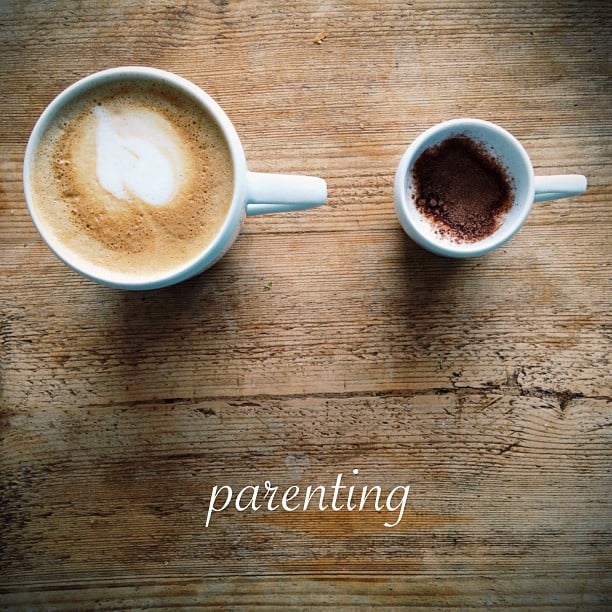
Anyway. I’m really into coffee. And this morning my wife brought the girls to our office for a visit. I made my daughter a Babycino (frothed milk + hot chocolate sprinkles), and I made myself a flat white (both pictured above). While I was making the drinks my daughter sat at the table, and asked me questions about what I’m doing and how the espresso machine works. I talked to her about coffee extraction and crema and milk steaming, thinking that would bore her to tears. But she was really into it. So I kept going and talked to her about craft and why it’s cool to take your time to learn how to do things well and how good it makes you feel when you really master something.

They left hours ago, but I’m still thinking about the brief time I had with my daughter this morning. I can’t help but feel like it was an important moment, and that I should create more of those types of moments with her. And not just with her, but with friends and colleagues too. A discussion about craft — especially if it happens around that craft — usually leads into a discussion about passion, and that easily spirals out of control to anything from a new appreciation of life to brilliant product ideas.

A big part of the joy of learning and practising a craft is the gathering of people around its edges, and the ideas that are sparked and shared as a result. We should actively create and seek out those moments of collaborative creative thinking.

Kids and their fascination with phones

James Fallows interviewed Linda Stone on Maintaining Focus in a Maddeningly Distractive World. This part, in particular, reminded me how destructive our technology use can be:

We may think that kids have a natural fascination with phones. Really, children have a fascination with whatever Mom and Dad find fascinating. If Mom and Dad can’t put down the device with the screen, the child is going to think, That’s where it’s all at, that’s where I need to be! I interviewed kids between the ages of 7 and 12 about this. They said things like “My mom should make eye contact with me when she talks to me” and “I used to watch TV with my dad, but now he has his iPad, and I watch by myself.”

There are many reasons why it’s important for kids to grow up around technology, but we should never forget how important it is for our kids to have our undivided attention when we’re with them.