Menu

Posts tagged “parenting”

Learning depends on our grasp of what we’re doing well, not what we’re doing poorly

Marcus Buckingham and Ashley Goodall discuss some fascinating research about how people learn in their essay The Feedback Fallacy:

What findings such as these show us is, first, that learning happens when we see how we might do something better by adding some new nuance or expansion to our own understanding. Learning rests on our grasp of what we’re doing well, not on what we’re doing poorly, and certainly not on someone else’s sense of what we’re doing poorly. And second, that we learn most when someone else pays attention to what’s working within us and asks us to cultivate it intelligently.

As a parent it’s natural to see the elements of “positive parenting” in this research. We (generally) don’t have to deal with tantrums at work, but it still makes sense people would be more motivated by this approach than by reminders of what they’re doing wrong. Something to keep in mind as we work with our teams.

How smartphone usage affects teens’ mental health

I should start by stating the obvious: I like technology and phones, and I think it’s essential for kids to be exposed to it so that they can be prepared for the future ahead. That said, despite its click-bait title, Jean Twenge’s Have Smartphones Destroyed a Generation? really got to me. She studied how teens tend to spend their time, and how it affects their mental health, and came to some alarming conclusions:

More comfortable in their bedrooms than in a car or at a party, today’s teens are physically safer than teens have ever been. They’re markedly less likely to get into a car accident and, having less of a taste for alcohol than their predecessors, are less susceptible to drinking’s attendant ills.

Psychologically, however, they are more vulnerable than Millennials were: Rates of teen depression and suicide have skyrocketed since 2011. It’s not an exaggeration to describe iGen as being on the brink of the worst mental-health crisis in decades. Much of this deterioration can be traced to their phones.

I know that sounds a bit like fear-mongering—and maybe it’s not as bad as Jean makes it sound. But it’s still worth reading the article and making up your own mind based on the data presented.

Fidget no more

Listen, I held out as long as I could with this whole fidget spinner thing. Sure yeah “It’s only $3, Dad!” but I just couldn’t get myself to do it. And then my 7-year old used the age-old trick used by 7-year olds for centuries: she went over my head and convinced my wife to buy one for her a couple of weeks ago.

Of course, the joke’s on her, because the fad is basically over. Why so soon? In The Rise of the Fidget Spinner and the Fall of the Well-Managed Fad Charles Duhigg takes a fascinating look at why fads… well, aren’t what they used to be. It all comes down to how they used to be managed carefully by marketing & sales departments, as is still the case with Beanie Babies:

In reality, though, all these middlemen were often crucial to ensuring that the pie was baked at all. As Osborne learned when she started selling Beanie Babies, middlemen like Joyce are often the ones who turn a fad into a sustainable business that creates jobs. You might think a company’s main function is to make stuff. But that’s usually wrong. Making stuff is often the easiest part of what a company does. It’s everything else — marketing and defending intellectual property, coming up with distribution strategies and knowing when to stop manufacturing Peanut the Elephant — that’s the hard part. That’s what middlemen do.

Anyway, consider this your PSA that we appear to have finally seen the last of those ghastly things.

Alexa, make my kids more self-sufficient

I accidentally went to a Best Buy the other day. To make a long story short, after an unplanned but long and pleasant chat with an Amazon rep I walked out with an Amazon Echo. Much has been written about Alexa and how good it is, and everything you’ve read about it is accurate. But I want to focus on a different aspect of Alexa: how it’s making my kids more self-sufficient.

See, the thing about kids is, they need you all the time. And that’s cool, because we’re their parents and we love them and we want to be there for them. But some tasks are incredibly boring and menial. I’ve outsourced some of those to Alexa to the great delight of our kids, who continue to find new things she never gets tired of doing.

Alexa, turn on some music that Mom and Dad are totally sick of

The biggest win for my kids so far has been the realization that they can listen to any music they want to. Right now it’s the Moana and Trolls soundtracks. Over and over and over and over and over and… But that’s ok, because my wife and I can be in another room, and they can listen to Get your hair up as much as they want without driving us insane.

Alexa, help us not fight over the iPad

We let our kids do iPad. Let’s just get that out of the way first. Anyway, it’s usually a choice between TV or iPad, and when they choose iPad it tends to result in a constant fight over whose turn it is. Not any more. Now they each get two turns of 10 minutes, and Alexa keeps score. They use Alexa to set the timer, and there hasn’t been any fighting (well, about this…) since.

Alexa, make us laugh

My daughters aren’t big fans of my jokes. It’s fine, I’m not bitter about it. Anyway, they discovered Alexa tells jokes too. I personally think my jokes are way better than hers, and here’s my proof:

Like I said, I’m not bitter about it.

Alexa, are we bad parents?

This is, of course, the big question when it comes to technology. Should we immerse our kids in it or should we shield them from it? We all find our own way when it comes to parenting, and even though we’re still working on what this technology balance looks like, my current feeling is that voice-activated UI doesn’t have many of the issues that are traditionally brought up as negatives about kids and technology.

First of all, Alexa is inherently social. It’s conversational, friendly, and it never gets tired. We laugh at her together. The Echo is not an “alone” device, and I think there’s something really powerful about that. But second, it’s also really useful. Our kids love asking it questions, and coming up with new ways to trick it into a misunderstanding.

Conversational UI certainly has a long way to go. But I will say that I am so far pleasantly surprised with the natural way in which it integrates with our family life. It’s not a substitute for human interaction and connection, and our kids get that. But as a useful playmate of an entirely “other” type of technology, it’s a winner.

The social media lives of teens

Mary Choi’s Wired feature on the social media lives of teens is utterly fascinating. I don’t even know where to begin. Let’s start with this bit from Like. Flirt. Ghost: A Journey Into the Social Media Lives of Teens:

Then there is the rule about likes and comments. According to Lara and Sofia, when your friend posts a selfie on Instagram, there’s a tacit social obligation to like it, and depending on how close you are, you may need to comment. The safest option, especially on a friend’s selfie, is the emoji with the heart eyes. Or a simple “so cute” or “so pretty.” It’s too much work to do anything else. If there’s any deviation, “you have to interpret the comment,” Sofia says. “If it’s nice, you’re like, is this really nice or are you …” “… I don’t know,” finishes Lara. Is the comment sincere? Or slyly sarcastic? Formulaic responses breed zero confusion. Instagram is not a place for tone or irony.

The whole article is full of examples like this that just makes me wonder how complicated it must be to be a teen right now. Of course, it’s not complicated to them, it just seems that way to us old folk. But seriously:

But back to the ladies. After a few mutual photo likes, the flirtation often escalates to emoji. If an emoji with the heart eyes gets another one in return, he says, you’re good. Other positive responses: an ellipsis thought-bubble to convey that she’s thinking about you; the bashful see-no-evil monkey. “‘Oh, thank you! I appreciate it’ is what I get from that emoji,” he says. Any of these responses means he’ll take it to DM (as in direct message). Other emoji are suboptimal. “The thinky face is like, ‘What are you doing commenting on my pictures?’” He says this isn’t a hard no, but it’s not great. The worst emoji—easily—is one you may not expect. “The smiley face,” says Ahmad with a pained expression. “Yeah, that’s the ‘Thank you, but I’m not interested.’”

I did do quite a double-take when I read this though:

Ubakum loves her [Android] phone. Deeply. iPhones for her are too easy, a little basic. “I’m not a fan of user-friendliness.”

I don’t really know what to make of that. It’s a fascinating statement, and I wish I could follow up to understand the sentiment more. If it’s true that a new generation of users don’t want products to be easy to use, what does that mean for us as designers? My head hurts.

Best board games for young kids (that are fun for adults as well)

Updated: October 17, 2016

Over the weekend my 6-year old daughter was playing with a pretend wand, doing what every 6-year old is supposed to do to her dad: make him do silly things. She would touch me with the wand and go, “Jump like a frog!” or “Walk around in circles!” And of course, I performed these actions in a crowded park without shame or reservations, because these are the things we do for our kids.

I even added a twist to the game. After performing each action (and once her laughter died down) I would say “Oh, that wand doesn’t work on me, it’s not making me do anything.” Her first few attempts to convince me (“See? You just jumped on one leg!”) failed, so she changed her strategy. She got quiet for a minute, clearly thinking through the problem of how she would get me to admit that she’s making me do stupid things. Then she looked up, touched me with the wand, and said, “Realize that the wand is working on you.” And that was it. How could I continue my ruse without breaking the core internal rules of the game? I relented.

Now, forgive my bias, but that’s a bloody brilliant solution to the problem. It’s a level of meta-thinking that I didn’t think a 6-year old would be capable of. But there she was, foiling my master plan to derive at least some enjoyment from the humiliation she was so gleefully putting me through. I readily admit that in this particular instance I got solidly beaten.

I mention this because there’s something else we’ve been doing a lot of recently, and that’s playing board games together. We started simple (i.e. boring for adults), but very soon moved on to more complicated games, and I think I’m now more excited than she is about our daily play sessions. And I have a feeling it’s changing the way she thinks. I’m pretty sure board games are teaching her how to think ahead, solve problems, and weigh the longer-term consequences of her actions. And maybe—I have to retain some dignity here, ok?—maybe that’s why she was able to beat me so cleverly in the wand game.

So with that pre-amble, I wanted to write down a short list of the games that we’ve enjoyed and play all the time, in case there are any other parents who would like to try this with their kids. We are having so much fun with this, so I highly recommend you give it a shot.

Let’s start simple and move on to the more complicated stuff…

Hisss Game

Hisss is the game we play when our 3-year old insists on playing along. It’s a dead simple color and pattern matching game, but still a lot of fun.

Tsuro Game

Tsuro is a game we found and tried in the game room at the absolutely wonderful Game Masters exhibition at the Oregon Museum of Science and Industry. It’s quick to set up and easy to play, but it lays a good foundation for thinking ahead and considering how actions that affect you might affect others as well.

Taxi Wildlife

Taxi Wildlife is fun because it’s a very tactile game. The core gameplay requires you to stick your hand in a bag and feel around for the shapes of different animals. It’s a great way to learn about the importance of different senses.

Lanterns Game

Lanterns is where things start to get serious (i.e. really fun for adults). It’s a game that combines a simple pattern matching mechanic with building up enough resources to “buy” the points you need to win the game. We’re spending a lot of time with this one at the moment.

Lotus Game

Lotus is made by the same studio as Lanterns, and it’s just as fun and beautiful. The artwork really is spectacular on this one. I’m not exaggerating when I say that as you build these flowers, it feels like the table you’re playing on is starting to bloom. The rules are less complicated than Lanterns, and it’s a fairly quick game, so it’s a great way to calm the kids down before dinner…

King of Tokyo

King of Tokyo is probably our favorite right now. We tried this out at the unbelievable Guardian Games store here in Portland. When we started I was nervous—the game takes a little while to learn. But once you get it, it goes fast and it’s a lot of fun. I think my daughter loves it because of all the decisions that are required. You roll 6 dice on a turn, and then you have to decide which to keep and which to “reroll” (you get 2 rerolls per turn). The game might seem cartoony, but don’t be fooled—this is a serious game that’s somehow still enjoyable by all ages.

Ticket to Ride

Well, I guess no game overview would be complete without Ticket to Ride. My daughter is obsessed with this one. In addition to the fun and tactile gameplay, it also teaches strategy in a simple way (I’ve already been able to use the phrase “play the long game” in multiple parenting situations…). I haven’t gotten any of the expansions yet, but I hear the 1910 expansion in particular is a very good one.

Splendor Game

And finally, we get to Splendor. Ah, what to say about Splendor. This game was a gift from Rich Mulholland, who came to stay with us for a couple of days on a trip to Portland a few months back. Rich is an obsessed board game geek, and he could see I was a curious newbie, having never played anything beyond Monopoly. So of course he took me under his wing. He taught my wife and I how to play Splendor, and then I took it around to a bunch of friends and got them addicted as well. For a while my daughter asked me to show her how to play it, but I held back, not wanting her to get frustrated—this is a pretty complicated game that I thought wasn’t really suitable for kids.

Well, what do you know. She got it on the first try, and beat me in the second round. It was very hard for me to not just go lie down and sulk for the rest of the day. Being caught between pride in my daughter and embarrassment in my own skills is not a good look on me.
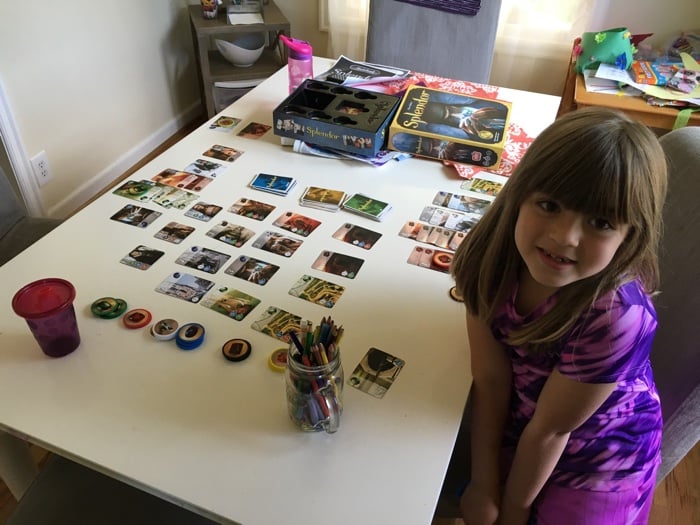
Getting beaten at Splendor

So those are the games we’ve tried and liked. I wanted to pass them on to you, just as Rich passed his favorites on to us and started what I’m sure will be a life-long connection between my daughters and I. Thank you, Rich. What a wonderful thing, to gift someone with a new passion.
When being alone on our smartphones, together, is okay

Emma Brockes wrote an essay for The Guardian called In praise of being alone on our smartphones, together:

The act of being with someone—or better yet, a group of people—and on one’s phone is just the modern iteration of a key pleasure of family life: to be among those whom one is sufficiently comfortable with to drift in and out of communication. Like doing homework at the kitchen table, it is the state of doing your own thing while others do theirs around you. The point is, whatever you are doing on your phone, it would be less pleasurable were you to be doing it alone in your room.

Screen addiction alters this, and there are levels of disengagement that can turn a sentient being into a piece of furniture, but the parameters of acceptable phone use should surely widen at this point to permit some middle way between being on one’s phone and considered rude, or turning the device off altogether.

The title of the essay is a clever reference to Sherry Turkle’s book Alone Together: Why We Expect More from Technology and Less from Each Other. It’s a book I enjoyed a lot, despite it being relentlessly full of depressing paragraphs like this:

Now demarcations blur as technology accompanies us everywhere, all the time. We are too quick to celebrate the continual presence of a technology that knows no respect for traditional and helpful lines in the sand.

[A] stream of messages makes it impossible to find moments of solitude, time when other people are showing us neither dependency nor affection. In solitude we don’t reject the world but have the space to think our own thoughts. But if your phone is always with you, seeking solitude can look suspiciously like hiding.

I recommend danah boyd’s It’s Complicated: The Social Lives of Networked Teens as a positive palate cleanser afterwards.

Anyway, back to Emma’s article. She also references Susan Dominus’s Motherhood, Screened Off, an article that was in heavy rotation towards the end of last year. Susan makes the point that smartphones result in a lack of transparency, since people (i.e. our kids…) don’t know what we’re up to when we’re on them:

It is that loss of transparency, more than anything, that makes me nostalgic for the pre-iPhone life. When my mother was curious about the weather, I saw her pick up the front page of the newspaper and scan for the information. The same, of course, could be said of how she apprised herself of the news. […] All was overt: There was much shared experience and little uncertainty. Now, by contrast, among our closest friends and family members, we operate furtively without even trying to, for no reason other than that we are using a nearly omnipresent, highly convenient tool, the specific use of which is almost never apparent.

And that’s where the answer to all of this comes back to “it’s complicated.” Yes, sometimes it’s ok to be alone on our devices, together in quiet contentment. But other times the lack of transparency about what we’re doing can be incredibly alienating to others. This wouldn’t be a problem if we could tell the difference between the two situations perfectly, every time. But alas, we are only human.

That Dragon, Cancer: a game that explores faith, hope, and love

Tomorrow, a game called That Dragon, Cancer becomes available to play. The premise is heartbreaking:

An immersive narrative videogame that retells Joel Green’s 4-year fight against cancer through about two hours of poetic, imaginative gameplay that explores faith, hope and love.

Earlier this month Wired did an incredible profile on the creator of the game: Joel’s dad, Ryan Green. From Jason Tanz’s A Father, a Dying Son, and the Quest to Make the Most Profound Videogame Ever:

Over time, That Dragon, Cancer became Green’s primary method of dealing with Joel’s illness, as well as a way for him to preserve a connection to his son, whom he struggled to get to know. In real life, Joel couldn’t talk about his feelings, leaving Green to guess at his thoughts and emotions. Joel’s reaction to radiation therapy was particularly puzzling. Children usually hated being placed on the gurney inside the giant linear accelerator, resisted the anesthetic, fought and clawed at their parents and doctors every time they entered the room. But Joel loved it. He grew impatient in the waiting room, and his face lit up when the doctors came to get him, more excited than his parents had ever seen him. Green couldn’t know just why Joel was so enthusiastic about undergoing the anesthesia, but he wrote a scene imagining the adventures Joel might be experiencing in his mind—riding animals made of stars, giggling and tearing across the cosmos.

It is an incredible story—equal parts sad and inspiring. This game scares me—I’m not sure I have the strength to play it. Here’s the trailer…

The power of making things

Jon Kolko wrote a wonderful personal essay called Look, I Made a Thing: Confidence in Making:

If you stick with it, through the years of shitty ashtrays and embarrassing critiques and rejections, you start to learn that making things is powerful, mostly because on the way to making things, you build confidence. You can take on problems that are out of your league. You can become a teacher with no teaching experience. You can make money and provide value. You can lead a conversation, advance an idea, and drive specificity where there were only vague generalities.

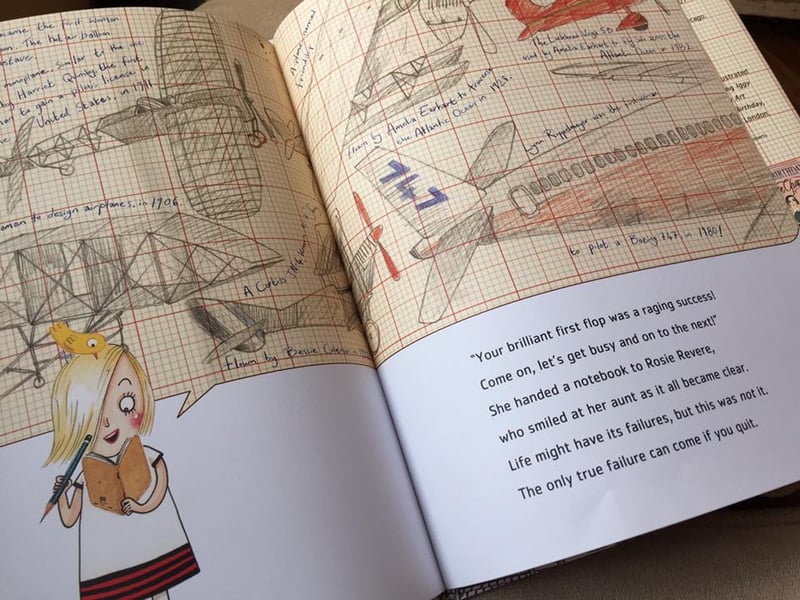
This idea—that just because you’re not good at something right now, it doesn’t mean you can’t become good at it—is something I try to instill in my daughters as well. And in doing that, I end up lecturing myself in the process too. One of my favorite books to read my daughters is Rosie Revere, Engineer by Andrea Beaty and David Roberts, because it explains this concept in language even I can understand…

Kids, technology, and nonverbal communication

I’m not usually one to freak out about kids and technology use, but Bruce Feiler makes some interesting points in Hey, Kids, Look at Me When We’re Talking:

Dr. [Clifford Nass, a communication professor at Stanford University] told me about research he was doing that suggested young people were spending so much time looking into screens that they were losing the ability to read nonverbal communications and learn other skills necessary for one-on-one interactions. As a dorm supervisor, he connected this development with a host of popular trends among young people, from increased social anxiety to group dating.

That’s pretty alarming.