Menu

Posts tagged “design”

On criticism, cynicism, and how to turn John Cage quotes into Internet jokes

A couple of weeks ago I read this quote by John Cage in The Art of Looking Sideways:
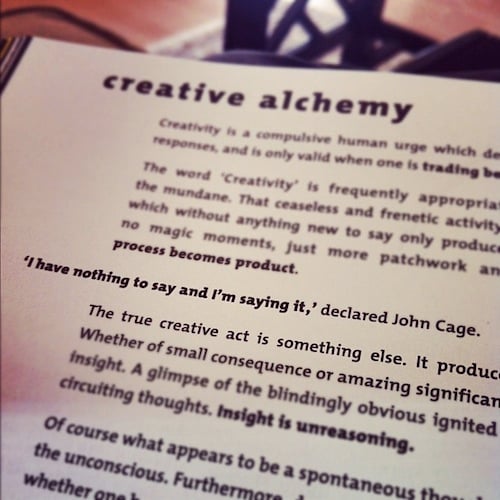
I have nothing to say and I'm saying it

I have nothing to say and I’m saying it. Is your mind racing about all the ways that statement applies to life on the Internet? Yeah, me too. In fact, the phrase immediately made me think of a joke I could make on Twitter, which I wrote down right away. But I wanted to get my facts right, so I started reading up on John Cage - as you do when you’re on vacation. This is where I ask you to please stick with me as we go on a brief detour about the nature of criticism.

My rabbit-hole journey into the world of John Cage led me to a great 2004 essay by Joe Dacey called John Cage Defined in the 1950s. It outlines how the phrase “I have nothing to say and I’m saying it” comes from his “Lecture on Nothing”:

In this lecture, he outright tells the listener that the lecture has no point and will go nowhere, “I am here and there is nothing to say. If among you are those who wish to get somewhere, let them leave at any moment”. He implores the audience to enjoy each and every moment of the lecture even though he admits that it is pointless. He advocates that, “Our poetry now is the realization that we possess nothing. Anything therefore is a delight (since we do not possess it) and thus need not fear its loss” and “It is not irritating to be where one is. It is only irritating to think one would like to be somewhere else”.

It’s not just you - that is a weird thing to do. What fascinates me most about Cage is that he never bothered to reflect on any criticism of his work. Ever.

Cage mostly ignored criticism he received believing that most people didn’t understand why he composed the music he composed. In fact, he saw society as “one of the greatest impediments an artist can possibly have” to creating good art. After receiving a review for a concert he gave in Seattle that stated the performance was “ridiculous,” Cage’s responded that he had no interest in the review because he “knew perfectly well it wasn’t.”

Knowing when to ignore criticism and when to listen to it is one of the hardest skills to learn, and so easy to get wrong. On the one extreme is the John Cage approach, where you view all criticism as bogus or not worthy of your attention. On the other extreme there are people (and companies) who change course with every little piece of feedback they get, regardless of its merit.

But somewhere in between is a happy medium where you use criticism as a springboard to ask yourself tough questions. If you’re a designer, those questions might be things like, “Why did I put this button here?” or “Why might someone find this interface confusing?”. Those are excellent questions to ask yourself. If you can answer them, and defend the decisions you made, you can move on to the next thing. If your questions lead you to make some changes, well, that’s great too because your end result is going to be a better product.

I like the way The 99 Percent approaches the process of finding this middle ground in their article On Criticism, Cynicism & Sharpening Your Gut Instinct:

Criticism is doubt informed by curiosity and a deep knowledge of a discipline related to your work. Whether the criticism you receive is constructive or not, it comes from knowledge. Informed insights like “I’m not sure someone would ever pay that much” or “you may not want to outsource that given the high-touch required” may cause you to question your approach.

By contrast, cynicism is a form of doubt resulting from ignorance and antiquated ways. Industry experts will often express doubt based on an ingrained muscle memory of past experiences that handicaps their vision for the future. Cynical statements like, “People will never read a book on a computer” or “Why would anyone want to put their rolodex online?” are famous doubts expressed by experts with handicapped vision.

Their advice is simple: Savor criticism, shun cynicism. That seems like a sound approach to me.

Anyway, I mention all of this to ensure you of the accuracy of the joke I ended up making:

“I have nothing to say and I am saying it” - John Cage in his 1949 lecture on posting Foursquare check-ins to Twitter

— Rian van der Merwe (@RianVDM) May 14, 2012

You are, of course, welcome to disagree and send me your criticism.

Where to find design inspiration

In Designing Ideas Paul Scrivens reminds us that distraction-free writing apps aren’t new - typewriters and pen & paper have been around for a very long time. He then encourages us to look beyond our immediate time and medium for ideas on how to solve design problems:

The problem with designing new ideas is that we are too busy looking at what the people are designing around us to realize that many of the solutions to the problems we are facing have been solved already in a different time.

You will never be first with a new idea. You will be first with a new way to present the idea or a new way to combine that idea with another. Ideas are nothing more than mashups of the past. Once you can embrace that, your imagination opens up a bit more and you start to look elsewhere for inspiration.

This is partly why I’ve spent so much time reading up on architecture. It’s a mature, related craft that can teach us a great deal about web design - arguably more than Dribbble can.

The Shape of Design by Frank Chimero: closing remark

I just finished reading Frank Chimero’s The Shape of Design. My closing remark on Readmill:

Highly recommended to anyone who wants to step back and get a sense of the state of design beyond the tools that we use. It makes us think about the reasons why we design, and how to give our work purpose and meaning. I found part 1 to be the strongest, but it’s a quick, easy read throughout.

You can follow the link to see the highlights I made - there are some really great quotes in there, such as this one:

Design doesn’t need to be delightful for it to work, but that’s like saying food doesn’t need to be tasty to keep us alive. The pedigree of great design isn’t solely based on aesthetics or utility, but also the sensation it creates when it is seen or used. It’s a bit like food: plating a dish adds beauty to the experience, but the testament to the quality of the cooking is in its taste. It’s the same for design, in that the source of a delightful experience comes from the design’s use.

In related news, I thoroughly enjoyed reading this on the Readmill app for iPad. I will try to read books with this app whenever possible from now on, with the Kindle as a backup if I can’t find the book as DRM-free ePub. The reader itself needs a bit of work to get to the standard that iBooks set, but the social features are really great. I love seeing who else is reading the book I’m reading, what they’ve highlighted, etc. Readmill embraces the digital reading experience in the best way that I’ve seen so far.

Design for learning

Hey, I dislike the word “gamification” as much as the next guy. The topic of game mechanics has been twisted and applied to everything with almost as much success as the recent “infographic” craze. And yet, I can’t help but link to this excellent post by Michael Lopp. In Two Universes he provides one of the few worthwhile explorations of game mechanics in software that I’ve seen:

The plethora of online Photoshop tutorials demonstrate its power and its flexibility, but I believe they also demonstrate its poor design. Think about it like this: what if each time you plunked down in front of World of Warcraft, you had to spend an hour trying to remember, wait, how do I play this?

Great design makes learning frictionless. The brilliance of the iPhone and iPad is how little time you spend learning. Designers’ livelihood is based on how quickly and cleverly they can introduce to and teach a user how a particular tool works in a particular universe.

His observations on what it takes to motivate people to learn are spot on.

The importance of getting the details right

Jeff Atwood starts his article This Is All Your App Is: a Collection of Tiny Details as a post about cat feeders, but stick with it. It’s gold:

Getting the details right is the difference between something that delights, and something customers tolerate.

Your software, your product, is nothing more than a collection of tiny details. If you don’t obsess over all those details, if you think it’s OK to concentrate on the “important” parts and continue to ignore the other umpteen dozen tiny little ways your product annoys the people who use it on a daily basis ”“ you’re not creating great software. Someone else is. I hope for your sake they aren’t your competitor.

Design isn't just surface work

Speaking of Frank Chimero, his Q&A on the Readmill Blog is really good:

A dull ache of sadness and disappointment works through me when I see design portrayed as surface work, or when I see a lot of time and money funneled into empty solutions to fake problems. It feels like squandered potential. Fruit rotted on the branch. I believe that design, at its best, can act as life-enhancement. We can make and use this stuff to help all of us live well, and I’d like to see us live up to those expectations across the board, my own work included.

Early thoughts on "The Shape of Design"

I just started reading Frank Chimero’s The Shape of Design. I wanted to wait for the physical book but my patience failed me so I accidentally started reading the eBook today.

I’m only about 20% through but I can already wholeheartedly recommend this book to anyone who is interested in the bigger context and purpose of design. In fact, one of the core ideas that Frank wants to get across is why we should care about more than just technique:

The relationship between form and purpose”Š”…”“”…”ŠHow and Why”Š”…”“”…”Šis symbiotic. But despite this link, Why is usually neglected, because How is more easily framed. It is easier to recognize failures of technique than those of strategy or purpose, and simpler to ask “How do I paint this tree?” than to answer “Why does this painting need a tree in it?” The How question is about a task, while the Why question regards the objective of the work. If an artist or designer understands the objective, he can move in the right direction, even if there are missteps along the way. But if those objectives are left unaddressed, he may find himself chasing his own tail, even if the craft of the final work is extraordinary.

Seriously, just buy the book.

We don't do art

Well, boom:

Don’t you think it is weird that every designer you come across says they like minimalism? Minimalism is an art term that designers tried to bring over into our realm. We don’t do art. We engineer solutions and if that solution is anything more than “˜minimal’ then it usually means we lost a battle with a client.

When design mistakes are fatal (and what we can learn from them)

The article Air France Flight 447: “Damn it, we’re going to crash” is long and fascinating. But most of all, it’s frightening. It paints a vivid picture of what happened the night of June 1st 2009, when Air France Flight 447 from Rio de Janeiro to Paris went missing. The plane was eventually found days later - all 228 passengers and crew died in the crash.

For me, the biggest take-away from the article is that sometimes bad design can cost lives. Much of the article is about the design flaws in Airbus planes that resulted in multiple - and eventually fatal - human errors by the pilots. The details are important so you should definitely read the whole article, but two main design issues are discussed.

First, there is a lack of information given to pilots:

In the next 40 seconds AF447 fell 3,000 feet, losing more and more speed as the angle of attack increased to 40 degrees. The wings were now like bulldozer blades against the sky. Bonin failed to grasp this fact, and though angle of attack readings are sent to onboard computers, there are no displays in modern jets to convey this critical information to the crews. One of the provisional recommendations of the BEA inquiry has been to challenge this absence.

Second, there is a lack of visual feedback on the particular kind of steering that’s used on all Airbus planes. Because of the way the so-called “fly-by-wire” steering method is implemented on the Airbus, it’s very difficult for pilots to see what their colleagues are doing, and therefore almost impossible to spot human error:

The American manufacturer [Boeing] was concerned about [the Airbus] side sticks’ lack of visual and physical feedback. Indeed, it is hard to believe AF447 would have fallen from the sky if it had been a Boeing. Had a traditional yoke been installed on Flight AF447, Robert would surely have realised that his junior colleague had the lever pulled back and mostly kept it there. When Dubois returned to the cockpit he would have seen that Bonin was pulling up the nose.

As I read through this article I was immediately reminded of Nielsen’s first usability heuristic:

Visibility of system status

The system should always keep users informed about what is going on, through appropriate feedback within reasonable time.

Both of the main issues that resulted in the crash of Flight AF447 could have been avoided by following the simple guidelines of system status visibility. It’s what makes this already horrifying event even worse.

As web designers we are extremely lucky - our design mistakes don’t endanger lives. But even though we don’t make daily life-or-death decisions in our profession, we should still pay extra attention to this first, and arguably most important, rule of UI design: always make sure users know where they are, and that they have the information they need to make their next decision. This is one of those simple design rules that seems obvious when it’s followed, but results in major abandonment when it’s broken.

When a user gives an input we have to acknowledge receipt of that input. This input is usually in the form of a click or a touch. It’s the user’s way of starting a conversation, so don’t be rude - talk back. These buttons below, designed by Alex Maughan for kalahari.com, is a good example of appropriate feedback:

kalahari buttons

As soon as the user clicks the “Add to basket” button, the animated spinner and text give an indication that something is happening. Or consider this idea for a new kind of signup flow outlined on the 37signals blog:

You could preview the workflow steps that come after the signup so it’s clear how much of a gap there is between signing up and getting value out of the product.

This approach gives users comfort, because they know what’s going to happen next. They have all the information they need, so there’s no need to panic and abandon the flow. (You can click through to the original post for a sketch of this idea)

This principle isn’t new or complicated. But reading about the Air France tragedy reminded me again that we sometimes skip over the basics to implement the fancy. So here’s an idea: pick your favorite “get the basics right” sports cliché and put it on the wall so you can see it whenever you’re designing (you know, like catches win matches or something). Or just get straight to the point and write, “Appropriate feedback makes for happy users”.

Why chairs suck

Against Chairs is a simply delightful article:

I hate to piss on the party, but chairs suck. All of them. No designer has ever made a good chair, because it is impossible. Some are better than others, but all are bad. Not only are chairs a health hazard, they also have a problematic history that has inextricably tied them to our culture of status-obsessed individualism. Worse still, w’ve become dependent on them and it’s not clear that w’ll ever be free.

It also boasts one of the better opening lines I’ve seen in a while. I won’t spoil it for you.