Menu

Posts tagged “culture”

The future will have only two kinds of jobs

In How the internet is making us poor Christopher Mims asks a chilling question about what he calls the “hollowing out of the middle class” — the phenomenon where knowledge workers are being replaced by computers:

Like farming and factory work before it, the labors of the mind are being colonized by devices and systems. In the early 1800′s, nine out of ten Americans worked in agriculture—now it’s around 2%. At its peak, about a third of the US population was employed in manufacturing—now it’s less than 10%. How many decades until the figures are similar for the information-processing tasks that typify rich countries’ post-industrial economies?

The article also quotes this thought-provoking statement from Marc Andreessen:

The spread of computers and the Internet will put jobs in two categories: People who tell computers what to do, and people who are told by computers what to do.

It might seem like the usual doom-and-gloom “technology will kill as all” refrain, but the article reviews some very interesting historical (and current) data, so it’s worth checking out.

Binge-watching and the future of TV

Willa Paskin wrote a really interesting article for Wired about the future of television. The most interesting parts of Netflix Resurrected Arrested Development. Next Up: Television Itself are about the rise of “binge-watching” — the behavior of churning through multiple episodes at a time in one sitting. Netflix found that designing shows to allow for binge-watching is good business:

The more that ­people binge-watch, the more attached they become to the show. “Binge-watching is a behavior that really started for us back in the DVD days. The way ­people were returning the discs, they weren’t watching one a night or one a week,” Sarandos says. “As we got into the streaming business, it became more trackable. What we saw was that the ­people who did this were much more attached to the shows. And because they were more attached to the shows, they reported more value in watching them on Netflix.” In other words, the more you binge, the better for Netflix.

This is why Netflix released all 13 episodes of House of Cards at once, and why those who say it was a stupid decision will likely be proven wrong.

Collaboration for introverts

Mark Boulton wrote a forceful counter-argument to the common mantra that collaboration results in better design. From Quietly working:

I see plenty of banner waving for collaborative working. Co-designing, pair programming, brainstorming, collaborative workshops. The overwhelming message is that these tools are better for reaching consensus, sharing work, and, ultimately, lead to better work. Well, I’m not so sure that’s the truth. Given my introverted nature, sometimes these activities can rush the process too much. They allow no time for me to think. […]

Personally speaking, a lot of the time, I’d rather listen to what you have to say and go and have a good think.

Mark makes some very good points, and as an introvert myself, his message really resonates with me. But I don’t think it’s an either/or situation. It’s not that we either collaborate, or work alone. Collaboration that doesn’t allow time and space for working alone is ineffective collaboration.

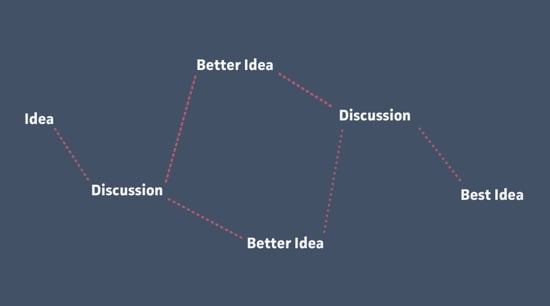
There are two illustrations about the collaboration process that summarize this idea well. The first is from Trent Walton’s Being Prepared To Contribute:

Better ideas

An idea, followed by discussion, often results in better ideas. But the “Better idea” step doesn’t happen in a meeting room — it happens at the designer’s desk, when they have time to reflect and focus on the problem without interruption.

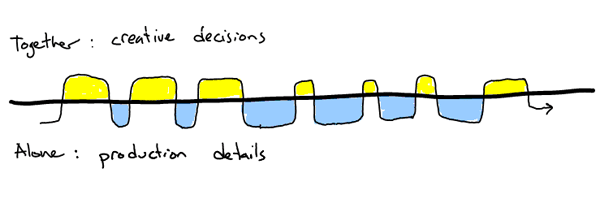
The second illustration is from Stefan Klocek’s excellent post Better together; the practice of successful creative collaboration:

Together

It shows how collaboration doesn’t mean that everyone should do everything together. Important decisions are made together, but the production details (the “better ideas”) happen while working alone.

So I’m definitely with Mark on his call for having more time to think and work alone. But that isn’t an alternative to collaborative working. It’s just a necessary — and too often ignored — part of the collaboration process.

(link via @ChrisFerdinandi)

Our weird and outdated definition of success

Jason Kottke once said that The Onion is often the most emotionally honest media source we have, and that was proven once again with David Ferguson’s recent article there called Find The Thing You’re Most Passionate About, Then Do It On Nights And Weekends For The Rest Of Your Life:

Because when you get right down to it, everyone has dreams, and you deserve the chance—hell, you owe it to yourself—to pursue those dreams when you only have enough energy to change out of your work clothes and make yourself a half-assed dinner before passing out.

But what I really want to talk about is Kevin Fanning’s excellent follow-up post where he tries to figure out why that Onion article struck a chord with so many people:

I think the reason this article is painful is because culturally we define success in such a weird and outdated way. There’s this idea that if you’re not doing what you’re most passionate about all the time, you’re a failure. If you aren’t making a living at it, you’re a failure. If you’re not Stephen King or Christina Aguilera, you’re a failure.

Kevin’s conclusion (among other things, that “maybe eventually we get to a place where we see that books and music and art are created by us, people who have school and day jobs and other shit we care about”) is a call to relax a bit, and be much less hard on ourselves. Read it and feel better!

Email signoffs: the end is (hopefully) near

I know there are more important things in the world to get annoyed with, but I completely agree with Matthew J.X. Malady’s rant about email signoffs:

After 10 or 15 more “Regards” of varying magnitudes, I could take no more. I finally realized the ridiculousness of spending even one second thinking about the totally unnecessary words that we tack on to the end of emails. And I came to the following conclusion: It’s time to eliminate email signoffs completely. Henceforth, I do not want—nay, I will not accept—any manner of regards. Nor will I offer any. And I urge you to do the same.

And while I’m complaining about things that shouldn’t bother me, is there a way to make airlines stop telling us to “disembark the plane” instead of just asking us to get off the thing? Here’s an idea: the next time an airline announcer asks you to “commence boarding procedures”, launch into the following speech:

Engineered to be vaguely dissatisfied

Your Lifestyle Has Already Been Designed is a punch-in-the-gut piece by David Cain. Consider this paragraph:

We’ve been led into a culture that has been engineered to leave us tired, hungry for indulgence, willing to pay a lot for convenience and entertainment, and most importantly, vaguely dissatisfied with our lives so that we continue wanting things we don’t have. We buy so much because it always seems like something is still missing.

Feeling indignant that he would insinuate that you of all people have been indoctrinated by a consumerist culture? Before you close your laptop in disgust, hear the man out. Haters gonna make some good points sometimes…

Design process: don't let extreme views grind you down

Josh Emerson offers some words of advice that we should all take to heart:

But perhaps the most important thing I want to highlight here, is that the answer to most questions is it depends, and very often in the grey area between black and white. Try not to take extreme views on things, and perhaps see that there is always another level of complexity to be discovered in any decision you make.

We just came out of a season of arguing whether or not Flat Design is the answer to everything. We also heard proclamations that wireframes are dead, designers do in fact need to code, and Photoshop is on its last legs.

But you know what? Screw that. We have to remind ourselves that the vast majority of design is done by people who don’t have Twitter accounts and large public followings. Out there in the trenches they shouldn’t have to worry about what’s cool or what styles they’re allowed to like. They should only care about getting the job done, and using whatever tools they have at their disposal to do the right thing.

Doing the right thing is complex, and messy. Sometimes it has the luxury of involving a content-first approach with interactive prototypes, but other times it involves having to make static wireframes and designing before any content is available. It’s not ideal, but who are we to judge a designer based on what we perceive as the quality of their process? What do we know about the complexity of the project, the relationships they are trying to navigate, and the users they are designing for?

My advice is this. Yes, follow the design zeitgeist. Study the big ideas and explore the edges where the industry is being pushed forward. But don’t get caught up in whatever the cool viewpoint is about any methodology or style. Only you know what your project needs. So be confident, ignore the extreme viewpoints, and use whatever tool will be most effective to help you do the right thing.

What it takes to realize your ambitions

Jeff J. Lin looked at the life of director Ang Lee and pulled out some insights on what it takes to be successful. This part from Ang Lee and the uncertainty of success talks about the long periods of non-success that often occur:

If you’re an aspiring author, director, musician, startup founder, these long stretches of nothing are a huge reason why it’s important to pick something personally meaningful, something that you actually love to do. When external rewards and validation are nonexistent; when you suffer through bouts of jealousy, wondering “How come so-and-so got signed/is successful/got a deal/etc?”; when every new development seems like a kick in the stomach, the love of what you are doing gives you something to hang onto.

Much is made of genius and talent, but the foundation of any life where you get to realize your ambitions is simply being able to out-last everyone through the tough, crappy times — whether through sheer determination, a strong support network, or simply a lack of options.

Related, Paul Tough’s thesis on how children succeed:

Noncognitive skills, like persistence, self-control, curiosity, conscientiousness, grit and self-confidence, are more crucial than sheer brainpower to achieving success.

Choose work based on impact, not profit

Jason Cavnar wrote a great piece for VentureBeat called Why developers should start choosing conscience over profit. He urges us to be Makers, not Takers:

Makers choose their work based on impact and happiness. They recognize the truths in the work of people like Daniel Pink and Simon Sinek — that income does not generate happiness or enjoyment, nor alleviate sadness or stress. They concern themselves with doing work that is important. With thinking about what moves society forward. With jobs and startups and weekend hacking and open-source contributions to things that have a real-world impact. They introduce and push fundamentally new technologies.

It reminds me of Matt Gemmell’s Makers and Takers:

People who make things, or Makers, contribute something to the universe. Makers are people like writers, musicians, artists, architects, software engineers, carpenters, and the chap at the coffee shop who makes your morning latte. He has a skill, and he applies it to create something that makes your day a little bit better. […]

When I’m choosing who to spend time with, or seek inspiration from, or learn from, or adopt as a role model, I’m exclusively looking at Makers. The fire and water, rather than the mere pipework. The lightning, not the rod. Surround yourself with Makers.

And one more, just for good measure. Here’s Mike Monteiro in Design Is a Job:

I urge each and every one of you to seek out projects that leave the world a better place than you found it. We used to design ways to get to the moon; now we design ways to never have to get out of bed. You have the power to change that.

So there you go — some nice midweek inspiration.

My phone isn't better than your phone

I really enjoyed Michele Catalano’s Grimes, Pop Music, and Cultural Elitism, which starts with this quote from Clare Boucher (better known as Grimes):

I don’t see why we have to hate something just because it’s successful, or assume that because it is successful it has no substance.

It’s an article about our tendency to look down on pop music (and the people who like pop music), but it points to a much broader cultural phenomenon:

The elitism one shows when they dismiss pop music as vapid and those who like it equally vapid is a detriment to any open conversation. The defenders of pop – myself included – are often put on the defensive, made to offer up excuses as to why we like what we do. No one should have to defend their musical choices. No artist who worked hard to get where they are should be roundly dismissed because their music doesn’t fit some elitist standard.

This kind of elitism is something we all have to watch out for. I will probably never switch away from my iPhone, but that doesn’t mean that Android users are undiscerning losers. The best phone is the phone you like the best. That’s all there is to it. As hard as it can be sometimes, we have to decouple the things people like and don’t like from their value as human beings.