Menu

Posts tagged “agile”

#estimates

An interesting counter-argument to the #noestimates movement—and a call for reasonable software development estimates—on the Clever PM blog1. From In Defense of Estimates:

From a business perspective, some level of estimation is absolutely required, so that judgment calls can be made as to priorities of execution and communications within the company and to customers. We need to have some level of understanding of whether something is “bigger than an elephant or smaller than a breadbox” so that we can deploy other parts of the organization appropriately. “It takes as long as it takes” is not useful for tactical or strategic planning within any organization.


  1. It’s kind of hard for me to link to this. First, there’s no byline, and I’d love to quote the author by name. Also, wow, that stock image… 

How to get more into Lean UX

Ben Melbourne’s UX Designers: Why are we Wasting Time? is a great post on lean methodologies and Lean UX in particular. Of course, I especially like this point:

No amount of text or slides will ever replace the richness of observing your target audience first-hand. Take your client/team out in the field with you, or you’re greatly reducing the value of your research. Seeing a user point out the flaws in your product is the quickest way to convince a CEO to drop his pet feature.

Product Discovery in the context of Agile development

Back in 2012 I wrote the following about a blind spot I’ve noticed in Agile development:

Problem solving involves not just iteration, but also lots of variation. This often requires time to get it wrong a few times, which doesn’t fit comfortably with the concept of release dates. See, the problem with integrating Agile and UX is not that designers want to hang on to “slow and heavy documents,” “big upfront design”, or whatever you want to call it. The problem is that each iteration further solidifies the chosen path, and there is no time to stop and ask if you’re going in the right direction.

All of that came flooding back when I read Jeff Patton’s Common Agile Practice Isn’t for Startups, in which he puts a slightly different spin on the issue that Agile is not very good at helping us figure out what to build. His solution is a product discovery process (something that’s obviously near and dear to my heart as well). He places the discovery process in the context of a different kind of velocity than is usually measured in Agile—trying to learn as much as possible about customers and the product:

There’s something very different about this process loop: the primary measure of progress during discovery isn’t delivery velocity, it’s learning velocity. And sadly, we can’t measure it in features or stories completed. And, even worse, we can’t plan two weeks of it in detail because what we learn today can and should change what we do tomorrow.

He goes on to describe a Nordstrom process:

Notice the Nordstrom Lab still uses time-boxes, 1 week in this case. But, they didn’t start the time-box by predicting how much they’d deliver, but with learning goals in mind. Then they iterated around the build-measure-learn loop as fast as they could.

The post is hard to quote from, so really, just go ahead and read it. It’s a very interesting approach to making discovery part of a regular Agile process.
Split code bases and team ownership

Marty Cagan continues his excellent product autonomy series by discussing what happens when teams get large enough to split up their code bases. In Autonomy vs. Ownership he describes his preferred way of dealing with the situation where a team needs a change in a different codebase to get one of their features implemented:

The alternative model is informally known as the “open source” model although to be clear this is not about open sourcing your code, it’s just called that because this is how much of the open source community operates. In this model, if the drivers team needs a change to the riders team’s code, then they could either wait for the riders team to do it, or they can actually make the change themselves, and then request that the riders team review the change, and include it if they’re okay with it (known as a “pull request”). This means that you are telling the software management system that you’ve made a change to the software, but the owner of that software needs to review the changes before they are actually approved and incorporated.

The importance of running experiments instead of launching MVPs

If I link to a listicle, it has to be good enough to overcome my unnaturally strong negative feelings about those types of article. Alas, Mike Fishbein’s 4 steps to make experimentation a repeatable process in your business is that good. It’s a great overview of the importance of hypothesis testing over “requirements gathering” in product management:

Most new products fail, and most frequently because they do not meet user needs. Running experiments helps product managers validate customer demand for a product concept earlier in the product lifecycle.

By running experiments instead of launching a minimum viable product, product managers in large organizations can gain more autonomy, limit risk and brand exposure, and gain user insights even earlier in the product lifecycle. With this speed to user insight, product managers become better informed to build successful products.

I also especially liked this bit:

In the next evolution of product management, the product leader’s role shifts from making bold assumptions to fostering a culture that encourages learning in an efficient and effective way.

Product roadmaps are still all right

Scott Sehlhorst wrote a really good defense of good product roadmaps in Features do not a Product Roadmap Make:

If your roadmap says “Will include update quantity control in shopping cart” you’re doing it wrong.  Your roadmap should say “Improved shopping experience on mobile” or “Better shopping experience for spearfisher  persona.” […]

When a roadmap is being used to communicate “what” the product will be, it should be in the language of describing which problems will be addressed, for whom, or in what context.  This is the most important type of theme which would be part of a thematic roadmap.  Other themes could be “improve our positioning relative to competitor X” or “fill in a missing component in our portfolio strategy.”

And this, in the context of agile, is a great point as well:

A backlog – a prioritized list of features – is not a roadmap. It is a reflection of a set of design choices which happen to fulfill in product what the roadmap sets out as a manifestation of strategy.

A roadmap tells you both “why” and “what;” a backlog tells you only “what.”

This reminds me of an article I wrote in 2011 called Product roadmaps are safe. Good times.

Autonomous teams: challenges and recommendations

Marty Cagan has some really insightful thoughts (as usual) on autonomous teams in Autonomy vs. Mission:

In healthy teams and organizations, the way we normally reconcile these views [where the team might have one perspective and the leadership might very well have another] is that the leadership has control of two major inputs to the decision process. The first is the overall product vision, and the second are the specific business objectives assigned to each team.

Problems arise if the leadership does not provide clarity on these two critical pieces of context. If they don’t, there’s a vacuum and that leads to real ambiguity over what a team can decide and what they can’t.

The section on how to ensure consistency in design across different teams is also really good:

In the name of empowerment and also speed, my personal preference is to invest in the necessary automation (with pattern libraries and style guides) so that the team can get the design (interaction and visual) mostly right pretty easily, and acknowledge that on occasion, you will incur some “design debt” where we realize that the design needs to be corrected, and that’s fixed as soon as the problem is spotted. I like this approach because the manager of design is still responsible for developing a strong set of designers, but doesn’t have to be in the review cycle for everything (which tends to slow things way down, as well as undermine autonomy).

Usability testing and agile, together

I really like the approach described in Jen McGinn and Ana Ramírez Chang’s RITE+Krug: A Combination of Usability Test Methods for Agile Design. It’s a dense paper, but worth your time. Here’s a key part (my emphasis added):

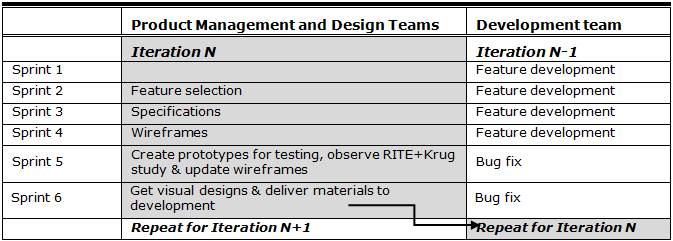
Prior to using the RITE+Krug combination, the user research process and results had been divorced from the Agile processes, which resulted in the findings coming too late to be acted on. Because of this issue, we integrated the user research with the rest of the process, as illustrated in Table 1.

The team consists of developers, product managers, user experience designers, visual designers, quality assurance engineers, and a user researcher. The user experience designers and product managers work closely with the development team during the feature sprints—answering questions, giving feedback on progress, and fine tuning the feature as it is implemented. The bug fix sprints give the developers time to focus on product stability.

Meanwhile the product managers, user experience designers, visual designers, and the user researcher work on preparing the small set of features that will be implemented in the next iteration (see Table 1). This work includes feature selection, design, user testing, and redesigns. The whole team (including developers) gives feedback on the feature specification and design before it is ready to be implemented. Like others, our design team stays an iteration ahead of the development team. Like Patton recommends, we iterate the UI before it ever reaches development, thereby turning what is traditionally a validation process into a design process.

And here’s the table:

One of the biggest issues with usability testing and Agile is the complaint that testing slows down the process. This seems like a really good way to alleviate those concerns.

How to write perfect software

Charles Fishman’s They Write the Right Stuff is an incredible profile of the engineers who write software for NASA’s space shuttle missions:

How do they write the right stuff?

The answer is, it’s the process. The group’s most important creation is not the perfect software they write — it’s the process they invented that writes the perfect software.

It’s the process that allows them to live normal lives, to set deadlines they actually meet, to stay on budget, to deliver software that does exactly what it promises. It’s the process that defines what these coders in the flat plains of southeast suburban Houston know that everyone else in the software world is still groping for. It’s the process that offers a template for any creative enterprise that’s looking for a method to produce consistent—and consistently improving—quality.

The article goes on to explore the four propositions that underly everything this team does. Also see if you can spot what’s different about their working hours…

User testing and long-term product planning

Steve Barnett makes some great points on long-term planning in Plans, Details, Dates, and The Future1. I especially like the point about how user research fits into planning:

Before development starts on a new bit of work, you should be building prototypes and doing user testing with them. This always results in some changes to the plan, and often results in rather large charges. You can’t plan what these changes will be: you don’t know until you’ve done your user testing.


  1. And bless his heart for using an Oxford comma.