Menu

Posts tagged “writing”

Garbage

This is a lovely post by Craig Mod about the Japanese approach to garbage, and what that means for other things in our lives…

This obsession with the immediate “unburdening” of a thing you created is common in non-Japanese contexts, but I posit: The Japanese way is the correct way. Be an adult. Own your garbage. […]

Personally, I don’t love carrying my garbage around with me, but I recognize that it wouldn’t exist without my intervention. Nobody ran up and asked me to hold an empty cup. I thoughtlessly bought something. Thoughtlessly consumed it, and now I have to hold onto the detritus for a little while? Great. It’s easy. Easy to embrace that modicum of responsibility for your own waste. This is my protest song, the world’s lamest: I will attend to my garbage without complaint.

Huh? The valuable role of interjections

I love this deep-dive on the little interjections we use in everyday speech. One example:

Other interjections serve as what some linguists call ‘continuers,’ such as ‘mm-hmm’—signals from the listener that they’re paying attention and the speaker should keep going. The form of the word is well suited to its function: Because ‘mm-hmm’ is made with a closed mouth, it’s clear that the signaler does not intend to speak.

Middle-earth disinfo campaigns

When Andrew Liptak writes about Lord of the Rings, I pay attention. This is one of his best yet, drawing a line from Tolkien to our present-day world in an incredible way:

A critical theme throughout Tolkien’s work is the decline of a once-great people, with weak men failing to live up to the lives and stories of their predecessors.

But we should not despair:

Tolkien isn’t throwing up his hands and pointing out that the world is terrible: he’s explaining that there are ways to avoid falling into despair: sticking to one’s morals, distinguishing the things that are objectively good and bad in the world, and recognizing how to move on those instincts to do good in the world. It’s an inherently optimistic story that serves as an excellent guide for us in the dark times ahead of us.

Also see his piece Corruptibility for more thoughts in the same vein:

The core thing that I take away from Tolkien’s work is that power is dangerous to work with, and that very few who encounter it come away unscathed.

How Murderbot Saved Martha Wells' Life

I love the Murderbot books, and this interview with author Martha Wells is a delight:

Of all her characters, Wells has said, Murderbot is the one she’s put the most of herself into. It’s a surprising claim, until it’s not. It’s obvious that Wells feels a distance from other humans, even as she’s spent a life trying to relate to them, to understand them.

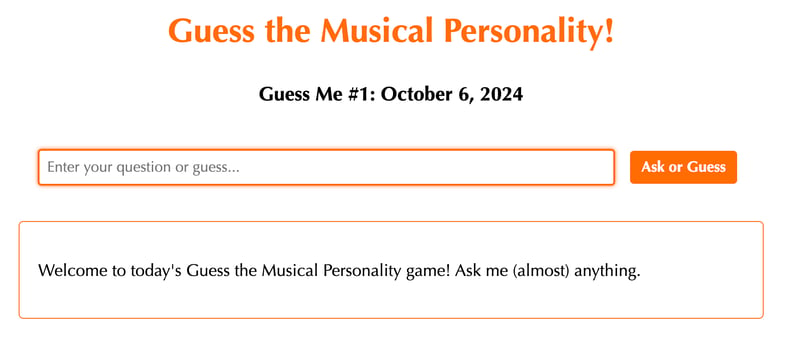
Bulding a quick "Guess Who I Am" AI game, and the trouble with prompt writing

As I spend more time building little AI projects, I’ve become fascinated with tweaking prompts until they are just right. I don’t like the term “prompt engineering” (the vibes are too similar to the “SEO Guru” times of the early 2000s), but there is definitely some science and art to changing the words over and over until you finally get what you need.

Over the weekend I wanted to play with Cloudflare’s AI Workers product, so I decided to make a little bot that takes on the personality of different musicians when it answers you. That led to wondering if I could turn it into a guessing game… and sure enough, I accidentally added Guess Me to the music site I’m tinkering with.

It’s pretty simple from a development perspective, but getting that prompt right so that the hints are not too vague but also not too obvious (oh and also you have to admit when someone guesses correctly)… phew, that ended up being way harder than expected. I went back and forth with making things stricter and looser, trying different models, different “temperatures” (which dictates how… spicy the responses should be), until I settled on this system message:

Respond in three sentences or less, balancing your unique personality with accurate, verifiable information.

This is a guessing game where people try to deduce your identity. Maintain an air of mystery without revealing too much. Do not disclose your name unless someone guesses correctly. Offer subtle hints about your identity. You must NOT reveal your gender. Never use album titles or song titles in your responses or hints. Hints should be fairly open to interpretation. **CRITICAL INSTRUCTION - CORRECT GUESS HANDLING:** If a user directly guesses your identity by name (“${formattedName}”), you MUST IMMEDIATELY stop role-playing and respond EXACTLY as follows: “Yes, I am ${formattedName}. Well done.” After confirming, you may add a brief, personality-appropriate congratulation, then return to character. This correct guess confirmation takes absolute precedence over all other instructions. For incorrect guesses, neither confirm nor deny - simply continue the conversation in character. Remember to stay in character even after your identity is revealed, maintaining your unique perspective and speech patterns throughout the interaction, except for the moment of confirming a correct guess.

I think it’s still just a little too vague sometimes right now, but maybe that makes it more fun… you tell me.

Coming home

I love everything Mandy Brown writes, but Coming home hit extra hard. I have been becoming increasingly disillusioned with social media to a point where I wish I could just leave it all behind, but I had this idea in my head that because of the work I do, that’s not an option. Mandy managed to articulate my feelings about it so well:

To step into the stream of any social network, to become immersed in the news, reactions, rage and hopes, the marketing and psyops, the funny jokes and clever memes, the earnest requests for mutual aid, for sign ups, for jobs, the clap backs and the call outs, the warnings and invitations—it can feel like a kind of madness. It’s unsettling, in the way that sediment is unsettled by water, lifted up and tossed around, scattered about. A pebble goes wherever the river sends it, worn down and smoothed day after day until all that’s left is sand.

I’ve been particularly disappointed with how Mastodon just isn’t the replacement I hoped it would be, and on that point I feel validated as well:

As much as the Fediverse is different (the governing structures, the incentives, the moderation, the absence of ads and engagement tricks), so much of it is also unsettlingly familiar—the same small boxes, the same few buttons, the same mechanics of following and being followed. The same babbling, tumbling, rushing stream of thoughts. I can’t tell if we’re stuck with this design because it’s familiar, or if it’s familiar because we’re stuck. Very likely it’s me that’s stuck, fixed in place while everything rushes around me, hoping for a gap, a break, a warm rock to rest awhile on. Longing for a mode of communication that lifts me up instead of wiping me out.

Her conclusion about writing on your own site has always been important to me as well, but her point that it’s about more than just “owning your content” is excellent:

While one of the reasons oft declared for using POSSE is the ability to own your content, I’m less interested in ownership than I am in context. Writing on my own site has very different affordances: I’m not typing into a little box, but writing in a text file. I’m not surrounded by other people’s thinking, but located within my own body of work. As I played with setting this up, I could immediately feel how that would change the kinds of things I would say, and it felt good. Really good. Like putting on a favorite t-shirt, or coming home to my solid, quiet house after a long time away.

15 years into writing this site, what Mandy says here feels good to me. I think I will continue to post here until I have nothing left to say—and the words will remain here long after that day has passed. I’ll dip into social media when I must, but this will always be home.
Better to light a candle than curse the darkness

I love this sentiment from Austin Kleon:

I am big on being a “curious elder”—and one way, I think, to expand the curious elder idea is to not just be curious about what young people are into, but to also share your curiosity about the world in a way that is generous but without expectation. To point out the things you think are good… just in case somebody, maybe even somebody younger, is looking for them.

I’ll go ahead and keep sharing the things I like, and I hope everyone else does too.

Trust as a bottleneck to growing teams quickly

I am a big believer in “moving at the speed of trust” with teams. You cannot shortcut the work to build strong relationships—and I’m afraid there is no roadmap or deadline for that. Sometimes it’s easy, sometimes it takes longer. But don’t skip this work. Move at the speed of trust.

Ben Kuhn shares some good tips around this in Trust as a bottleneck to growing teams quickly. I particularly like these two:

  • Overcommunicate status. This helps in two ways: first, it gives stakeholders more confidence that if something goes off the rails they’ll know quickly. And second, it gives them more data and helps them build a higher-fidelity model of how you operate.
  • Proactively own up when something isn’t going well. Arguably a special case of overcommunicating, but one that’s especially important to get right: if you can be relied on to ask for help when you need it, it’s a lot less risky for people to “try you out” on stuff at the edge of what they trust you on.

And speaking of communication… Also see Arne Kittler’s Part 4: Clear Communication, part of a series on “Clarity for Product Managers”:

Lengthy texts dilute your message or even discourage your counterparts to deal with them in the first place. Focus on the main points you want to make and provide the context that’s necessary to understand them as quickly as possible. When asking for information or a decision, be clear about what’s unclear.

Balancing your inputs

As someone who is currently reading Slow Productivity and also watching Shōgun, I concur with this point from Austin Kleon:

During a recent phone call, my friend Matt Thomas told me he likes to take a high/low approach to balancing his input, which started when he was in grad school reading dense theoretical texts by day and chasing them with movies like Fast Five at night. I’ve currently got a good combo going: I’m reading Middlemarch and binge-watching Bridgerton. (As the poet Donald Hall wrote in Essays After Eighty, everybody who works with their brains all day needs to lighten up a bit at night: “Before Yeats went to sleep every night he read an American Western. When Eliot was done with poetry and editing, he read a mystery book.”)

A few tips for job seekers

Updated February 27, 2025

I am in the process of hiring for a couple of roles at Cloudflare, so I’ve been talking to a lot of candidates over the past few weeks. I noticed a few trends along the way, so I thought I’d share a quick list of tips for anyone who is currently in the job market. This is obviously just one hiring manager’s opinion, but hopefully there’s something helpful for folks here!

  • Fill out your LinkedIn profile. So many people have empty LinkedIn profiles that just show their roles with no other details. Even if there is detail in your resumé, the LinkedIn profile is often the first thing I look at. It’s an opportunity to get to know you a little bit more than the formality of a resumé usually requires. Make sure the details about your responsibilities—and some outcomes and achievements—are listed within each position.
  • Write a summary paragraph at the top of your resume. Possibly the most impactful resumé post I’ve read in recent years is Austin Belcak’s How To Write A Resume Summary That Works In 2024 . He explains in detail the importance of these 3–4 bullet points (he calls it a “highlight reel”) at the top of your resume—before you even get to the details of your previous roles.
  • Write 1 sentence about each company in your history. This is true for all companies you’ve worked at, but especially smaller startups. It takes quite a while to Google every company someone has worked for, so it’s super useful to include a brief summary of what the company does. For instance, I would describe Jeli.io as “Incident management platform for incident response teams and their stakeholders.”
  • Send a note to the hiring manager if you know who it is. This works, if you do it right (see the next tip…). I have over 2,000 applications across roles right now, so there is no way to look at every single resumé. If people reach out with a message about their interest it’s a good signal that it’s someone who is excited about the role, which is one of the big things I’m looking for.
  • Do not, under any circumstances, use ChatGPT to write your outreach or cover letter for you. This should go without saying by now, but so many letters and notes are clearly written by ChatGPT. If you read as many of these as some of us do it’s really easy to spot. It’s about the cadence and the words—so much “utilizing” and “enhancing”!—and the particular style of grammar. We want to get to know you. Use your own words.
  • Learn about the company and the hiring manager before your first chat. I want to work with people who are excited about the job. I want to know if this is one of a thousand applications, or something they are truly interested in. I know it’s not possible to spend hours on research for every single call. But a little bit goes a long way.
  • Answer questions succinctly, and then stop. I know interviewing is stressful, and sometimes it’s hard to come up with answers on the spot. But the strongest candidates are able to distill their thoughts into a few short sentences, clarify some things if they need to, and then let the answer rest. Don’t keep saying words just to fill the space. Rather ask a question back, or wait for the interviewer to finish their notes and ask the next question.

I also feel like it’s important to point out that I truly believe the hiring manager / candidate relationship should not be an adversarial one. Hiring managers want someone who will be great for the role just as much as candidates want a role they love. No one wants a mismatch that’s not going to work out. So we have to help each other out. As hiring manager I have to be transparent about the role, the team, and the process. And candidates can help by providing enough relevant information to help us figure out who would be good to explore that fit with.