Menu

Posts tagged “startups”

Focus on product instead of technology

Laurent-Pierre Baculard makes some great points in WhatsApp Grew to One Billion Users by Focusing on Product, Not Technology:

Examples such as WhatsApp demonstrate that real-world innovation, in many ways, looks like an assembly line. At one end is a customer pain point or a potential new market. At the other is a product or service that solves the problem or addresses the market in a way nobody has thought of before. In between, people sit down and force themselves to examine the problem from a variety of fresh angles. Sometimes they tap the lab and bring a radical new technology to bear. But much more often they reach for pieces of technology that already exist and assemble them with new (or old) capabilities to produce a solution that turns the pain point into a delighted customer. Think of it as high concept meets whatever is lying around — an unconventional combination.

The problem comes when we reach for technologies that seem “cool” but can’t actually be linked to any real customer problem.

Yes, after a long break I’m giving the blog another shot. Let’s see how it goes…

Product Managers are not "mini-CEOs"

I enjoyed answering some questions about prototyping and Product Management in startups from the nice folks at Justinmind recently. Among other things I got an opportunity to share my thoughts about a particular phrase we hear a lot about Product Managers, one that I think is quite dangerous for our profession…

What kind of challenges and opportunities face Product Managers in a software development context?

I think the Product Management role is still incredibly misunderstood (and misused). I’ve never liked the “We’re like mini-CEOs of the Product” thing you often hear. Any metaphor you come up with that implies a hierarchy (such as air traffic controller, shepherd) gives Product Managers an incorrect view of themselves as The Boss™, and serves only to alienate teams.

We might be the final decider on some issues, but it’s not because we’re “above” the team. It’s because our jobs are to know about user needs, business goals, technical needs, and how all of it comes together in a successful product. Our jobs are to listen to our teams in their various roles and make sure that everyone knows what they need to know. And then our jobs are to walk with the team in a direction that everyone understands and agrees on. It’s not “here are your requirements, see you on the other side of design!” We still see way too much of that in the industry.

Until we change that perception, which will require a change in attitude from us as product managers, we’ll continue to be viewed as obstructionists in many companies. Maybe the best metaphor to use is that we’re servants. Servants to our customers, our teams, and the product. That’s the opportunity we have to bring value.

You can read the full interview here.

Customer needs up and down the technology stack

I’ve seen Anshu Sharma’s Why Big Companies Keep Failing: The Stack Fallacy come up in my feeds a bunch of times over the last couple of days. I personally found the writing quite confusing, and had to read it several times to figure out what he was trying to say. I even drew a picture to help me.

If I understand the argument correctly, Anshu is saying that wherever your core business is in the technology stack, it’s easier to expand your market by going down the stack than up. Like so:
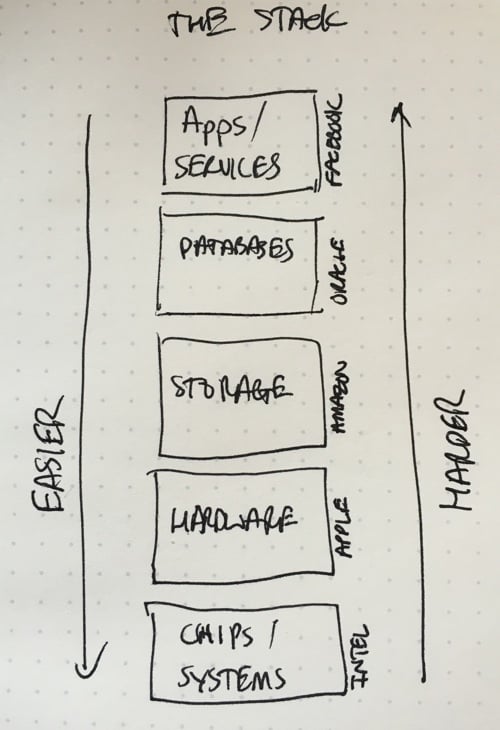
Stack Fallacy

This is obviously an oversimplification and leaves a lot of things out, but it was just a way for me to make sense of the article. That said, it’s this part in particular that stood out for me:

The bottleneck for success often is not knowledge of the tools, but lack of understanding of the customer needs. Database engineers know almost nothing about what supply chain software customers want or need. They can hire for that, but it is not a core competency.

The reason for this is that you are yourself a natural customer of the lower layers. Apple knew what it wanted from an ideal future microprocessor. It did not have the skills necessary to build it, but the customer needs were well understood. Technical skills can be bought/acquired, whereas it is very hard to buy a deep understanding of market needs.

In other words, it’s easier for Apple to take on Intel than it is for Apple to take on Facebook. Likewise, it’s easier for Amazon (AWS) to take on hardware manufacturers than it is for them to take on Salesforce. And the reason for this is that most companies understand the customer needs of the components their core business is built out of, but they don’t understand the customer needs of the businesses that other companies build using their components.

Update: This tweet from Peter Matthaei is a much better summary than the one I came up with:

.@RianVDM If your company uses something, it’s down the stack; anything that companies can build with your stuff is up the stack.

— Peter Matthaei (@mobivangelist) January 20, 2016

It’s an interesting theory, especially if you consider the logical conclusion that apps and services like Facebook and Salesforce (etc.) are at the top of the stack, and everyone not originally in the software business is going to have a really difficult time competing with them. I’d be curious to hear what others think of this…

The handicap of big product teams

Most businesses don’t admit how costly things like company wide announcements, project management, interviewing, internal politics, and large scale collaboration are on productivity. They all work against flow, and should be considered a handicap on product teams. Small teams substitute process with trust, eliminating overhead.

— Kyle Neath, Million Dollar Products

Solve social problems where you live

Courtney Martin’s essay on The Reductive Seduction of Other People’s Problems really got to me. She makes the case that instead of traveling all over the world to solve social problems in other countries, we should focus on the problems at home:

The reductive seduction of other people’s problems is dangerous for the people whose problems you’ve avoided. While thousands of the country’s best and brightest flock to far-flung places to ease unfamiliar suffering and tackle foreign dysfunction, we’ve got plenty of domestic need. […]

I think there is tremendous need and opportunity in the U.S. that goes unaddressed. There’s a social dimension to this: the “likes” one gets for being an international do-gooder might be greater than for, say, working on homelessness in Indianapolis. One seems glamorous, while the other reminds people of what they neglect while walking to work.

Her proposal is worth considering:

There’s a better way. For all of us. Resist the reductive seduction of other people’s problems and, instead, fall in love with the longer-term prospect of staying home and facing systemic complexity head on. Or go if you must, but stay long enough, listen hard enough so that “other people” become real people. But, be warned, they may not seem so easy to “save.”

What they say vs. what they do

If you invest in growth before you have retention, you’re renting users, not acquiring them.

— Gillian Morris in a great post about what users say vs. what they do.

Product/Market fit is not a trap

Thomas Schranz writes in Product / Market Fit is a Trap:

Obsessing about product/market fit is a huge waste of your time. Yes … waste of your time. There … I said it again. […]

As I said above you don’t want to focus on product/market fit. You want to focus on building a great product and on getting it into the hands of your customers.

First, let’s talk about tone. I’m pretty averse to absolute language like “it’s a trap” and “it’s a waste of time.” Things are rarely that dramatic, but I guess nuance doesn’t play very well on the internet. This is also the problem I have with proclaiming that “flat design is evil.” A good designer won’t let an aesthetic trend get in the way of affordance and visual hierarchy. A good designer will work within the constraints of a particular aesthetic to accomplish their (and their users’) goals.

But I digress. On to the substance of the post…

If you read Marc Andreeessen’s entire post on Product/Market fit, you’ll see that Thomas and Marc’s views are not in conflict at all. Marc might use slightly different language, but his definitions of product and market are very similar to what Thomas proposes above (my emphasis added):

The quality of a startup’s product can be defined as how impressive the product is to one customer or user who actually uses it: How easy is the product to use? How feature rich is it? How fast is it? How extensible is it? How polished is it? How many (or rather, how few) bugs does it have?

The size of a startup’s market is the the number, and growth rate, of those customers or users for that product.

Marc is using VC terms, but his meaning is clear: build a great product, try to get more people to use it (or as Thomas puts it elsewhere in his post: focus on product and distribution). It is up to us as product designers and product managers to figure out how to make that happen. Jobs to be Done, Personas etc. are fantastic ways to do that. But those methods are not opposing theories of startup success, as Thomas suggests. They’re a continuation (the how) of Marc’s Product/Market fit framework.

The business of design

Christina Wodtke writes about the intersection of design and business in Why Design Needs Entrepreneurship (and Entrepreneurship Needs Design). This is a particularly nice summary of the three major startup handbooks in high circulation these days:

Steve Blank said you should talk to your customers as you develop your offering. He said there were no answers in the building, you must go out into the world if you want to make something people want.

Eric Reis said you should build small things, test them, learn, then build the next thing until you find successes.

Alex Osterwalder said you should look at all aspects of the business and design them collectively to assure a successful ecosystem. While all three hold a distinctly user-centered design approach, Osterwalder is the first to state it unambiguously, using design tools and innovation games throughout his book and calling them that. It is a designed book, in every sense of the world, and it was written in collaboration with a group of beta readers.

All three, at their hearts, are user-centered designers. They just happen to design business.

This is a great call for designers to care more about the business of design.

Easy with the onboarding

Some interesting perspectives from Dharmesh Shah in Why Your Startup Should Ignore Your Onboarding Experience (For Now):

Great user onboarding makes users say, “WOW, this is awesome,” and recognize that your product is a must have experience. But these WOW moments don’t come easy. And the mechanics by which you onboard users is just a small part of whether or not they fall in love with your product.

The more substantial part of the equation is the value your product delivers to your user: something in their life that must get easier, faster, cheaper, more productive, more fun, etc. because of using your product. Otherwise, why would they switch?

And that’s the difficult part to create. That’s the part that requires customer development and experimentation. It requires you to test your assumptions, to pivot, to try new things.

His recommendation is to do completely manual onboarding at first—contact every new user to find out why they starting using the product, email users who become inactive, etc. It might not scale, but it provides invaluable feedback at the inception of a product. Once you get to about 100 active users, Shah believes you know enough to create a great in-app onboarding experience. Food for thought!

Streaming music and venture capital

Ben Thompson wrote the best analysis of Tidal I’ve seen so far. From Tidal and the Future of Music:

I would again draw an analogy to venture capital: startups can spread via Twitter or new discovery services like Product Hunt; minimum viable products are cheaper to build than ever thanks to Amazon Web Services, Microsoft Azure, etc.; and distribution channels like App Stores have natural promotional channels. And yet the importance – and amount – of venture capital has never been greater.

The truth is that because so many folks can now get started it is that much harder – and more expensive – to cut through the noise. Consumer companies need massive growth for many years, and enterprise companies need expensive sales forces, and the only folks enabling both are venture capitalists.

It’s a great overview of the all the challenges Tidal will have to overcome to beat incumbents like Spotify and Pandora.