Menu

Posts tagged “product strategy”

How to make “product principles” more useful

There’s an interesting discussion going on in the Elezea Community about “Product Principles”. What they are for, when you need them, how they can be made more useful, etc. A couple examples given are Intercom’s set of guidelines for making decisions, Dan Ritz’s interface design values and my own company’s values.

The biggest challenge I see with principles like these is figuring out how to make them specific enough to help us make decisions. The further I get into reading Good Strategy, Bad Strategy the more I realize how much we tend to hide behind nice words, when in most cases those nice words don’t actually change our behavior in any meaningful way. For example:

Bad strategy is not the same thing as no strategy or strategy that fails rather than succeeds. Rather, it is an identifiable way of thinking and writing about strategy that has, unfortunately, been gaining ground. Bad strategy is long on goals and short on policy or action. It assumes that goals are all you need. It puts forward strategic objectives that are incoherent and, sometimes, totally impracticable. It uses high-sounding words and phrases to hide these failings.

I fear that “product principles” are prone to be made up almost exclusively of “fluff”:

Fluff is superficial restatement of the obvious combined with a generous sprinkling of buzzwords. Fluff masquerades as expertise, thought, and analysis. A hallmark of true expertise and insight is making a complex subject understandable. A hallmark of mediocrity and bad strategy is unnecessary complexity—a flurry of fluff masking an absence of substance.

I think product principles, in particular, need to be detailed and specific enough so that they affect day-to-day decision making. This is similar to how we should use Personas (and why so many people hate Personas). If you just put a Persona’s face on a coffee mug, that’s not going to be very useful. But if you’re able to say, “this feature would be useful for a persona that’s not in our target market so we’re not going to build it”, that’s an entirely different story.

Which leads me to wonder if what we call “product principles” should rather just be the combination of a well-defined design system and content strategy. HelpScout’s Style Guide immediately comes to mind as a good example of this. Because what are “Product Principles” for if they don’t help us make product decisions?

Do you have thoughts to add on this topic? Join the community.

The ideal balance between product building and marketing, and other advice from a product founder

My friend and colleague Garrett Dimon wrote about his experiences building and selling a product in his post Hindsight. He gives some advice based on what he learned. You might not agree with everything, but I think his perspective is really interesting and worth checking out. For example, on the balance between building product and doing marketing:

I don’t want to build an operational system to grow a business and then spend no time on the product. I want to design a company to build the product and serve customers. That’s not to say that there shouldn’t be some type of marketing that will need to be done, but I’d rather find ways where marketing is a by-product of the software rather than a separate activity. Checking analytics and numbers eventually becomes relevant for a business, but it’s a spectrum. I want to check the numbers to make sure the business is healthy, but I don’t want to be in a situation where I’m spending days analyzing or optimizing.

Why copying competitor features doesn’t work, and what to do instead

I think most of us know by now that merely copying competitors’ features or business models is a bad idea. Jesse Weaver’s Emulation Is Not a Product Strategy does a very good job of explaining why this approach almost never works, and what to focus on instead. One example:

In focusing their efforts on emulation, product managers stop considering options that could enhance what is unique about the company and its customer base. They miss chances to deliver something powerful and unexpected. Instead, product managers should focus on unique strengths — those things their customers came for in the first place. In doubling down on those, product managers can exponentially increase a product’s value, deepening customers’ connection to the specific magic that makes a product special.

Startups die at the mercy of go-to-market, not at the hands of product.

This interview with former Google and Flipkart product leader Punit Soni covers a lot of ground and is interesting all the way through. His thoughts on the importance of a go-to-market strategy is so important, and a trap many product managers fall into:

When an idea is finally in sight, it may be tempting to jump feet first into product building. According to Soni, founders need to resist the impulse to obsess over product to the exclusion of everything else at the very beginning. “It’s tempting to slip into a ‘build it and they will come’ mentality, especially if you’re convinced of your own product prowess. Now I’m a product manager through and through, but I’ll be the first to tell you that product usually isn’t the issue,” he says.

Instead, tackle go-to-market, working through who’s going to buy, why and what they would pay. “Product is more binary in that, either the tech will allow you to do it or it’s not possible. Making sure that you can build a sustainable business model around that product is a far tougher task,” Soni says. “Figure all of that out before you start a company, not as you go along. Once you check that box, then you can become a product-focused company.”

The product manager’s goal is not to win, but to get the best outcome

In Egoless Innovation Sari Harrison reminds us that ideas are not personal. As product managers our goal should always be to get the best outcome, not to win or be right or for everyone to “just get along”:

When the idea you are advocating for gets challenged, an egoless innovation mindset means choosing to see the challenge as a gift to the innovative outcome which the idea hopes to someday become. It means looking objectively at the input, responding to it authentically, saying “wow, good point, I’m going to take that back to the team” if it was a point you hadn’t considered and saying “yes, we thought of that and…” if you have. It means you don’t get flustered by questions or negative comments because you are focused on achieving the best outcomes, not your own status. If you can embody this, you will be helping move the culture towards more and more innovation occurring with less and less friction. And you will be more successful.

When it’s appropriate to rewrite your software

Herb Caudill’s Lessons from 6 software rewrite stories is an extensive analysis of the rewrite projects of companies like Basecamp and Trello, why they succeeded or failed, and what we can learn from them:

Once you’ve learned enough that there’s a certain distance between the current version of your product and the best version of that product you can imagine, then the right approach is not to replace your software with a new version, but to build something new next to it — without throwing away what you have.

Eventually all product managers face a decision like this, so I found these case studies invaluable.

“Why Not?” is a bad reason to ship a feature

I agree with Chris LoSacco that “Why Not?” is a dangerous questions to ask for any product team:

Often stakeholders assume that if their ideas aren’t bad, they should be on the roadmap. “This isn’t hard; let’s get it in front of the engineers.” But the burden of proof is the other way around — ideas should get turned down unless they clear a high hurdle.

Just because a feature is easy or obvious doesn’t mean you should build it. This is why I prefer the question “Why Now?”:

What is the danger of not doing this project right now? If we don’t solve this problem or add this feature right now, what do we lose? Are sign-ups going to drop? Are we going to lose customers? Are we going to miss a major shift in the market? If so, then, yes, now is a good time to work on it. But if the room suddenly falls silent and everyone comes up short on the downside of skipping over the idea, that’s a pretty good indication that it can wait for later.

What I look for in product management software

I’ve had this vague sense for a while that I need to dig into the product management software space a lot more. So on Friday I just did it — I signed up for a bunch of accounts and started playing around. As I went through each product I realized two things:

  1. I didn’t know what I was looking for.
  2. Most of the products I was looking at didn’t know why they wanted me to use it either. The landing pages are all great, but once I was in the product, it was like a different (and very confusing) world. Which is kind of ironic for a product that’s aimed at product managers.

So I took a step back and asked myself why I’m actually doing this. What are the issues I’m hoping to address with software? What am I looking for?

In short, I am looking for a better way to plan. JIRA is a great execution tool — I don’t want to change that part. But JIRA is a terrible planning tool. And our current process of using Basecamp and Dropbox Paper for planning works just ok for me. The combination lacks a bunch of things to make it as effective as it can be.

I then identified what I would need to feel like our planning and scheduling process is effective and efficient:

  • A visual, lightweight, flexible representation of our product ideas and overall strategy, to help us with prioritization.
  • Prioritization scoring (customer / business impact, effort, etc.). I’d like to try a version of RICE at some point, but it should be flexible enough to use whatever system we want.
  • Incorporating, summarizing, and linking customer feedback from a variety of sources. We currently do this in JIRA, and it’s not a great workflow.
  • A way to go from general idea to product specifics in an orderly and predictable fashion. Right now we use JIRA, Confluence, Dropbox Paper, and Basecamp, and that can get a little confusing.

This gave me the framework I needed to evaluate the different products I was looking at. I’m not done evaluating, but right now productboard is the one that seems to fit our particular culture and goals the best.

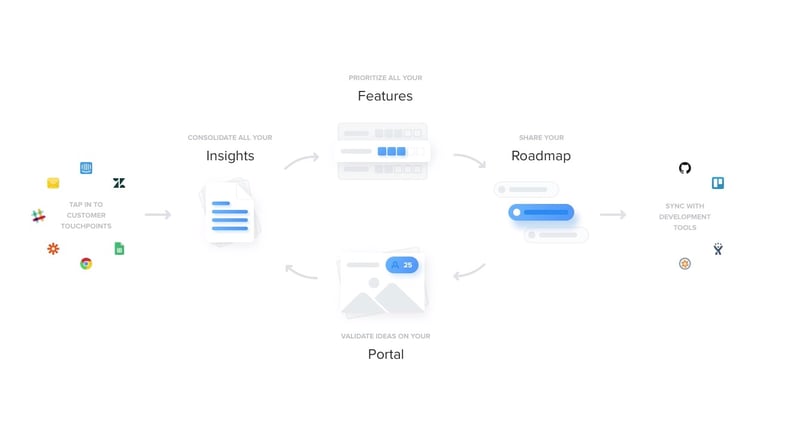
productboard overview

Here are the list of things productboard has going for it:

  • The one thing that makes it stand out from all the others is that it’s a flexible system rather than a process (see the overview diagram above). Instead of forcing a particular software development process, it has no opinion on the specific methodology you use to prioritize and get work done. It’s focused on letting you use your own way to gather customer insights, define business goals, and prioritize work.
  • It will let us gather all user insights together, and prioritize features based on our goals and objectives (or “drivers” in the productboard language).
  • It will let us easily share, communicate, and change the plan without getting too formal about it.
  • If we wanted to, we could have a public-facing portal to get feedback on ideas, like this.

Oh, and their Why productboard? page is pretty solid, especially this phrase:

a way that provides transparency, fosters collaboration, and encourages alignment with the broader product team.

I’m not done evaluating yet, and who knows where we’ll end up. But I thought I’d share my initial thoughts and explorations of this interesting meta-industry.

When it comes to adding new features, slow and steady is usually best

In the article From Four Wheels to Two RJ Marsan talks about the Lyft engineering team’s principles for quickly and safely adding major features to a mobile codebase. It’s full of interesting learnings as they went through the process of adding scooter rentals to the app. Here’s a good point about trying to avoid doing everything in the first release of a new feature:

Every new feature is a chance to start with a clean slate, and it’s often tempting to immediately build for scale. We all want our products to launch to massive fanfare and usage, but more often than not, the path to success for new features is slow and steady. With steady growth in mind, we designed our first architecture to support exactly what’s needed for our first product iteration, and nothing more. For Lyft Scooters, we cut out many features one might expect from a classic ride such as sharing ETA or setting a destination.

Using Opportunity Solution Trees to focus on the product priorities that matter

Prioritize Opportunities, Not Solutions is a really good post by Teresa Torres about using the Opportunity Solution Tree methodology to make sure we place lots of product bets early on in a lifecycle, and only implement the ideas that matter. I also like her distinction between one-way door decisions (“once you’ve walked through the door, you can’t turn around and come back through”) and two-way door decisions:

Your opportunity assessment and prioritization decisions are two-way door decisions. Once you choose a target opportunity, you’ll test whether or not you made the right decisions by prototyping and experimenting with solutions that address those opportunities. If you learn through experimentation that you didn’t choose the best opportunity, you can always walk back up the tree and choose another opportunity.