Menu

Posts tagged “product management”

The Myth of Velocity

Randy Silver in The Myth of Velocity:

When we measure how quickly teams ship stories & code, we’re measuring speed—how quickly they move. It’s only when we measure the effect it has on the target metric—the value that we’re after—that we’re actually looking at velocity.

It doesn’t matter how much you ship if the end result doesn’t deliver value to your customers and your company. If you’re measuring story points, you’ve fallen into the trap of measuring outputs, not outcomes. When we talk about slowing down to speed up, this is the point: the only thing that matters in this equation is how quickly we can deliver actual value. Everything else is theater.

You can't stand under my umbrella

In You can’t stand under my umbrella the Raw Signal team makes the case for when it’s not appropriate for managers to be “sh*t umbrellas” for their teams:

When things are steady, and people know the right things to work on, teams are constrained by velocity. We know the course we’re racing, the question is just how fast we can go. In that context, it makes sense for a manager to clear every obstacle out of our way. But during times of significant change, teams are constrained by agility. It’s not that velocity doesn’t matter, it still does. But when everything has changed about the race, we need the ability to steer. A manager who tries to preserve velocity at all costs risks running us into a wall.

They go on to talk about how to Accept, Adapt, and Act in such moments of significant change.

Technical debt, product debt, and how to prioritize addressing it

Mike Fisher argues that we should rebrand technical debt as “product debt”, and I think it’s a good argument! That said, I’d like to add some considerations to two of his points. First:

We usually think of refactoring as “cleaning up” code, where we change the code to be more easily understood, perform better (faster or more efficiently), or follow current conventions/standards. The goal of refactoring is to change the code without changing its functionality; it should continue to pass all unit and functional tests. 

I take a slightly different approach to refactoring, and how to prioritize the work. I believe it’s important for teams to have a stated and agreed-upon value of “leave the code better than I found it.” This means that refactoring shouldn’t be a separate activity, for its own sake, that needs to be scheduled. It should be a natural part of feature development.

If you’re creating a mechanism for add-ons on the product, spend a few extra days to refactor the billing code you’re already working on. If you are adding metrics to the dashboard in your UI, take the time needed to refactor the front-end code to make it more performant. Whatever code you’re touching while you’re working on a project, leave it better than you found it. It is way more efficient to extend a project by a week to refactor code you’re already working on than it is to create a separate project that needs to be planned, prioritized, and worked into the roadmap.

Second point:

So, how do we ensure we are paying down technical debt when there is so much pressure to ignore it until things really break? I think one part of the answer is to use a different term. Instead of tech debt, which implies it is the responsibility of the tech team, let’s call it product debt.

I think this is a good first step to getting more teams to care about technical debt—but it’s not enough. One of the issues with getting technical/product debt prioritized is that often “the business” doesn’t see the value in statements like “we’re going to clean up the code so that it doesn’t break a few months from now”. Instead, we need to frame the work in terms of the benefits to customers and/or the business.

For instance, we could make the case that refactoring this piece of code would significantly increase our deployment speed, which would mean faster time to market. Or we could argue that fixing our slow staging environments would result in happier, more productive engineering teams.

With technical debt—as with most things in software development—the thing you do is never the main thing. The main thing is what the thing you do enables. What value it brings to customers and the business. That’s the framing we need for working on technical debt.

The Cynical PM Framework, a business-first approach to product

Frank Tisellano in The Cynical PM Framework, a business-first approach to product:

Every product, every feature even, serves a function in your business. It has one of three jobs:

  • Acquire new users or customers
  • Retain those users or customers
  • Expand engagement or revenue per user or customer

Move past incident response to reliability

Here’s an interesting article by Will Larson with advice on how to move past incident response to reliability in our products. Among other things it reminded me to watch out for “incident legalism”:

Incident legalism is when an incident response and analysis program—trying to better drive reliability improvements—becomes focused on compliance and loses empathy for the engineers and teams operating within the program’s processes.

He goes on to propose a more holistic, expanded model for reliability to help teams diagnose their systemic problems—and how to solve them:

Finally, you study the mitigated incidents, determining how to prevent them from recurring, and they become remediated incidents.

Principles for building software for developers

Kathy Korevec started a series about her principles for building software/tools for developers. Since I work on Postmark—one such tool—I read the intro post with great interest. The second installment is on the principle she calls You are a chef cooking for chefs:

Developers are masters of building applications, so when you’re building tools and experiences for them, you’re cooking in their kitchen. You can marvel at the delight you bring to the experience because no one can appreciate your hard work more than another developer. Developers can spot inconsistencies, antipatterns, and hurdles a mile away, so you must pay close attention to these details. At the same time, they know the challenges, understand the concerns, appreciate the details, and can provide crucial feedback to make your product even better.

This is one of the main reasons why I love working on developer tools. It’s an audience that can be brutal critics. But for the most part they do that because they care and want to see the product succeed—not because they want to fight just for the sake of it. And because they care, feedback generally have a degree of specificity that is invaluable for troubleshooting, use case discovery, and improving the product.

Anyway, this looks like a fantastic series and I can’t wait to read the rest. You can sign up for Kathy’s newsletter here.

Advice For Engineers, From A Manager

Marco Rogers has been an engineer and manager of engineers for 20 years. In this post he shares some short, practical (but not always easy to follow!) advice for engineers. A few of my favorites:

  • Learn what the true scope of the project needs to be. Back away from “story points” and understand what the project needs to accomplish. More context about the goals will help you negotiate what’s in and what’s out of scope.
  • Collaborate on designs. Designs never have the level of detail that matters. When you run into UX problems, work with people to develop a solution. Don’t just ask for more mocks. Own the details of what you’re building.
  • Don’t just write code. Solve problems. Make sure you understand the value of your work and you talk to people about that. Not just “features”. For example, “this needs to ship by Fall because it’s our big strategic bet for the year.” Tell people how to achieve the strategic goal.

Read the rest of his post for the others.

Don’t delete your old backlog

There’s a sentiment I started to see in the agile development world that advocates for deleting old/stale items off a backlog completely. A good recent example is Jason Knight’s latest newsletter:

The backlog becomes a dumping ground for every single customer support query. Every account manager and every salesperson has something in there from conversations with customers and prospects. […]

It’s tempting to see “length of time in backlog” as some kind of vector for prioritisation, but it really isn’t. It’s quite the inverse, in fact. So let’s all try to get comfortable, embrace the idea of getting rid of old stuff in our backlogs, and give people a “no” rather than a “one day”.

I’m not trying to pick on Jason—his work is great and it’s another very good edition of his newsletter! I am just using it as an example that got me thinking about this a bit more deeply.

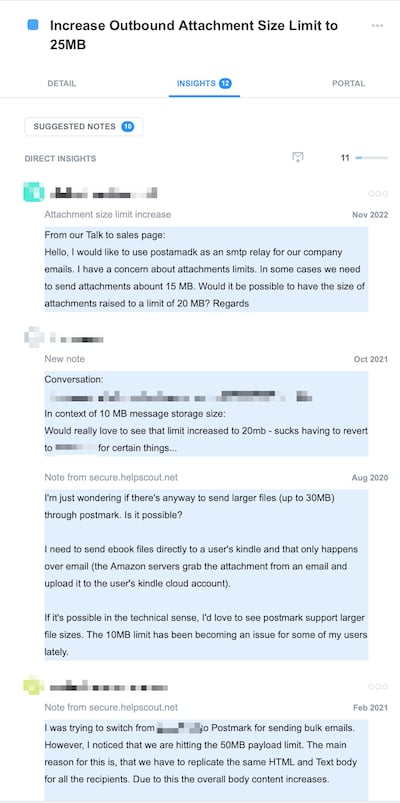
My take is that we should absolutely keep all customer feedback around in our backlogs, because that is continuous discovery data that would be a shame to lose. Instead, my proposal would be to normalize the backlog as a place to build organizational memory and a customer feedback knowledge base—not as a list of things that all have to get done.

Two tactics can help with this approach. First, a Now/Next/Later roadmap keeps the focus on the list of current priorities. The entire backlog doesn’t go into the “Later” column—only things that are currently prioritized to start within the next few months.

Second, have a standard process that the entire company (especially the customer success team) can use to collect user feedback and attach it to features. In our case that’s Productboard, and our success team can easily add and process customer feedback via a browser extension.

I guess our list of features in Productboard is technically our “backlog”, but it doesn’t cause us stress in terms of feeling like we need to work on everything that’s on there. However, as part of our planning cycle we can go through this list and figure out if anything is important enough to pull into the “Later” column of our roadmap. An added bonus: if/when we start to work on any of those features we have access to lots of customer data about each feature, and we can reach out to those customers to have more in-depth conversations with them about their needs.

So instead of deleting old issues off our backlogs, let’s rather remove the pressure and stigma around what backlogs are for (maybe we should rename it to “customer needs knowledge base”?). And then let’s use our actual roadmaps for the list of things we know we’re going to work on.

How New Managers Fail Individual Contributors

In the post How New Managers Fail Individual Contributors Camille Fournier makes a great point about the split between “managerial” and “technical” career tracks:

Most people become managers right at the point where career tracks split between “technical” and “management” specializations. The result is that many new managers have most recently been very technical, yet they have no idea what it means to climb the technical track, but they will be managing people who want to follow that path. To be a great manager, you can’t afford to let the ICs on your team feel that they have no career path, so it’s up to you to manage this well.

She goes on to to list five pitfalls that new managers should work to avoid in order to set their direct reports up for success.

Human systems and the stuff they make

There’s so much goodness in Mandy Brown’s latest management post Made It, but it’s this paragraph that gets to the heart of it:

This is one of the ways that the adage about “maker time” versus “manager time” does harm. Setting aside the fact that it’s not even coherent—managers make decisions and plans and systems and visions all day long!—it also serves this notion that the stuff is what matters and the humans are just an unruly mess that gets in the way of the stuff. This is a self-defeating story, inasmuch as you don’t get good stuff without a system that takes care of the humans.

I have been thinking about human systems a great deal over the past few weeks. It started when I read Donella Meadows’s Dancing With Systems. When I applied that lens to my own work it was impossible not to see it in absolutely everything we do. Take this quote, for instance:

Don’t maximize parts of systems or subsystems while ignoring the whole. As Kenneth Boulding once said, Don’t go to great trouble to optimize something that never should be done at all. Aim to enhance total systems properties, such as creativity, stability, diversity, resilience, and sustainability–whether they are easily measured or not.

There are so many implications of this principle for the way we make software today. Here are a couple I’ve been thinking about in particular.

Quality

When we have quality issues in our product it’s tempting to try to solve those issues with process and overhead. Common ways to do that include instituting additional approval gates before code can be deployed to production environments, or adding “QA periods” where the entire organization is asked to test a feature before it goes live.

These solutions optimize for parts of the system—such as deployments or manual testing—while ignoring the system that is responsible for introducing quality issues into the product in the first place. To quote Deming:

Inspection does not improve the quality, nor guarantee quality. Inspection is too late. The quality, good or bad, is already in the product. As Harold F. Dodge said, “You can not inspect quality into a product.”

We have to look at the system as a whole. What kind of automated test coverage do we have? What bottlenecks exist in our CI/CD pipelines? What level of responsibility do we ask of engineers to be stewards of their own code? Do teams have enough time to make sure that quality is built in from the start and not an afterthought? These are the total systems properties questions that have to be addressed in order to fix quality issues.

Team stability

One of the bigger leadership mistakes we make is to think that the humans that make up a social system are interchangeable and can be moved around at will without impacting the system as a whole. You see this especially in engineering teams where “resources” are constantly moved from one project to another—usually to speed something up that is perceived to be behind schedule. But we forget that it is the human system that produces the stuff, not the individuals.

Similar to the discussion about quality, if we perceive a project to be off track we need to understand how the project came to be off track, and then find ways to improve the system to correct that. Did we place unrealistic deadlines on the team without getting their input? Are we asking teams to build features that have not been validated with customers? Do teams have adequate autonomy and ownership over the way they prioritize their work? Do teams have the business context they need to make the best possible decisions?

If we instead go for the shortcut of moving people around, we will never get to the heart of the matter. Inserting additional humans into a system can inadvertently break it—and worse, moving folks from one project to another leaves a gap that is very likely to destabilize the project that they were working on before. Suddenly Customer Success doesn’t have an Engineer to talk to about documentation, or the Marketing Team doesn’t have anyone to fix an issue with a piece of demo software.

Once again, Donella Meadows says this well:

Before you disturb the system in any way, watch how it behaves. If it’s a piece of music or a whitewater rapid or a fluctuation in a commodity price, study its beat. If it’s a social system, watch it work. Learn its history. Ask people who’ve been around a long time to tell you what has happened.

Stable teams that work together for an extended period of time all have a steady beat, and we shouldn’t make changes to the system until we know exactly how that beat works. Here’s Donella again: “Before you charge in to make things better, pay attention to the value of what’s already there.”

And that’s how all this connects to Mandy’s piece that I linked to at the beginning. If we want the stuff to be good, we have to pay attention to the beat of the system of humans that make up an organization. We have to understand how they work, and we have to ask them how they want to work. We have to listen to the people who are beating the drums.

It may sound a little counter-intuitive, but if we optimize for the humans who make up a system, the good stuff will follow.

Discuss this post on Mastodon