Menu

Posts tagged “product discovery”

Products as donkey tails

I like this mental image of the “product in search of a solution” phenomenon we see so much of of these days:

Your organization invents something no one else does. The rest of the process goes like this: I have this tail. I put it on the donkey. I spend money testing and fixing the tail to get it closer to what the donkey wants it to do. I also spend money on marketing and sales people to convince the donkey I have what it needs.

There is, of course, a better way.

The value of Design Research

Jan Chipchase is writing a series on Design research in big corporations. In Part 2: A Backgrounder for Corporate Design Research he succinctly captures the benefits that Design research methodologies have over traditional Market Research methods:

The basic premise of design research is that spending time in the contexts where people do the things that they do can inform and inspire the design process with a nuanced understanding of what drives people’s behavior ”” which can then be used as a foundation for understanding and exploring the opportunities for new products and services.

I don’t think you can overstate the value that in-person, observational research brings to product design.

Don't believe the rumors: User Experience Design is alive and well

I’ve never seen an industry as intent on un-defining itself as the field of User Experience Design. There’s a long list of articles proclaiming the death of this term that most us identify with at the moment. Just in the last few weeks we saw articles like User Experience Design is Dead; Long Live User Experience and Can We Drop the Term UX Design Already?.

I understand and appreciate the arguments these designers and writers are trying to make, but as someone who teaches introductory courses on User Experience Design, this plead to call ourselves something else (or nothing at all) is problematic. To people new to the industry, the term User Experience Design makes sense once the basic elements are explained to them. Even with all the arguments against it, many of us don’t have the luxury to wait around until we come up with a better way to describe what we do. So I’m going to go the other way and do something decidedly uncool: I’m going to spend time defining User Experience Design.

This short post is my simplified definition of User Experience Design, meant as an introduction to those who come to it from other areas of expertise. It’s not exhaustive by any means, but I find it useful in getting people into the flow of what we do, and interested to learn more. That said, I’d love to hear from you if you think I’m missing something, so please send me a tweet or an email if you have something to add - or, of course, write a response on your own site so we can all share in the discussion.

So, here we go.

User Experience Design, defined

User Experience Designers solve problems by uncovering user needs and helping to create products that meet those needs. If you break it down to its most basic level, Design is a set of decisions about a product.

The diagram below shows the primary elements that make up the process of User Experience Design.
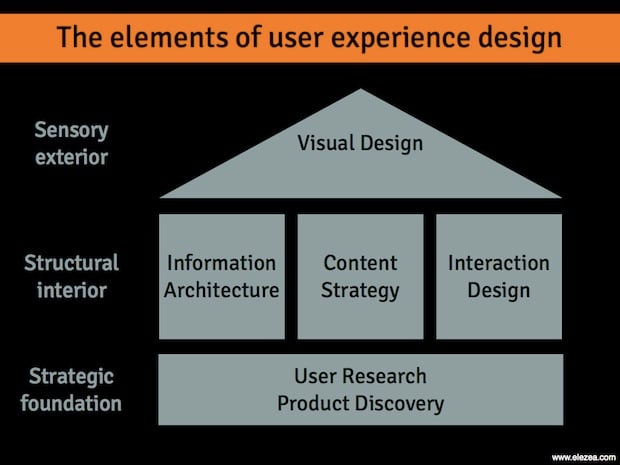
The elements of User Experience Design

Strategic foundation

To provide a solid strategic foundation, User Research is a set of methodologies focused on users’ interaction with a product. Through mainly observational, task-based techniques, user needs and usability issues with a product or idea are uncovered.

Product Discovery uses the learnings from User Research, among other things, to ensure the right product is being built for the right users. By framing the problem, exploring multiple solutions, and then prioritizing and planning for the implementation of the best solutions, Product Discovery lays down the guiding principles for the product that is being built.

Structural interior

The inner workings of a product usually has three main components.

Information Architecture maps out the paths between the different pieces of information on a site. We usually associate Information Architecture with site navigation, but below the surface there are activities such as information organization, information relationship building, and customer journey mapping that form the backbone of a usable product.

Content Strategy plans for the creation, delivery, and governance of content. This doesn’t mean that we should always have content ready before we design, but we should at least know how the content will be structured. If done right, this usually includes a non-dickish SEO strategy.

Interaction Design defines the structure and behaviors of interactive products and services, and user interactions with those products and services. The outputs of Interaction Design are artifacts like flow diagrams, wireframes, and prototypes. Interaction Design is mostly concerned with layout, structure, and flow; not typography, colors, and aesthetics.

Sensory Exterior

Once the structure and flow of the product has been defined (and even while that’s still happening), we get to work on the part that most people associate with the word “Design”.

Visual Design is the art and profession of selecting and arranging visual elements — such as typography, images, symbols, and colors — to convey a message to an audience. The goals of visual design are to set the visual hierarchy of a page or flow, and elicit appropriate emotional responses about the product.

The Complexity at the Other Side

Once we understand the basic concepts of User Experience Design, the journey can start. True User Experience is more than the sum of these parts. It’s a “seamless merging of the services of multiple disciplines, including engineering, marketing, graphical and industrial design, and interface design” (from the NN Group definition) to provide efficient and enjoyable experiences to users. This takes time, continuous practice, and an understanding that we’ll never know everything there is to know about Design. But keeping these basic elements in mind ensures that we never think of Design as just eye-candy, or something we tack on to the end of a development process. Without these building blocks, the house collapses.
Where have all the Information Architects gone?

Lis Hubert wrote a thought-provoking piece for UX Magazine called The De-Evolution of UX Design. The link-bait title put me off a bit, but I’m glad I stuck with it. It’s a well-written article that you won’t be ambivalent about - you’ll either agree strongly, or disagree strongly. In essence, Hubert laments the decline of the Information Architecture function in UX:

It’s been seven years since I took that first step into IA, and, sadly, it seems that the practice of understanding and prioritizing information before designing the interface has been abandoned. And because of that, we are facing a huge problem in the world of UX, which is, simply put, that we are devolving.

She goes over the problems of skipping the IA phase, and then offers some solutions. Her point is in line with the thoughts I shared in my World IA Day talk called A lack of UX purpose (and what we can do about it):

It seems that ther’s unfortunately plenty of UX work out there that jumps straight into wireframes without first understanding the design problem, as well as the purpose of the solution. Purpose ”“ the reason for which something is done or created ”“ often appears to be missing. And this is where I believe Information Architecture can come to the rescue.

So, needless to say, I’m in the strongly agree camp on Hubert’s article. But maybe you won’t be, so definitely give it a read.

How to build products that have clear user benefits: begin at the end

Jake Knapp writes that you can build better products by designing the marketing first:

Okay, let’s pretend I grab you and stuff you in a DeLorean. We time travel a few weeks into the future. Your latest project has just been released.

Imagine you can see the launch page. It has a nice simple headline explaining the appeal of your product, with a couple of secondary call-outs. You print the screen, hop back in the DeLorean, and return to the present.

With this glimpse of the future in hand, your team will be better at focusing on the core of the product. If it’s on the launch page, double down! If it isn’t, think hard before spending any time on it.

That reminds me of a similar technique used by Amazon called “working backwards”. It’s outlined in this Quora thread:

For new initiatives a product manager typically starts by writing an internal press release announcing the finished product. The target audience for the press release is the new/updated product’s customers, which can be retail customers or internal users of a tool or technology. Internal press releases are centered around the customer problem, how current solutions (internal or external) fail, and how the new product will blow away existing solutions.

Once the project moves into development, the press release can be used as a touchstone; a guiding light. The product team can ask themselves, “Are we building what is in the press release?” If they find they’re spending time building things that aren’t in the press release (overbuilding), they need to ask themselves why.

These are both great techniques to prevent scope creep and ensure that you’re building products that have clear user benefits.

World IA Day: A lack of UX purpose (and what we can do about it)

I flew up to Joburg this weekend to speak at one of the World IA Day events that were happening in 14 cities around the world. The bulk of the talk was about Customer Journey Maps, and specifically how we used the technique to help us prioritize our roadmap at kalahari.com. In this summary post I want to focus primarily on the topic I started the talk with. It’s about a particular gap I see in current UX work, and how Information Architecture is uniquely positioned to bridge this gap.

In 1955 David Ogilvey wrote a letter about his copywriting habits, and among other things, said the following about campaign work:

I write out a definition of the problem and a statement of the purpose which I wish the campaign to achieve. Then I go no further until the statement and its principles have been accepted by the client.

It seems that ther’s unfortunately plenty of UX work out there that jumps straight into wireframes without first understanding the design problem, as well as the purpose of the solution. Purpose - the reason for which something is done or created - often appears to be missing (*cough* Color.com *cough*). And this is where I believe Information Architecture can come to the rescue.

There are plenty of definitions of IA to choose from, but I like this one in particular by Peter Morville:

I’m an information architect. I map paths and places across physical, digital, and cognitive spaces. #ias10 #iasw

”” Peter Morville (@morville) April 15, 2010

I like it because it brings into focus the idea that at its core, Information Architecture is about a unique way of seeing the world. A way that is essential to build successful user experiences.

I love the example Dan Klyn’s uses in Information Architecture is a Way of Seeing. You have to read the whole thing to appreciate it fully, but in short, he tells a story about having to deal with some pretty severe back pain recently. After visiting an MD who only gave him a prescription for Vicodin and some exercises that didn’t help at all, he ended up at a Chiropractor who was able to sort out the problem in just a few days (after taking an X-ray to help diagnose the problem). When asked why the MD didn’t originally take an X-ray to get to the root of the problem, the Chiropractor replied that it wouldn’t have mattered if she did:

Even if the MD had taken an X-Ray, she would not have seen what I saw. Show us each the same image and we see different stuff.

It’s this different way of seeing that makes the IA profession so crucial right now. IAs specialize in looking at a vast amount of information and making sense of it in a way that is credible, consumable, and relevant to users (and the business). Where most of us only see Navigation, they know that part is just the tip of the iceberg. Underneath it lie activities like Information organization, Information relationships, and IA research that all work together to give IAs their unique view of the world.

Within this large toolset that IAs have to choose from to do their work, Customer Journey Maps stand out as the one technique that can be most effective to bring purpose back to our UX work. As UX Matters defines it:

Customer journey maps are documents that visually illustrate an individual customer’s needs, the series of interactions that are necessary to fulfill those needs, and the resulting emotional states a customer experiences throughout the process.

These maps are important as a way to find UX purpose because it accomplishes the following goals:

  • It provides a common understanding within an organization about customer needs, product strategy, and business goals - i.e., the product’s reason to exist.
  • It’s an excellent product prioritization tool.
  • It’s a guiding light for design, always bringing the project and the process back to the customer journey and the purpose of the product.

There are many different ways to approach these maps, but I find the Adaptive Path way the most effective. It places a strong focus on user research, and forces you to think about the implications of the journey map, and how it can integrate with and guide the design process.

So, that was my story at the conference. Thanks to everyone who came out! Here are the slides from my talk:

Good design practice: agree on the problem before tackling the solution

In 1955 David Ogilvy wrote a fascinating letter about his habits as a copywriter. One of his points jumped out at me:

I write out a definition of the problem and a statement of the purpose which I wish the campaign to achieve. Then I go no further until the statement and its principles have been accepted by the client.

This is applicable to design projects as well. If clients (internal or external) ask us for some quick wireframes, it is our responsibility as user experience designers to push back and make sure everyone agrees on the problem and the goals of the project first - before the design cycle starts. It sounds so obvious, but I see people falling into this trap all the time.

The product discovery process can take months, weeks, or even a few hours if there are tight deadlines. But it cannot take zero hours - that’s a recipe for disaster.

Google Circles and Path 2.0: How good UI design cannot fix a broken solution

When Google+ first came out there was plenty of praise for its UI design[1], particularly the “un-Google like” design of the Circles feature. Oliver Reichenstein wrote:

Every interaction seems to have been thought through and designed until its last little bits (and those matter as much as the big bits). It even has room for some warmth (like the circle rolling away when you delete it) which is rare for Google’s cold UID approach.

We’re seeing the same thing with last week’s release of Path 2.0. I agree with the entire Internet on this: the design is gorgeous with lots of small delightful details. Here’s Geoff Teehan in Going down the right Path:

It feels familiar, but they’ve made some smart decisions that break away from the norm without wandering off into obtuse interactions or under/over-designed visuals. The decisions they’ve made not only make things better, they add personality and delight ”“ something that is crucial, and often overlooked when designing something functional.

Here’s the thing. Google Circles aims to solve a real problem with social networks, but the solution is tedious. Path has a beautiful interface, but I can’t figure out what user need it’s trying to solve. And those issues are problematic if you want to get to product/market fit.

Google Circles

There are inherent problems with binary social networks. The idea that someone is either full-on in your life (and therefore has access to everything about you) or not at all is not how it works offline. You tend to share certain information only with certain groups of people. Only some people will be interested in photos of your new puppy, whereas those same people will probably not be interested in blog posts about your work.

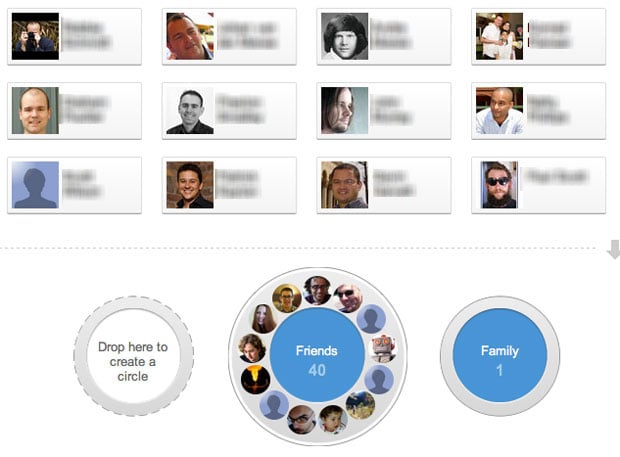
Google Circles aims to solve these problems by allowing you to drag and drop people into distinct buckets, and letting you only share what you want with each circle. And yes, the UI makes it really easy to do this. It’s great design.

google circles

The problem is that it’s just too much work. I’ve long since given up trying to maintain my Circles, and I’m pretty sure I’m not alone. Circles also lost its core utility for me. After I put about 100 people into different buckets I couldn’t remember who I put where, and what I was supposed to share with which Circle. So I just gave up and started sharing everything publicly.

It doesn’t matter how great and fun an experience is, good UI design cannot fix a broken solution.

Path 2.0

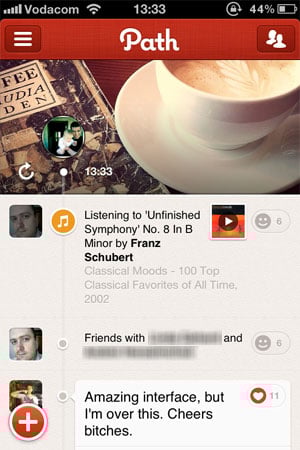
I get the same feeling when I play around with Path. Let me be clear: I love this app. I wish I could dump Facebook and use Path all the time. Sometimes I go in and scroll up and down just to see the clock animation. When I open the app in the morning I tell it that I’m awake just so I can see what the weather is going to be like today. Fantastic design.

path user interface

There’s a problem, though. I don’t know what I’m supposed to be doing with this app. Yes, I know it’s still early and not a lot of people are on the network yet (even though it’s now starting to gain some real traction). But here’s one reason the app might not have enough staying power to grow out of its initial “Hey, that’s cool!” phase: what unmet user need does it solve? Is it doing anything that’s not already being addressed by a number of general and niche social networks? I don’t think so.

Once again: it doesn’t matter how great and fun an experience is, good UI design cannot fix a broken solution. Good design can effectively differentiate a good solution, and bad design can completely ruin a good solution. But good design simply cannot make up for a solution that doesn’t address a core user need really well. As a recent post on ZURBlog proclaimed, people don’t buy products - they buy the benefit.

I’m afraid that in the case of both Google Circles and Path 2.0, they might just be flawed solutions wrapped in a layer of beautiful UI design. It’s fun to play with for a while, but when it inevitably becomes tedious you eventually just forget to use it. Forever.


  1. When I talk about UI design in the context of this article, I mean specifically Interaction Design and Visual Design. I don’t mean to imply that Design = Making Things Pretty, or that UX is only about those elements. I use this term in the interest of simplicity since this is not an article about the elements of a User-Centered Design process. ↩

Update: Luke Bornheimer pointed me to his answer on Quora where he argues that Path’s biggest differentiator is how it easily enables private/public sharing.

Designing for permanence

Jennifer Fraser brings up an interesting point in What I Bring to UX From ”¦ Architecture:

As an architect, the implicit permanence of designing a building carries with it a sense of responsibility”¦ I can’t help but wonder if we would have better designed products if some of that responsibility and sense of permanence of architecture found its way into what we do as user experience designers.

We live in an environment where most web design is seen as variable. With A/B testing, Minimum Viable Products, and the prevalence of Content Management Systems, nothing is set in stone. If something doesn’t work, we change it immediately - and see the results of those changes immediately as well. This is a very good thing; optimizing user experiences is, after all, what we do.

But I do wonder what would happen if we felt the weight of responsibility a little more when we’re designing. What if we go into a project as if the design we come up with might be around for 100 years or more? Would we make it fit into the web environment better, give it a timeless aesthetic, and spend more time considering the consequences of our design decisions?

The role of UX in the future of products and services

Kyle Baxter in The Age of Insight, responding to a fantastic essay by Seth Godin called The forever recession (and the coming revolution):

We have to think about completely disparate fields””say, manufacturing, software development, design, and psychology””and combine them to make products that conform themselves to humans, rather than making humans contort themselves to the product in order to use it. We must think about big ideas””ideas that will change society and how people interact””and the little ideas that merely improve peopl’s lives just a little.

We have to think. This is an age where all of our gains will come from insights into what make products, services, processes, and structures fundamentally better for us. Whereas the twentieth century was about standardization and following a series of steps in a well-defined process, in this new century, there are no defined processes. Everything is to be questioned, re-thought, re-made, or even thrown out altogether.

I completely agree with Kyle’s view that we’re shifting from a world where users have to conform to products and services, to a world where those products and services go extinct quickly unless they conform to the needs of users. I further believe that the field of user experience design needs to be a central player in this shift. The theory, psychology, tools, techniques, and practice of user experience align perfectly with the type of thinking that’s needed to make things that work better for us.

One of the biggest issues holding us back from taking a leadership role in this space is the term itself: user experience design. There is so much not to like about it. “User” has a sterile, detached, almost robotic feel. “Experience” can mean absolutely anything, and opposition to the word is growing (and not just from Merlin Mann). And then there is “Design”, a word everyone wants to own - and despite some fantastic definitions out there, no one can completely agree on what it is.

But for better or worse, this is the term we’re stuck with. So we have a predicament. The UX community is fighting over semantics and who should be allowed to call themselves a UX designer. If we could just step out of that for a while and think about the larger implications we’d be able to see how perfectly positioned we are to drive this fundamental shift to better products and services.

We borrow from social sciences to bring ethnography to design so we can uncover needs by observing users in their natural environments. We borrow from psychology to design experiences that follow the principles of visual perception and emotion. We build on a very long tradition of graphic design. We use design thinking, product discovery, and all the tools and techniques that go along with that to come up with appropriate solutions to problems. The list goes on and on.

My wish is that, as a user experience community, we would move beyond the argument over what to call ourselves.  And that we would move beyond our focus on web design and take ownership of our ability to bring our skills to physical products as well as “services, process, and structures” (in Kyle’s words). Let’s be a big part of the coming revolution.