Menu

Posts tagged “marketing”

Marketing in a post-marketing world: make better products

Andrew Chen wrote a very interesting piece called The Law of Sh-tty Clickthroughs. I recommend you read the whole thing before continuing here. Chen goes into great detail to explain just how ineffective banner ads and other marketing methods have become, and he gives some very astute reasons for why it’s happening:

Customers respond to novelty, which inevitably fades.

First-to-market never lasts.

More scale means less qualified customers.

In short, I loved the article. All the way to the last section. Here is Chen’s proposed solution to the problem:

The real solution: Discover the next untapped marketing channel

The 10X solution to solving the Law of Sh-tty Clickthroughs, even momentarily, is to discover the next untapped marketing channel. In addition to doubling down on traditional forms of online advertising like banners, search, and email, it’s important to work hard to get to the next marketing channel while it’s uncontested.

This is certainly a solution to the problem, but I think there’s a better one: Make an excellent product, and then support the crap out of it. I guess I’m suggesting that we’re entering a post-marketing world where people don’t care about how companies tell them they should feel. In response, we need to shift our focus away from traditional channels to focus on what’s really important: the thing we’re making.

Instapaper is famous for doing no marketing, and yet it’s an enormously successful app. The popularity of Sparrow seems largely due to unsolicited reviews and good word of mouth. Amazon.com has become the de facto place to get user reviews and do price comparison shopping - I’d argue that keeps them top-of-mind more than traditional marketing does.

The lasting benefits of “Word of Mouth” have long been acknowledged, but recently that worthy goal has been derailed by a frantic quest for the short-term benefits of “going viral”. The term “viral marketing” is presumably used without realizing the irony that viruses”¦ you know”¦ kill people.

So I’m not saying that you should try to make a video that millions of people watch on YouTube. I’m saying that there is indeed a formula for effective marketing, and it relies on an unending supply of good will from customers. The formula is quite simple, but unfortunately there are no shortcuts. It looks like this: make great products, sell it to people, support it well, and be patient.

And here’s the beauty of this strategy. This “marketing” method isn’t susceptible to all the issues that give traditional marketing channels such a short shelf-life of effectiveness:

  • The novelty of a good product that keeps getting better doesn’t fade.
  • There is no first-to-market messaging advantage to lose, because your focus is on the product, not the message.
  • And finally, more scale means more and more people to talk about your product.

The other benefit? If the product fails, it will fail for the right reason: it’s just not good enough. Which gives you more time to focus on the next product that will be good enough.

Online influence: relevance trumps number of followers

Jared Keller summarizes the results of a new study on online influence in What Fuels the Most Influential Tweets?:

According to co-author Vespignani, having millions of followers does not denote an important message. Rather, the messages with the most immediate relevance tend to have a higher probability of resonating within a certain network than others. Think of it as “survival of the fittest” for information: those tweets that capture the most attention, whether related to a major geopolitical or news event or a particular interest, are likely to persist longer.

This isn’t exactly earth-shattering news, but it’s an interesting study nonetheless (you can find the original research paper here). It shows that online influence is not so much about the number of followers you have, but the relevance the message has to existing current events. So it’s not really about guiding conversations, but about being good at joining whatever conversations are already taking place.

Eyeballs vs. Readers

From Game of Thrones: How HBO and Showtime make money despite low ratings:

On the networks and basic cable, shows are a delivery vehicle for advertising””and if a program doesn’t attract a big enough audience for those ads, the consequences are clear: It’s pulled from the schedule, and a new show is dropped into the time slot. On those channels, viewer is just another word for person who sees a commercial.

This is contrasted with the subscription model that premium channels like HBO and Showtime use:

The premium networks are in the business of selling subscriptions. A Showtime spokeswoman told me that the channel’s goal is to satisfy subscribers and to entice non-subscribers to sign up. They keep their customers happy by allowing them to watch original TV series, exclusive movies, and sports programming whenever they want to.

I’m pretty sure you know where I’m going with this, but the situation is analogous to what we see in online publishing today. Ad-supported sites aim to rack up all the “eyeballs” in the world so that they can be resold to advertisers. Subscription-based sites aim to satisfy their readers by providing great content that will, in turn, entice more non-subscribers to sign up.

The exhaust of our digital lives

Frank Chimero provides another eloquent take on frictionless sharing (automated posts in news feeds, like what song you’re listening to on Spotify):

The less engaged I become with social media, the more it begins to feel like huffing the exhaust of other peopl’s digital lives. It’s a bit of a weird situation: all that’s needed is a simple filter to prioritize manually posted content over automated messages.

He doesn’t explicitly say this, but the point in his post is clear. Automated content shows up in your stream not because it adds value to the network, but because it’s good Marketing ROI for brands.

The New York Times non-apology, and the end of lazy marketing language

Yesterday I received an email from the New York Times in which they told me, “Our records indicate that you recently requested to cancel your home delivery subscription.” They proceeded to use a phrase that bears an uncanny resemblance to something I told a girlfriend who dumped me when I was 15: “We do hope you’ll reconsider.”

Here’s the problem: I canceled my subscription 3 years ago. No big deal though, mistakes like this happen all the time. I hit the Archive button and forgot about it. But this morning I woke up to another email from the Times, this one with the subject line “CORRECTION: Important information regarding your subscription.” One of the paragraphs read as follows:

This e-mail was sent by us in error. Please disregard the message. We apologize for any confusion this may have caused.

I find passive voice non-apologies like this frustrating and insulting - worse than the original mistake, because it somehow manages to avoid taking responsibility for what happened. And it looks like I can finally move on from the idea that I’m the only one who feels this way. Here’s Clinton Forry:

“This e-mail was sent by us in error.” -New York Times email. I’ll just sit here and wait for an apology for that use of passive voice.

”” Clinton Forry (@wd45) December 28, 2011

And John Holdun:

JUST ONCE I’d like a big company to omit their “We apologize for any inconvenience this may have caused” in favor of a “Sorry.” ”” John Holdun (@johnholdun) December 28, 2011

In Subscribing to The New York Times, a post about the paper’s subscription pricing, Khoi Vinh alludes to a recurring pattern in their email communications:

In the run up to my subscription expiring, the company had been sending me promotions that were urgent in their warnings but exasperating in their vagueness. Each email was unequivocal about the number of days that remained in my subscription, but the renewal rates were only hinted at.

“Urgent in their warnings but exasperating in their vagueness.” That’s a great description.

This is a big deal. Content Strategy has become mainstream, and more and more businesses are finding out that it’s more effective to talk to their customers like real people (and get to the point quickly). Yet too many old school companies continue to speak to us in that patriarchal tone, assuming that since they clearly know what’s best for us we’ll just go ahead and click that “Buy now” button (if we can find it, because we’re not that smart you see). That’s why the Times didn’t just say this in their “apology” email:

Yesterday we made a mistake and sent you an incorrect email about your subscription. We’re sorry about that. You can delete the email.

The problem is that we’re starting to notice when we’re being talked down to. This has very real implications for marketing, where traditional slogans like “Your savings start here!” and “Unbeatable service!” lose their power to pull the wool over our eyes if they’re not backed up by something real. I recently lamented the laziness of the slogan “Everything you could ever want. And more. For less.” I wondered what it would cost for some happiness and a toilet made out of solid gold, because if you take that slogan at face value I should be able to get that, right?

The lesson to companies is simple: We’re smarter than you think. Be honest about the product or service you provide, and just say “sorry” when you made a mistake. We’ll love you for it.

The welcome shift to context-based e-commerce

Des Traynor wrote an excellent article for .net Magazine called The death and rebirth of customer experience:

Customer service online has been relegated to “handling complaints”. Sites like to boast about how quick they can respond, but it’s rare you’ll hear any boast about what a great shopping experience they had online.

Online businesses are obsessed with user experience, optimisations, page rankings and much more. Yet a thousand of their customers could walk past their offices every morning, and they wouldn’t even recognise them.

In our quest towards total commerce automation, we’ve failed to bring the most important part of commerce with us. The customer experience.

The personal contact and connection that is needed to bring customer experience back to online retail reminds me of Dan Frommer’s thoughts on the intersection of commerce and editorial content. In Commerce as content, shopping through art he writes:

[T]he best wave of new e-commerce companies may also be the ones that are great content producers. That means: Clear writing, attractive photography, and good design. I haven’t done the math, but it seems to me that great content with devoted readers could be a heck of a lot more effective at generating sales than just buying banner ads on random websites.

He goes on to give some great examples of quality editorial content. Both these articles are indicative of a welcome shift away from product-based to context-based e-commerce.

Product-based e-commerce sees the product as the unit of measure, and the user experience is built around presenting products in the best possible light to convince a customer to buy them.

Context-based e-commerce sees the a customer’s unique situation as the unit of measure, and the user experience is built around delighting them based on who they are and how technology can help improve their lives. Quality, personal, context-based content serves as the bridge between product and customer.

Horace Dediu recently wrote about iCloud and, among other things, discussed what happens when “value moves from selling things to ‘getting to know you’”. That phrase is a perfect way to summarize this shift. In getting to know us, e-commerce sites can move away from just selling us stuff, and instead sell us ways to become better people.

Persuasion design in grocery stores

I recently wrote about persuasion design on the web. In How Whole Foods “Primes” You To Shop, Martin Lindstrom gives some great examples of how grocery stores use persuasion design tactics to get people to buy more:

Ever notice that there’s ice everywhere in this store? Why? Does hummus really need to be kept so cold? What about cucumber-and-yogurt dip? No and no. This ice is another symbolic. Similarly, for years now supermarkets have been sprinkling select vegetables with regular drops of water—a trend that began in Denmark. Why? Like ice displays, those sprinkled drops serve as a symbolic, albeit a bogus one, of freshness and purity. Ironically, that same dewy mist makes the vegetables rot more quickly than they would otherwise. So much for perception versus reality.

I get it, and I understand that businesses need to make money, and this helps them do it. I don’t have to like it though, right?

Deluge of Content on the Web Swamps Yahoo (and puts content creators in a tough spot)

The Wall Street Journal in Deluge of Content on the Web Swamps Yahoo:

As Web traffic explodes, Internet companies are struggling to profit off ads shown next to the articles, videos and other content offered to viewers.

It’s a simple rule of any market. The more information that is created, the more the value is reduced. And despite attempts to woo spending with bigger, bolder and more targeted ads, services that help consumers navigate that content, namely search, remain the big money makers online.

As I (and many others) have written before, it doesn’t look like display advertising is a sustainable business model for media sites going forward (and I think we can agree that it makes for a pretty bad user experience). This puts content creators in quite a predicament: how do you make money from producing content? The WSJ piece points to the central problem here:

“People tell me that content is king, but that is not true at all,” says Rishad Tobaccowala, chief strategy and innovation officer at Vivaki, the digital-media unit of Publicis Groupe SA. “Most people make money pointing to content, not creating, curating or collecting content.”

Although the value of pointing to content is indisputable, we need a better way than display ads for content creators and curators to make a living. And I don’t think we quite know what that looks like yet.

New Rules for Effective Customer Service

A couple of weeks ago our 2-year old daughter threw my wife’s phone in the swimming pool. The resulting journey through the Vodacom customer service labyrinth to replace the phone was frustrating, but it also gave me a new level of understanding and empathy for the immense challenges of providing customer service to hundreds of thousands of people.

This is an article about social media, customer support channels, and the principles every company should establish in their culture to serve their customers better. And (spoiler alert!) I do manage to get a new phone for my wife.

”Umm, So, Our Daughter Threw My Phone In The Pool”

What’s most surprising about getting a call about my wife’s phone suddenly finding itself at the bottom of our pool is how completely nonplussed I was about the whole thing. When you become a parent the kinds of things that upset you change significantly. I think I’ve discovered a pattern: if there is no blood involved, there’s really no reason to get upset. So after establishing that there was no blood involved, I proceeded to the next step - trying to replace the phone.

My wife had an LG Generic (or whatever it was called) on one of Vodacom’s cheapest plans, and the thing has been driving her nuts. She’s had her eye on my iPhone for a long time, so I decided to try to upgrade her. The problem is that I’m not eligible for an upgrade until the end of December. And that’s where this journey starts.

My first step was to walk into a Vodacom store to ask for assistance. This is pretty much the extent of the conversation that took place with the support representative:

Me: “Hi. My daughter threw my wife’s phone in the pool, so I’d like to get her an iPhone please.” Rep: “Your contract isn’t due for an upgrade until the end of December.” Me: “I understand that. I’m saying that my wife’s phone is now wet and doesn’t work any more, so I would like to give you more money by going onto a more expensive plan.” Rep: “It’s against policy to do an early upgrade. That’s why you should insure your phone.”

Imagine that conversation with a “Sucks to be you!” look on the representative’s face, and you’d have a really good idea of how it went down.

Having failed with the first point of contact, I took to Twitter:

Vodacom Support

The response was very quick, asking me to DM my number so that someone could call me. I sent my number, and a representative called me the next morning. I thought this was getting somewhere, and I was already starting to write this post in my head. My headline (“Social media works!”) needed some work, but it was going to be great.

But not so fast”¦ I told my story to the representative, who looked up the account and told me the same story: “Sorry, it’s against policy.” (At least this time someone was sorry about it). I threw out what would become my standard line throughout this process: “You realize I’m trying to give you more money, right?” But no luck. The conversation ended when the rep told me, “I will ask the upgrades department if there is anything we can do.” Translation: “You’ll never hear from us, ever again.”

After not hearing from the “upgrades department” I sent another DM, and got a call from another rep. Same story. Against policy. “You realize I’m trying to give you more money, right?” Sorry, against policy. I then took it to the next level and told the rep that I will be taking my business to MTN, convinced that this statement would trigger some script alarm somewhere and get me a free ticket to a ride up the “escalation path”. Not so much.

Rep: “Oh. Well that’s not good.” Me: “No, it’s not. Anything you want to do about that?” Rep: “Well, this is our policy. Can’t be changed.” Me: “You don’t want to tell someone that I’m about to take my business elsewhere?” Rep: “I’ll make a note in the system.”

At that point I gave up and decided to wait until I am eligible for an upgrade. That decision lasted about 3 days. I decided to give it one last shot, and tweeted Vodacom’s CEO:

Vodacom Support CEO

And this is where the story gets boring, in a good way. Pieter Uys tweeted me back (in my first language, which means he looked at my profile and thought before responding). 4 hours later I got a call to say we can do the upgrade. End of story. No questions, no statements about policy. I can do the upgrade = happy customer + more money for Vodacom.

Your Call Is Not That Important To Us

Before moving on to the main point of this article I want to tell another quick story. I’ve been banking with ABSA all my life. I’ve also been unhappy with ABSA all my life, but that’s a story for another day. I recently mentioned ABSA on Twitter and linked to this post. The post got retweeted a few times, and then I got this:

FNB

That really interested me. Here is a bank (FNB) that monitors what people are saying about their competitors, and joins the conversation in relevant ways. Notice that he wasn’t pushy, he was merely getting in on the joke. I tweeted back:

FNB

I said this would be a short story, so I’ll just say this. One week later someone from FNB was sitting with me, filling out forms to transfer all my accounts from ABSA to FNB. They took care of the whole thing, I didn’t have to fill out a single form. All because of a tweet. And I’m pretty sure ABSA doesn’t even know (or care) that they lost another customer.

It’s All About The People

All customer support revolves around people, processes, and tools.

CRM and community tools like Salesforce, Get Satisfaction, and Twitter give support reps the means to communicate with customers. Processes set guidelines for what those interactions should be like. But all of that is useless unless the people doing the support understand and live out the culture of the organization. The ease of establishing that culture also depends a great deal on the support channel used.

Synchronous, 1:1 support like in-store interactions and phone support is expensive and extremely difficult to manage. Unless you’re Zappos and call yourself “a support company that happens to sell shoes”, most companies don’t have a deeply ingrained support culture. So it’s very hard to filter the right processes and culture through to the 1:1 support channels, since they are generally pretty far removed from “management”. They are therefore very rarely empowered to make decisions that might not follow policy, but would be the best thing for the customer (and the company).

I would argue that my early upgrade situation is a good example of this. That representative in the store should have been empowered to ignore policy and upgrade me on the spot. It’s not her fault that she’s not allowed to do that, it’s just the way it is.

On the other hand, asynchronous, 1:many support like live chat, online forums, and social media platforms are much cheaper, and I would argue also easier to manage from a support culture perspective. You’re able to set appropriate guidelines (more on that later), and in general the people who manage those channels have a much more direct path to different resolution scenarios (and therefore more decision-making power).

All this to say that I am not upset any more about my bad experiences in the store and initially on the phone. Because I recognize how incredibly difficult it is to nurture a true culture of customer-centric support. And to find that balance between empowering everyone in the company to break policy when they feel it’s needed, while still having enough process in place so you don’t give away control of your short-term and long-term business strategy.

I don’t have an immediate solution for this, but I want to write about it because I believe it’s a very real problem that a lot of companies are struggling with. Especially now that social media support channels are getting so much adoption.

Lessons In Customer Service

Even though I don’t have the perfect answer, I do want to spend a little time discussing some recommendations I have for better customer service, based on my recent experiences with FNB and Vodacom.

1. Understand what engagement really means

There is no substitute for authenticity. When Pick n Pay asks what I’m going to be doing today, it doesn’t feel like real engagement. Why would I want to tell a supermarket that? When Vodacom sends me the scripted answer “I heard about the problem you experienced”, that tells me they didn’t really take the time to think about the response when sending it (“Well, of course you heard about it, I sent you a tweet!”).

When FNB joins a conversation in a natural way, or when the CEO of Vodacom responds to me by name - that’s engagement. It’s such a simple rule: read, think, respond like a human.

2. Web governance is essential

Web governance “defines decision-making processes for the web, and sets policies and standards for web content, design, and technology””in a way that respects subject-matter expertise” (from Web Governance: Become An Agent of Change). Defining user-centered standards for every touch point with an organization is enormously important to those who want to succeed, and it’s not getting enough attention at all.

One part of web governance that needs more attention in particular is content strategy, which “plans for the creation, publication, and governance of useful, usable content” (see The Discipline of Content Strategy for more). Among other things it defines the tone and language and underlying principles for talking to customers. Every company should do this before they open their Twitter account or create a Facebook page. (Btw, if you’re in South Africa and need help with stuff like this, talk to Kerry-Anne)

How you talk to your customers makes a huge difference to their experience, and if you don’t define a strategy for it, your community will define you and you’ll have no control over it. That’s not a good place to be.

3. Empower support representatives

I want to come back to this. As mentioned earlier, I recognize how difficult it is to walk the line between empowerment and total loss of control. But I think there are ways to test this out as a strategy without giving the whole house away.

Start with one specific department, call center, or representative. Allow them to make some decisions based on what they feel is right for the customer and the company, and see what happens. If they break some rules/policy, ask them why they did it, and follow up with the customer to see how they felt about the exchange.

This kind of empowerment isn’t a binary switch for the whole organization. Start small, test, and see if it might be possible to build a culture that encourages doing The Right Thing.

All’s Well That Ends Well

My story had a happy ending. But I know there are an enormous amount of customer support stories that don’t end that way. The rise of cheaper, more efficient channels for customer support can make experiences better not just for customers who engage in those channels, but for everyone. We can take the lessons from the asynchronous channels and apply them to the 1:1 interactions.

Be authentic, get in on the joke, and break some rules every once in a while. Because they did that, FNB has a new customer and Vodacom didn’t lose one. I think that makes it worth it.
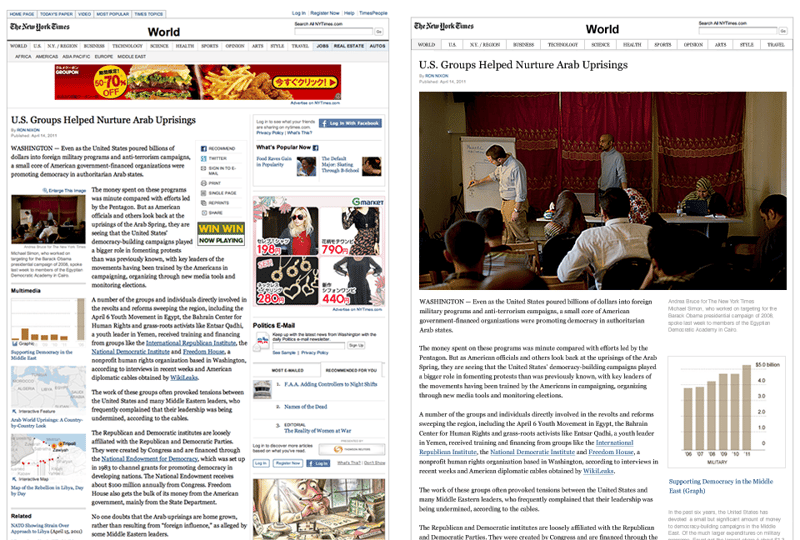
No More Banner Ads: Alternatives to Ad-Supported Media Sites

This morning I read an article about something that’s been on my mind for a while: Banner ads on media sites/blogs. In The Truth About Display Advertising, Mitch Joel writes:

Go to the website for your local newspaper. How many display ads, banners, buttons, text links, etc… do you see that are ads? Mine has over 15. That’s not in consecutive order… that’s all at once. It’s hard enough to get consumers to sit through four TV ads in a row, so what did you expect to have happen when you blast them with 15 ads on one page, all at once? Foregoing the aesthetics and the basic Marketing lesson that an ad will experience diminishing returns based on how cluttered the environment that it’s placed in is, does anyone really believe that this is the best way to advertise to consumers in the digital spaces?

No. I don’t think this is the best way to advertise to consumers. In fact, I don’t even think advertising is the best way to monetize media sites either. But are there viable alternatives? I think there are at least two business models that could work.

Distraction-Free Reading

One of my favorite services on the web is Readability. Users sign up for at a low monthly fee (minimum $5), and it then allows them to read articles in a beautiful distraction-free environment with all the ads stripped out. But here’s the best part: publishers also get something out of it:

70% of all Readability membership fees go directly to writers and publishers. Every time a subscriber uses Readability on your site, a portion of that subscriber’s fees are allocated to you. Whether in a web browser, iPhone, or just about any mobile or tablet device, Readability puts reading ”” and your content ”” at the center of the experience.

Here’s a 1-minute video that summarizes the experience:

You’ll also see that the Readability buttons are the only content sharing buttons I have on my blog apart from the Tweet button. There are many reasons for only choosing those two, but with Readability it’s simple - I think they have a fair business model where both reader and publisher win.

How would this work as a replacement for ads? Sites could integrate the “Read Later” functionality in some innovative ways. Sites that publish a lot of content could provide an ad-free home page with content snippets and “Read now/later” buttons to get to the full article. Users without a Readability (or an equivalent) account could view ad-supported full articles if they prefer. My hope is that content would win and readers would start to prefer paying small amounts of money for ad-free reading environments.

This is by no means a well-explored alternative for ad-supported sites, but it could be the beginning of something great that rewards both readers and publishers.

Business Class Subscriptions

Oliver Reichenstein recently posted another very interesting alternative to traditional paywalls on sites like the New York Times. He refers to it as Freemium for News, and the idea is that instead of paying for additional content like with traditional paywalls, you pay to get a better experience (just like paying for Business Class still gets you to the same destination, but in a much more comfortable way). Think of it as a Readability season ticket for a specific site. Here is one example he shows:

Now, think about how this might work for ad-supported sites. I would certainly pay $0.99/month to access a Business Class version of TechCrunch. Would you?

But Can Any Of This work?

Realistically, could either of these ideas provide viable alternatives to the traditional ad model for media sites and blogs? Probably not yet. But I don’t think we’re seeing enough discussion about alternatives, particularly those that focus on user experience as opposed to “monetizing traffic”. I also don’t think these ideas would ever replace ads completely (just being realistic), but at the very least it could provide an additional revenue stream that’s actually based on what users want, not on what advertisers want to push down our throats.

Let me end with something I probably should have begun with. I am no expert in the area of publishing, so it’s easy for me to back-seat-drive media sites out of their biggest source of revenue - after all, it’s not my car. I am in the lucky position where I don’t need to monetize this blog, so I don’t really have to make tough decisions about these things.

But I do hope that if I ever need to make money here, there would be a viable alternative to putting ads all over the page. I just don’t think an ad-supported User Experience Design blog is a good idea. So from the back seat I just ask those who make a living in the publishing industry: Can you please figure out how to do this so I don’t have to?