Menu

Posts tagged “leadership”

Useful

I love Molly Graham’s career advice in Useful:

One of the most important lessons I have learned over and over again is that the greatest thing you can do for your career is to be the person that everyone in the room knows they can rely on to get things done. Be the person that makes everyone else look good. Be the person that everyone wants to work with again.

Explorations On Leadership

Big +1 from me on James Whatley’s thoughts on leadership in the latest edition of his Five things on a Friday newsletter:

Demonstrating that you as a leader are imperfect, that you get things wrong; that you are fallible—and doing so in a way that shows that it’s safe to open up and be vulnerable—enables and creates the feeling of psychological safety. You’re saying “I, the person who is meant to be leading this team, can be vulnerable therefore this place, this team, that we all work in, is a place where you can feel safe to be vulnerable too.”

The anatomy of a people-first job ad

I love all the advice Charlotte Carnehl gives in The anatomy of a people-first job ad. If you’re about to go into a hiring phase, definitely bookmark this one for when it’s time to write the job description. One example:

When looking for a new job, it’s not only the position and responsibilities that are part of the package, but also the people I’ll be working with. So please tell me in your job ad: Who will be my manager? Who will I work and interact with most? Once I know, I can learn more about my potential future colleagues, and look at their writing or social media posts—just like you will do your research about me.

Evolving our organization: introducing Engineering Managers and Engineering Leads

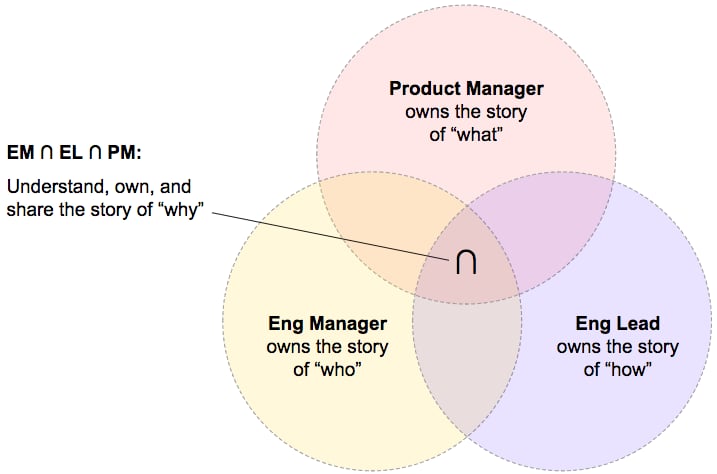
I’ve been digging into different ways to structure engineering teams a bit, and I like this take on the different roles of Engineering Managers and Engineering Leads:

It became obvious that in most cases it’s too much for one person to manage people (growth, performance and motivation), along with driving technical execution. At the same time, in most teams, we had one or more senior developers on whom Tech Lead could rely and delegate architecture decisions, quality, mentorship, etc… We decided to give these engineers roles to make them recognized in the company for their impact, also to improve communication channels, and to help team and product leads. We introduced the role of Engineering Lead to have a major influence on how we build products. Additionally, we replaced the Tech Lead role with the Engineering Manager role, which gave more focus on people and team management (“who”).

It also reminded me of Lara Hogan’s excellent post on how Engineering Managers and Engineering Leads work with Product:

Organizational health is (still) the key to long-term performance

This is an excellent read from McKinsey. It turns out that, unsurprisingly, organizational health is (still) the key to long-term performance:

McKinsey’s Organizational Health Index (OHI) continues to show, for instance, that, over the long term, healthy organizations deliver three times the total shareholder returns (TSR) of unhealthy organizations, regardless of industry. Other findings point to greater resilience and higher financial performance in healthy organizations, even as the world around them has become that much more complicated.

This bit particularly resonated with me:

According to the OHI research, companies with leaders who take decisive actions—and who commit to those decisions once they are made—are 4.2 times more likely to be healthy, as compared with their peers.

But it’s not enough just to be fast with those decisions; our OHI research shows that decisive leaders who empower their employees (giving those closest to the work the autonomy to make their own decisions) are 85 percent more likely to improve the quality of organizational decisions, as compared with their peers.

I’ve long been a fan of the adage “move decision-making to those closest to the data”. This research shows how important that continues to be for companies to succeed and employees to remain happy and fulfilled.

An Unreasonable Investment

An Unreasonable Investment is another excellent leadership essay by Michael Lopp. Here’s something to take with us into our jobs every day:

You want some free leadership advice? You build yourself by building… by helping others. The selfless act of helping humans will teach you more about being a credible leader than any book.

Your career is not your job. It’s the humans you help along the way.

Fit

Molly Graham has a fantastic essay on how to figure out if a job is the right fit for you. The post focuses on senior roles, but there are some great tips for everyone here:

What I look for, truly, is the intersection in the two sides of the equation: does what we NEED match what this person WANTS to do? As I said, most companies and most interviews focus more on the question: can this person do what we need? But if you’re trying to recruit the best talent in the world, it needs to start with them. Who are they? What do they love doing? What are their ambitions? How does their past shape what they want for their future? What are they insecure about? What do they want to prove? My interview style is really about mapping that.

Say the quiet part out loud: simplifying communication in high context environments

The Culture Map by Erin Meyer is a great book about how to improve communication between different cultures when you work at a company with a global workforce. Recently I’ve been thinking about how these concepts apply not just at a (geographical) global level, but within the systems of a single organization. What are the norms of how people communicate with each other in meetings, in email, over Slack? What type of confusion/misalignment might happen because of those norms, and how can it be improved?

There’s one dimension the book covers that I think applies particularly well to modern organizations, and that is the difference between high context and low context communication.

High context settings are those where communication relies heavily on implicit understanding. The assumption is that everyone has the same frame of reference, which means a lot is left unsaid, with the belief that everyone “just gets it.”

Low context environments, on the other hand, are those where things are spelled out more clearly. There’s less assumption that everyone has the same background information or knowledge, leading to more explicit communication.

For instance, if you often don’t know what people are talking about in meetings and it makes you feel like you missed something obvious, you might be in a high context environment. Perhaps things move so fast that there’s an assumption that everyone already has all the context of the previous 10 meetings that happened about a topic. It’s natural for this to happen—but it reduces the effectiveness of our work and the health of our relationships.

I’ve been trying to be more deliberate about addressing this issue—at least for myself and the people I work with most closely—by actively going more “low context” in my communication. When something is implied through context, but not explicitly stated, I aim to go out of my way to make it explicit.

The goal is to ensure that no one has to feel like they can’t contribute (or be scared of making the “wrong” contribution) because they weren’t part of every conversation. By making the implicit explicit, we level the playing field. It’s not just about adding clarity to our communications, it’s about fostering an environment where everyone, regardless of their starting point or level in the organization, has the same opportunity to understand and contribute.

By breaking down our messages into clearer, more accessible information, we’re not dumbing down—we’re opening up. We’re building a foundation where everyone can work confidently, equipped with the knowledge they need to contribute meaningfully.

Keep an eye out for opportunities to say the quiet part out loud. To clarify a statement, or state the thing that appears to be said between the lines. It takes work and concentration, but it’s a shift that can make a big difference in how we work and relate to each other.
Whose job is it?

This is another fantastic post on career development from Johnathan and Melissa Nightingale. This bit really resonated with me:

I want to feel like I’m making progress. And to feel like the various work experiences I’ve had are all building toward a thing. I want to be able to talk about work, not as a string of jobs I’ve done, but as a career.

The Law of Propinquity And The Work From Home Dilemma

Here’s a solid, research-based take on remote work by Paul Taylor. He discusses what type of work is usually more successful when done in person vs. remotely:

If you are doing solid repeatable work, or work that requires intense solo concentration, you can work from pretty much anywhere. If you are in a discovery phase of work, and trying to fuse ideas together from multiple viewpoints remote working might be a hindrance.

It reminds me of a saying I heard somewhere: “In-person is where decisions happen, remote is where work happens.” I also really like this (new to me) concept:

The law of propinquity states that the greater physical (or psychological) proximity between people, the greater the chance that they will form friendships or romantic relationships. Other things being equal, the more we see people and interact with them, the more probable we are to like them.