Menu

Posts tagged “leadership”

Why productivity might be falling in organizations

Here’s a good theory by Bruce Daisley about the real reason why productivity might be falling in organizations:

If you want to understand why productivity is falling, we need to look first at high levels of employee turnover. If we want to solve productivity issues the first step needs to be to lower the resignation rate.

We all know well when people quit their jobs a period of unproductivity commences: bosses and colleagues need to cover the work of the person leaving, the recruitment process takes unproductive attention and new starters take months to ramp up. As Ton says, ‘high employee turnover is ruinous for productivity’.

Blaming “low productivity” on the rise of remote work—like some publications are trying to do instead—seems pretty lazy.

How to spend your life force as a product manager

I’ve been spending lots of time recently thinking about and working with my team on what I can only refer to as “how we should spend our life force.” If that sounds weird, hold on to your hats because I’m going to make it even weirder by (and I apologize in advance) throwing a 2x2 matrix into the mix. So. Come with me in this post as we discuss how our biggest strength as product managers can easily become our biggest weakness, and how we can protect our health and sanity in the midst of all the turmoil in our companies and the world at large.

First, without getting too deep into the metaphysical or get myself in trouble about things I don’t know enough about, I do think it’s import for each of us to make conscious decisions to spend our “life force” on things that make us generally feel fulfilled and bring us closer to the person we want to be. That can take many forms—a bike ride, a fun side project, a bad action show (The Night Desk is so bad good!), an interesting problem at work… those can all be good ways to spend our life force! Being on the internet too long, on the other hand, is rarely that:

This is true at a macro level in our daily lives, but also when we zoom into how we spend our time at work. PMs in particular have this annoying habit where we tend to gravitate towards the wicked problems—a trait that makes us good at what we do, but can also be self-defeating because when we spend too much of our time depleting our life force, burnout eventually finds us.

So 2x2 matrix incoming! I think of the way we spend our life force as PMs on two dimensions: the difficulty of the task, and our likelihood of influencing the task’s success.

Some tasks fall in the easy bucket (relatively speaking—don’t @ me!). Think about things like customer interviews, collaborating with designers on a good user experience for a feature, or puttering around in JIRA making comments here and there. But then there are the difficult tasks—solving an organization’s quality problem, fixing development and deployment dependencies, understand team dynamics and creating a safe and open work environment where the whole team feels happy and fulfilled… you get the idea.

We are probably all familiar with that dimension. But the dimension we don’t always take into account is the probability that our work will actually influence the outcome of the task to ensure its success. Maybe the collaboration with the designer has a low probability of success because they report into a different org with different values. Maybe fixing development and deployment dependencies have a high probability of success because you have a really good relationship with engineering leadership and you all are highly motivated to solve the problem.

Which leads me to my main point. It’s in the combination of the ease/effort involved in a task, as well as our known sphere of influence, that we are able to make the best decisions about where to spend our life force. Let’s break out that long-promised matrix now, shall we?
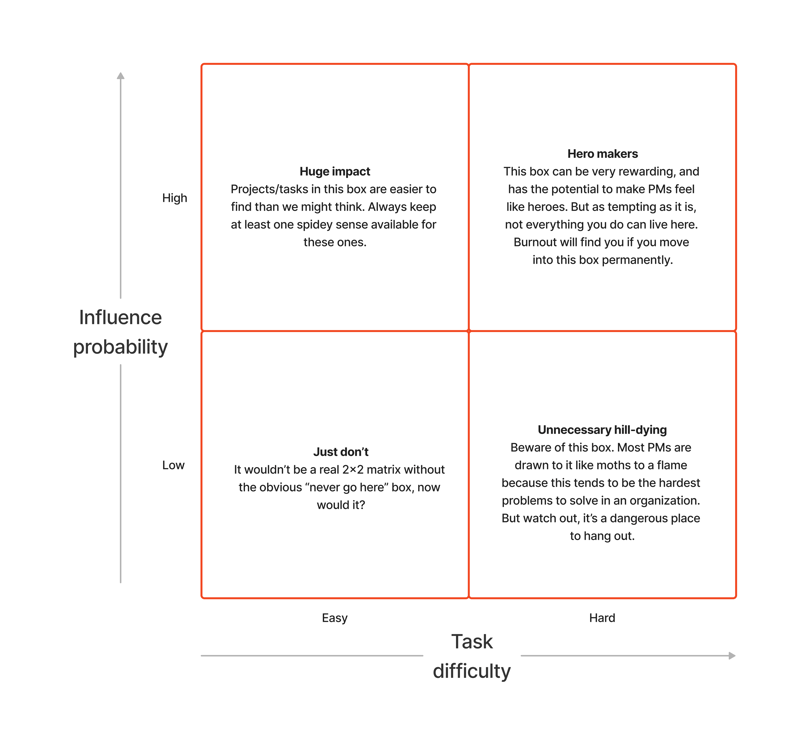
You’ll have to excuse me, I’m not good at naming things. But let’s go through these.

Just don’t

Let’s get this one out of the way first. There are tasks that are easy, that we might be tempted to pick up—especially when we’re already tired and close to burnout—that simply don’t make sense because there really is no winning.

Maybe you are a JIRA wizard, and you think it would be an easy win to redo some of your workflows. But maybe the engineering team has no interest in changing any workflows and they see no benefit in learning a new system. They dig their heals in, and before you know it you’ve spent weeks on an “easy” task that only served to erode trust between you and the engineering team.

Just don’t.

Unnecessary hill-dying

This bucket is really interesting to me because I think a lot of ambitious, smart PMs gravitate towards problems like these. We want to go for the hardest, “wickedest” problems out there, and prove to ourselves and the world that we can solve them. This is such an admirable quality, but not a sustainable way to live your work-life.

Think of our example of solving an organization’s quality problem. This is likely a really hard problem that requires coordination and buy-in across multiple teams, with a lot of resistance and meetings and meetings about meetings and meetings to talk about how bad that one meeting went. With extensive effort and superhuman patience and collaboration skills you might get to a point in 9–12 months where the quality of the organization’s output has seen a marked improvement. At that point it will feel amazing and you’ll be proud—as you should be. But it might also kill your drive, enthusiasm, and ambition and turn you into a relentless cynic.

I think we should all attempt a task like this at least once in our careers. But it is no place to build a home.

Hero makers

Oh, we love these kinds of tasks too, don’t we. Really hard problems with enough social and organizational capital to make a real difference in a reasonable time frame? That’s PM catnip right there! This box is definitely a better use of life force than unnecessary hill-dying, but we have to limit ourselves here too. Because even though the payoff / enjoyment / fulfillment of this work can be huge, so can the cost. This is difficult work that can also become addictive, and if we don’t pace ourselves and limit the number of tasks we take on in this box, burnout will find us here. So choose these carefully, and try to shift more of your life force to…

Huge impact

As we progress in our careers some tasks that used to be difficult become second nature to us. What sometimes happens is that we forget that it wasn’t always easy, so we erroneously start to think that everyone on the team already knows what we know, and we start to undervalue our contributions / knowledge.

Take a moment to think if this is happening to you. Maybe you have gotten really good at JTBD interviews, or facilitating group FigJam sessions, or getting a team to define a customer problem / business outcome effectively, or… What are the things that you can do in your sleep, but only because you’ve spent so much time on those tasks that you have a level of familiarity that others on the team simply don’t have?

Those, my friend, are high impact tasks that take very little energy/life force, and often gives you energy because of how electrifying it can be to be really good at something. You should always be on the lookout for ways to apply those unique skills to problems/opportunities where it can be really impactful. Unfortunately we can’t spend 100% of our time on tasks like these—and frankly, we shouldn’t want that, because then we’ll stop growing. But the number should definitely be more than 0% and probably closer to 20% of our time.


The main point I want to make with this post is that as PMs we generally have a lot of autonomy over how we spend our time, and that can be a blessing and a curse. A blessing because we get to prioritize our impact. A curse because we too often spend our life force on tasks that drain us and lead us towards burnout.

So take a moment to breathe, and think about the amount of time you spend in each of the life force buckets I mentioned here—and where you might need to make changes to avoid the road to exhaustion and burnout. And please, come up with better names for the buckets than I did.

4 effective product team structures

Ravi Mehta’s 4 Effective Product Team Structures is a helpful framework for leaders to figure out how to organize product teams:

Because of the nature of product work, there are two vectors that product teams need to be organized around: area of focus and level of accountability.

  1. For area of focus, product teams can align their work with either business outcomes or feature development.
  2. When considering the level of accountability part of the structure, product managers either act as fully responsible owners of the work or as facilitators of the work, where they share metrics responsibilities with cross-functional partners.

In the article he goes through the pros and cons of each of the 4 structures.

Leadership tip: be a thermostat, not a thermometer

In Be a thermostat, not a thermometer Lara Hogan provides a helpful analogy for leaders on what to do when meetings go off the rails…

Once you’re able to start noticing when someone’s amygdala-hijacked, or simply that the vibes are off, you can reframe and use “be the thermostat, not the thermometer” for good. Since humans tend to mirror each other, you can intentionally change the energy in the room, setting the thermostat to a more comfortable temperature.

How to onboard executives into a new role

This is such a great post by Will Larson about onboarding executives into a new role. His recommendations for topics to cover in the first two weeks are especially good. Like this:

Where can the new executive find real data to inform themselves, rather than relying on existing narratives? The best executives will listen to you, but won’t fully believe anything until they’re able to find data to substantiate your perspective. That’s not because they don’t trust you, but because any seasoned executive has been burned by trusting someone who fervently believed something that ultimately wasn’t true.”

And this:

Who do they need to spend time with to understand the current state and the company’s implicit power structure? Especially the longest tenured employees who uniquely hold parts of the business in their heads, and individuals who have significant influence over the executive team that wouldn’t be obvious from the reporting hierarchy.

Turns out there’s a Donella Meadows quote for everything:

Before you charge in to make things better, pay attention to the value of what’s already there.

Podcast appearance: getting started in product management, empowered teams, and... kettles.

I recently had the opportunity to talk with Blake Thorne on The LaunchNotes Podcast. I think I’m a little rusty with the speaking thing, but I did have a lot of fun here. We covered a bunch of topics, including how people got into product management before Inspired was published, how to enable autonomy and ownership in product teams, the value of writing and publishing what you learn, and also somehow… my favorite kettle. Give it a listen if you’re into that sort of thing!

Hyper-growth, and the power of doing more with less

David Poblador writes about The Pitfalls of Hyper-Growth: How Companies Can Do More with Less. Startups tend to operate more with a scarcity mindset at the onset, but as they grow…

As businesses grow, they often rely on flawed indicators of success that do not necessarily correlate with sustainability. One of the most common measures of success is headcount growth. Unfortunately, hiring lots of new employees can create inefficiencies, harm company culture, and reduce productivity. When hiring becomes the only tool to get the job done, it can detract from the most important things, like focusing on priorities and managing the company’s lifecycle.

David’s post led me to a fascinating interview with Jesper Kouthoofd, who is the founder of music-tech company Teenage Engineering. In the interview he talks about why they specifically avoid running after hyper-growth:

We only want to make great products and when you don’t focus only on making money and have reached a certain level, everything becomes about quality. Right now, there is a certain cultural fascination with fast growth, IPOs and so on, but I want to go slow, really slow and think long-term. It takes time to do good things. You see, this cultural phenomenon of speed and growth at all costs is displayed in every startup, they all look the same, it’s like fast food: it looks good, its taste is consistent but then you feel horrible afterwards.

This is obviously not desirable or true for all companies, but it’s worth noticing that there is more than one way to run a business.

Authentic leadership is about getting in the trenches with our teams

Here’s an interesting take by Sheril Mathews on why people often don’t trust their managers, or find them inauthentic:

Managers don’t come across as authentic because more often than not they don’t have an intimate understanding of the day to day realities of how their teams actually get work done.

Sheril goes on to discuss some some great advice on how to show up for our teams in authentic ways (spoiler: it’s about getting our hands dirty in the trenches). But I also wanted to share this 1973 (!!!) quote from Henry Mintzberg in The Nature of Managerial Work, because it really stopped me in my tracks:

The prime occupational hazard of the manager is superficiality. Because of the open-ended nature of the job and because of the responsibility for information processing and strategy-making, the manager is induced to take on a heavy load of work, and to do much of it superficially.

Hence the job of managing does not develop reflective planners; rather it breeds adaptive information manipulators who prefer a stimulus-response milieu.

Sheril’s article—and that quote—is inspiring me to take a real hard look at my own work, and where there could be opportunities to weed out the “superficiality”.


This is a bit of an addendum that I think is valuable enough to add here. I shared the above Mintzberg quote among some friends and the discussion ended up being really interesting. Vince pointed out that as for the assertion that superficiality is an inevitable outcome of management, he prefers Russell Ackoff’s take from 6 years later. Here’s what he said in 1979:

Managers are not confronted with problems that are independent of each other, but with dynamic situations that consists of complex systems of changing problems that interact with each other. I call such situations messes. Problems are abstractions extracted from messes by analysis; they are to messes as atoms are to tables and charts … Managers do not solve problems, they manage messes.

Pete (who I’ve been begging to start a blog, please go yell at him as well) also went the less cynical route with his comments:

As you move up the levels of a company, you move to higher levels of abstraction. Every level takes the output of the level below, and distills and summarises it, passing it up. It also takes direction from above and tries to nudge the processes below in that direction.

I think that’s the just way it is, the way it has to be. I can’t think of any examples where a different model has been applied successfully at scale.

The key to this working successfully though is to make sure that information is correctly analysed, distilled, summarised and communicated at every level.

The problem with superficiality is not abstraction. It’s dillution. If you throw away the good parts and keep the wrong parts when summarising, the system starts fraying. And you’re setting those above you up for making the wrong decisions, and thus setting up those below you for failure.

How to help our managers work with us more effectively

I’m sure we’ve all seen those “here’s how to work with me” documents (and the controversies around them), but I like this slightly different take. In her post 9 Managers in 4 Years: Creating Continuity in Chaos Genevieve Conley Gambill shares a framework for helping our managers understand our skills, our work, and our career goals:

  • Foundation – What are my unique strengths and capabilities?
  • Trajectory – How do I view my current role and performance?
  • Aspirations – What am I working towards in the future? 
  • Support – What do I need to adjust or build on to get there?

She also shares a great Google Doc template with more details. The post goes into more detail on each section of the framework.

Why stable software development teams are more effective than “agile” teams

In the latest Platformer piece Meta doubles down on layoffs we see a perfect example of why stable software development teams are more effective than “agile teams” where people are seen as interchangeable cogs in a machine. When leaders think that people can be moved around between projects and “initiatives” at will and without knock-on effects, they run headlong into the basics of systems thinking, as shown here by Mark Zuckerberg’s realization:

In retrospect, I underestimated the indirect costs of lower priority projects. It’s tempting to think that a project is net positive as long as it generates more value than its direct costs. But that project needs a leader, so maybe we take someone great from another team or maybe we take a great engineer and put them into a management role, which both diffuses talent and creates more management layers. […] Indirect costs compound and it’s easy to underestimate them.

As a side note, this is honestly a pretty frustrating thing to read. It seems like such a basic software development concept—was there no one in Mark’s orbit that could tell him about the indirect costs of building VR headsets? And now that epiphany is costing Meta another 10,000 jobs. Ugh.