Menu

Posts tagged “culture”

Google wreaks havoc on our company's calendars

We run our company on Google Apps for Business, and we’ve never had any problems. Until now. On Friday morning we came in to work to find that all our calendars are completely, utterly messed up. We lost data, ownership changed randomly, and some of us lost access to our own calendars. We’re still coming to terms with what happened, and it’s hard to explain without getting into specific detail, so I’ll just give you taste of the damage. Sorry for all the names of people you don’t know, but it’s the only way I can keep this straight:

  • My work calendar disappeared from my account, and is now owned by Chris’s personal Google Apps account.
  • I now own the Boardroom calendar, which is a resource calendar.
  • Chris’s work account now owns his personal calendar.
  • Debré’s work calendar disappeared from her account, and is now owned by Philip’s work account.
  • Philip’s personal calendar disappeared from his account, and is now owned by Angela’s work account.
  • Some events have gone completely missing from calendars — they’re just not there any more. Those events also disappeared from our clients’ calendars, which is a huge embarrassment and inconvenience because we don’t know when we’re supposed to meet with who.

And on and on it goes. Google Apps for Business promises 24/7 customer support, with a guarantee that “We’re always available to help via phone or email.” We discovered this issue on Friday morning, so I called immediately. They opened a case, I sent some screen shots, and then we waited.

Later in the day I got an email saying that “Your case will now be further analyzed by the next tier of support.” And then they went dark. I kept sending more information as we found it, but nothing happened. I phoned again on Friday evening and Saturday morning, but by then, phone support couldn’t do anything because the case was transferred to a “calendar specialist”.

On Saturday evening I received an update from Google Apps Support:

I looked at the calendars you mentioned and see the strange names that you mentioned. However, determining exactly what happened will require some in depth logs analysis. This will take some time.

And after that — nothing. Now it’s Monday morning and our ability to run our business is crippled since we don’t have access to our meeting schedule. And since we know that some events have gone missing, we can’t even trust what remains.

On the Google Apps Calendar page it says this (my emphasis added):

Google Calendar is designed for security and reliability with features like encrypted connections to Google’s servers, simultaneous replicated storage for your calendar appointments, built-in disaster recovery and fine-grained sharing, which lets you share your calendar with people in and out of your organization.

So if there’s built-in disaster recovery, why can’t they just restore our calendars to the state it was in Thursday night? Why has it been three days and we’re not getting regular updates and progress reports? Why promise 24/7 customer support if you can’t deliver it? And yes, this includes both phone and email support of their “core services”, which includes Google Calendar.

I’m writing this to hopefully accomplish three things:

  • Get some more attention on the issue so that Google can fix it and let us get on with our business.
  • Ask if anyone has experienced this problem before — if so, please get in touch.
  • Warn you about something you most likely already know: your data is not safe anywhere.

That’s the story so far. Google, please help. We just want our calendars back, and we’d love to know what happened.

Update 12/10/2012: The Internet works! On Monday evening I received a call from a senior Google Calendar employee, and he spent 30 minutes on the phone with me to help troubleshoot and get to the bottom of the issue. Our calendars aren’t fixed yet, but I’m confident that Google is now on top of it and will give us regular updates on what’s going on. At this point it looks like a 3rd party application had a sync issue with GCal, and that instigated a weird chain reaction. I’ll update again with more information once it’s all been fixed.

Update 12/12/2012: We’re mostly back up and running. It sounds like BusyCal had a conniption during one of its regular syncs, and used an API call that created the whole mess. I’m told that the API call that was used doesn’t give them much logging, so we’re not able to figure out exactly what happened. That’s too bad, but at least we’re mostly restored (still some events missing, but we’ll live with that). They ended up undeleting all events that were deleted when the issue happened. I think we could have done that on Friday, and still not sure why it took so long to sort out, but since this post went out Google became really involved and responsive, so I’m happy with that. And that, as they say, is that.

Facebook and the imperfect past

So we beat on, boats against the current, borne back ceaselessly into the past.

— F. Scott Fitzgerald, The Great Gatsby


Eric Bellm remembers the early days of Facebook in When Facebook was Fun:

And we grew older. The guy who was your buddy in class or in the dorms moved to a different city, and you lost touch with him, except in the weird limbo of Facebook, where you remain capital-F Friends and your seven-year-old inside jokes remain preserved in digital amber. You don’t notice it, as the News Feed pushes your recent history out of sight, but who you were trying to be back then can still be found in your Timeline. What was once a means of creative expression and a connection to a living community has ossified: a hidden record of who you aspired to be, as you became who you are now instead.

Facebook Timeline is a brilliant piece of behavioral design. It encourages people to reminisce constantly about the past in a way that cuts out most of the bad and non-exciting parts. As Matt Haughey pointed out in a widely-circulated post called Why I love Twitter and barely tolerate Facebook:

At Facebook, half the people in my recent feed are defined by the university they attended, even if that was 50 years ago. Their location is mentioned in posts and prominently on their profile, as well as their entire school history. Heck, the whole notion of organization at Facebook is now defining a person as a “Timeline.” I find the new life history Timeline approach to be a way of constantly dredging up the past, to show others how it shaped this person, and it’s not necessarily the best way to define ourselves.

Jason Kottke expanded on Matt’s thoughts in Twitter is a machine for continual self-reinvention:

For a certain type of person, changing oneself might be one of the best ways of feeling free and in control of one’s own destiny. And in the social media world, Twitter feels like continually moving to NYC without knowing anyone whereas Facebook feels like you’re living in your hometown and hanging with everyone you went to high school with. Twitter’s we’re-all-here-in-the-moment thing that Matt talks about is what makes it possible for people to continually reinvent themselves on Twitter. You don’t have any of that Facebook baggage, the peer pressure from a lifetime of friends, holding you back. You are who your last dozen tweets say you are. And what a feeling of freedom that is.

I find Facebook’s deliberate focus on the past such a cunning piece of design, especially since most other social networks feel more focused on what’s happening now. What’s so interesting is that your past as told by Facebook’s Timeline is only a minuscule part of the full story. Yes, there were parties, vacations, and engagements. But there was also heartache, grief, and lots and lots of plain-old boring life.

Obviously Facebook only tells the story it knows, and most of the time it only knows about your happy times. What we sometimes forget is that it’s conflict that makes the story of our life interesting. In his book A Million Miles in a Thousand Years Donald Miller puts it this way:

When we watch the news [and stories about violence come on], we grieve all of this, but when we go to the movies, we want more of it. Somehow we realize that great stories are told in conflict, but we are unwilling to embrace the potential greatness of the story we are in.

I’m slowly coming around to the idea that if we’re going to embrace public living (in the form of social networks) at all, we should either go all in with the full spectrum of our emotions, or rather not bother. Because if we only share a small, perfect sliver of our lives, we start to create unrealistic expectations for ourselves, and the people who know us.

The best article I read about this stuff in a long time is Leah Reich’s Disconnect:

But sometimes, even now, I think about public mourning rituals. I think about how the Victorians treated grief, how publicly they wore it, how they wore rings made from the hair of their beloved deceased. I recall telling myself I could say something, I could document my grief. It was okay to make it public, even if it felt like a very wrong, obnoxious, and strange thing to do. I remember thinking I needed someone to do something, but I didn’t know what it was and I didn’t know how to ask.

That’s the rub, isn’t it? Under even the most ordinary circumstances, how difficult it is to tell people we feel awful, to ask for a little extra patience, to ask for comfort. So to reach through the emotional distance when the stakes are so much higher, when the cost of rejection is risking further isolation at a time when you are already floating on what seems like the last splinter of wood from the great wreck of your life — well, you know, maybe throwing a thing or two at the internet and seeing what sticks doesn’t seem so crazy.

Yes, I know. We’re already in a culture of over-sharing. So I’m cognisant of the fact that it’s not quite practical from information overload and audience burden perspectives for all of us to suddenly start gushing every time we’re having a rough day. So I don’t really have an answer for how this should work. But I worry that our incomplete, happy pasts will someday come back to haunt us when we realise that by ignoring hard times, we have no idea how to deal with them any more.

Stop telling us how much everything sucks

Last night Cennydd Bowles tweeted something that really resonated with me:

Never ascribe to stupidity that which is adequately explained by complexity.

— Cennydd Bowles (@Cennydd) December 3, 2012

It reminded me of Erin Kissane’s contribution to the A List Apart article What I Learned About the Web in 2011:

If a single idea has followed me around this year, from politics to art and work to friendships, it’s been this one: “it’s more complicated than that.”

It’s centrally important to seek simplicity, and especially to avoid making things hard to use or understand. But if we want to make things that are usefully simple without being truncated or simplistic, we have to recognize and respect complexity—both in the design problems we address, and in the way we do our work.

I don’t know the flow of events that led Cennydd and Erin to their respective statements, but I know why it struck a chord with me. It feels like the number of tweets and blog posts that are written to ridicule and obliterate new products/apps/redesigns are on the rise. It’s like people don’t like anything any more — unless their friends made it. I think we can do better.

It’s easy to write a few paragraphs about how much something sucks. You know what’s difficult? Recognizing and respecting complexity. Giving people the benefit of the doubt and trying to understand why they made the decisions they made — whether it’s related to business, design, development, or anything else.

What’s really difficult is starting your argument from an assumption that other people are deliberate and thoughtful, and then working through each of your criticisms methodically. You’ll either realize that they made the right decisions, or arrive at the conclusion that they made some mistakes. Even if they did make mistakes — and we all have — by starting from a different baseline you’ll end up with a solid (and respectful) critique that the person can use to do things better.

For a creative person, the difference between reading “You suck!” and reading “Here’s where I think you made some wrong decisions” is the difference between being shamed into crawling under the covers and never putting their work out there ever again, and being encouraged to make their product better. We should always, always aim to do the latter.

Passion takes practice

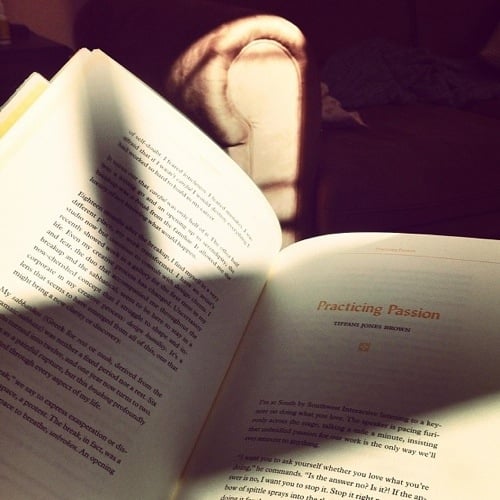
I’m slowly making my way through Issue #3 of The Manual. If you haven’t read these books, I highly recommend it — they’re wonderful essay collections. This morning I read Practicing Passion by Tiffani Jones Brown, in which she dissects the whole idea of following your passion and doing what you love. She starts with this observation:

Sure, I’d been excited to start my own business. And sure, I’d loved the idea of writing for a living. Yet banal and frustrating tasks — the kind you approach with a groan, not a fist-pump — make up much of my job. So do I feel over-the-moon about my work? I truly like it. I feel good when I get better at it. Passion overstates the point.

She then goes on to recommend a more tempered approach to the passion thing:

Instead of asking “what will make me feel passion?” we should ask, “how can I make passion happen?” The answer is to cultivate a way of living and working that makes passion more likely. Passion takes practice.

But the point that really resonated with me is the part where she talks about flow:

You can get into flow doing almost any activity, no matter how good you are at it, no matter how mundane the task. Only two things are required: the activity has to have a clear goal and a challenge. You need to be really plugged in and focused; what you’re doing must stretch your body or mind. You won’t achieve flow while multitasking or surfing the internet but you might, odd as it seems, while doing a content audit or cleaning up comps.

Those are good words to remember. Sometimes we do what we want to do. The rest of the time we do what we need to do to get the job done and get better at what we do. Anyway, I guess the point is, buy The Manual. It’s such a treat.

Practicing Passion

A tribute to the quiet ones

I’ve really been enjoying Tim Kreider’s columns for the New York Times. His essay called The ‘Busy’ Trap got a lot of attention, and for good reason. His latest is called The Quiet Ones:

We’re a tribe, we quiet ones, we readers and thinkers and letter writers, we daydreamers and gazers out of windows. We are a civil people, courteous to excess, who disdain displays of anger as childish and embarrassing. But the Quiet Car is our territory, the last reservation to which we’ve been driven. And we can be pushed too far.

I don’t want to spoil it, so I’ll just link there quietly.

The Best vs. The Worst

A few weeks ago the Internet went nuts about a blog post by Dustin Curtis called The Best, in which he argued that it’s important to spend the time (and money) to find and purchase the absolute best of everything. The money quote:

If you’re an unreasonable person, trust me: the time it takes to find the best of something is completely worth it. It’s better to have a few fantastic things designed for you than to have many untrustworthy things poorly designed to please everyone.

The post got linked to by most of the sites I read, and I must have seen about 20 tweets about it in my stream.

I get the sentiment of going for the best, unwavering quality, and all that, but the post just didn’t sit right with me. I was going to write a response to it, but so far all I’ve been able to come up with is this montage from Arrested Development:

But yesterday, Moxie Marlinspike wrote a response that gets pretty close to the issues with Dustin’s philosophy. The Worst unfortunately steps into personal attacks, which is a real shame, because his argument is pretty solid, and would have been stronger without the snark. Anyway, the core of his message is this:

Hacker News could possibly be drawn to Dustin Curtis’ cutlery because it’s reminiscent of “simplify.” The makers of the cutlery took the concept to its core essentials, and nominally perfected them. But to me, “simplify” is about removing clutter — about de-emphasizing the things that are unimportant so that it’s easy to focus on the things that are. We shouldn’t be putting any emphasis on the things in our life, we should be trying to make them as insignificant as possible, so that we can focus on what’s important.

In a sense, the best gives a nod to this by suggesting that getting the very best of everything will somehow make those things invisible to us. That if we can blindly trust them, we won’t have to think about them. But the worst counters that if we’d like to de-emphasize things that we don’t want to be the focus of our life, we probably shouldn’t start by obsessing over them. That we don’t simplify by getting the very best of everything, we simplify by arranging our lives so that those things don’t matter one way or the other.

Of course, the right answer is most likely somewhere in the middle. To seek out quality without letting things own us. But it’s good for the Internet’s equilibrium to hear the complete opposite of Dustin’s argument.

For another perspective, consider Charles Faraone’s answer on Quora to the question What’s your favourite parable? Charles tells the story of a university professor who gave his students a large pot of coffee and an assortment of cups to choose from — some plain, others expensive and exquisite. Once all the students have chosen their cups, and only the plain and cheap ones were left behind, the professor commented:

While it is normal for you to want only the best for yourselves, that is the source of your problems and stress.

Be assured that the cup itself adds no quality to the coffee. In most cases it is just more expensive and in some cases even hides what we drink. What all of you really wanted was coffee, not the cup, but you consciously went for the best cups. And then you began eyeing each other’s cups.

Now consider this: Life is the coffee; the jobs, money and position in society are the cups. They are just tools to hold and contain Life, and the type of cup we have does not define, nor change the quality of life we live.

Sometimes, by concentrating only on the cup, we fail to enjoy the coffee. Savor the coffee, not the cups!

In other words, make the best coffee you can, and don’t worry about what you drink it in.

Read The Best, The Worst, and What’s your favourite parable?

Designing to improve lives

Meagan Fallone wrote a great article on social entrepreneurship for Fast Company. From Technology Is Useless If It Doesn’t Address A Human Need:

We in turn can teach Silicon Valley about the human link between the design function and the impact for a human being’s quality of life. We do not regard the users of technology as “customers,” but as human beings whose lives must be improved by the demystification of and access to technology. Otherwise, technology has no place in the basic human needs we see in the developing world. Sustainable design of technology must address real challenges; this is non-negotiable for us. Social enterprise stands alone in its responsibility to ensuring sustainability and impact in every possible aspect of our work.

There is much we can learn from this approach. Even in the consumer space, we need to replace some “customer” thinking with “human” thinking and look for ways to improve people’s lives, not just get more money from them.

In another great article on social entrepreneurship, David Bornstein quotes Sally Osberg, president and chief executive of the Skoll Foundation:

“I’ve come to see how the ‘social’ that characterizes their purpose also characterizes their way of working. In other words, social entrepreneurs don’t just pursue a social end, they pursue that end in a fundamentally communal way.” This approach is badly needed at a time of extreme factionalism, she adds: “Regardless of whether you call it teamwork, collaboration or consensus-building, we need it, and we need it now.”

I’ve seen this first-hand in our work with Praekelt Foundation. Their passion for their work, clarity of purpose, and relentless pursuit of working together to create the best possible experience, is teaching me so much about how powerful design can be — in any context.

Quote: How to tell if your company has a design-driven culture

Look at your feature roadmap right now. Are there major initiatives and ideas that were generated directly from your designer or design team? If yes, was design in the room when the other items were created and prioritized? Congratulations, you’re design-driven.

— Cap Watkins, Building a Design-Driven Culture

How to be less boring

Scott Simpson tells us something I think we all desperately need to hear in his article in Issue 4 of The Magazine:

You are boring. So, so boring.

Don’t take it too hard. We’re all boring. At best, we’re recovering bores. Each day offers a hundred ways for us to bore the crap out of the folks with whom we live, work, and drink. And on the Internet, you’re able to bore thousands of people at once. […]

The Big Bore lurks inside us all. It’s dying to be set loose to lecture on Quentin Tarantino or what makes good ice cream. Fight it! Fight the urge to speak without listening, to tell a bad story, to stay inside your comfortable nest of back-patting pals. As you move away from boring, you will never be bored.

This relates really well to a recent post by Able Parris called Focus Means Ignoring:

We need to spend less time looking to others for interesting things, and start spending more time doing the things that make us interesting. […]

Similarly, and I am saying this more for myself, it’s easy to give time and attention to the things you enjoy or are easy, but true character comes when you give focus to the things that are difficult but must be done. This means you have to ignore everything else, and know that you will be better because of it.

Just imagine the virtuous cycle this could set off… As people post fewer boring things like Foursquare checkins and retweets of how awesome they are, and we all take the conscious decision to read fewer boring things and instead spend that time listening, learning, and doing new things, we could slowly and collectively pull the current state of the social web out of that cesspool of boringness. Well, that’s a pipe dream, of course. And to be fair — there’s nothing wrong with clicking on a good animated gif every once in a while.

Anyway, back to Scott’s article. One of his recommendations for fighting the descent into becoming boring is what he calls “Expanding your circles”:

When you expand your social and intellectual range, you become more interesting. You’re able to make connections that others don’t see. You’re like a hunter, bringing a fresh supply of ideas and stories back to share with your friends.

This is very much related to Mark Granovetter’s 1973 theory of weak ties1. The theory states that because a person with strong ties in a network more or less knows what the other people in the network know, the effective spread of information relies on the weak ties between people in separate networks.

In other words, to get more interesting information out of Twitter or any other social network, you need to follow people who give you access to additional knowledge clusters. If you see too many tweets about the same thing in your timeline, or if your RSS reader shows 5 consecutive links to the same tech article, you may have too many strong ties.2

Go and and find those weak ties at the edges of your interests, and strengthen them. Otherwise we’ll just continue to talk about the same stuff over and over and over again. And that’s boring.


  1. “The Strength of Weak Ties”, Mark Granovetter, 1973. PDF link

  2. I wrote about this extensively in How to get more out of Twitter

Two legacies to strive for

The Great Discontent just published another great interview, this time with Cameron Moll. The final two paragraphs, where he speaks about the kind of legacy he’d like to leave, really spoke to me. First, on a personal level:

I think the legacy I hope to leave for my family is that they, of all people, knew me in the most intimate way and regardless of how the public saw me, I hope they will be appreciative and thankful for who I was in their presence.

Or to quote CJ Chilvers:

As noble as you may believe your pursuit of excellence is, it means nothing if you go home at night to people who do not recognize you or want you around.

I’ve been thinking about family a lot lately, since the birth of our 2nd daughter 6 weeks ago. The first child is mostly a physical adjustment — the long, hard process of getting used to very little sleep, very little time, and no room for selfishness. The second child is more of an emotional adjustment. Suddenly you’re a family of four. Suddenly you’ve become your parents. Suddenly the people close to you can be scattered in many different places, and your heart somehow needs to stay in your body and not freak out because of all the evils in the world that can possibly hurt them. From physical exhaustion to emotional exhaustion — that’s the move from one to two kids.

But for me it is also a move to a better understanding of what it means to be a family, to be bound together through thick and thin, to care more for these people than I ever thought would be possible. And with that comes the realisation that I don’t want to be that guy. That Dad at the park who’s always on his iPhone. The one who’s never home in time for bath time. So I obsess over these things — it pretty much takes an act of God for me not to be home to give my 3-year old a bath. And when I fail, I fall hard, and sometimes stumble rather slowly back on my feet.

So anyway, I’ve been thinking about family a lot lately. And as much as I love my work and my side projects, I cannot allow that to become more important than my family is. So I identify with Cameron and CJ’s words. I feel like I often fail at building towards that legacy, but I’m going to steal a buzz phrase from startup parlance and say that I think I at least “fail forward”. I hope.

And then, on a professional level, Cameron says this:

I don’t have it all figured out; I’ve made so many mistakes, but I hope that through some of the work I’ve produced or the efforts I’ve championed, people feel inspired to try harder and be better.

These things seem like pretty good legacy goals to strive for. Sign me up.