Menu

Posts tagged “culture”

The Instagram Generation

The truth, then, is this: our generation was raised with an understanding that the image we portrayed mattered more than who we actually were. We believed this not out of some malevolent, externally imposed agenda, but because it was actually true. The result was that nothing we ever did felt organic; instead, everything felt like a checked box. You played sports to prove you were competitive. You took classes to get grades, those wonderful letters that separated friends and induced panic attacks and never really went away and felt like the world for as long as I can remember. You took AP classes because they were decidedly not interesting; they were just faster, and for that reason, better signals of competence. You participated in extracurriculars because if you didn’t, there would be more empty boxes on your applications than there would be on those of your competition

— Zander Nethercutt, The Instagram Generation.

The uncertainty of friendship

The most fatal disease of friendship is gradual decay, or dislike hourly increased by causes too slender for complaint, and too numerous for removal. Those who are angry may be reconciled; those who have been injured may receive a recompense: but when the desire of pleasing and willingness to be pleased is silently diminished, the renovation of friendship is hopeless; as, when the vital powers sink into languor, there is no longer any use of the physician.

— Samuel Johnson, No. 23. Uncertainty of friendship.

Remote product management: challenges and opportunities

Even though more and more companies are getting comfortable with remote work, the field of product management still seems to push back against this trend quite forcefully. There is a general sense that product managers can’t do the things they need to do unless they are physically located with their teams. This has some ironic consequences, such as that Slack — a company that builds a tool “where work happens” — doesn’t hire remote employees.

I confess that at first I was skeptical as well. But as we started to work together and make progress at Postmark, my skepticism fell away. I do believe it’s harder to make the product management role work remotely than some other roles like customer success or development. But it is possible, and I believe that companies need to start being more open to hiring remote product managers.

We often hear about the drawbacks of remote work, but it’s important to remember that there are certain things that remote work is naturally better suited for than on-premise work. Most importantly, remote work makes it much easier to develop and instill a rhythm of collaboration and focused time for a team. This rhythm will be different for every team, but I like to think of it as a wave. Here’s one example of what a cycle of private and public work could look like in a team:
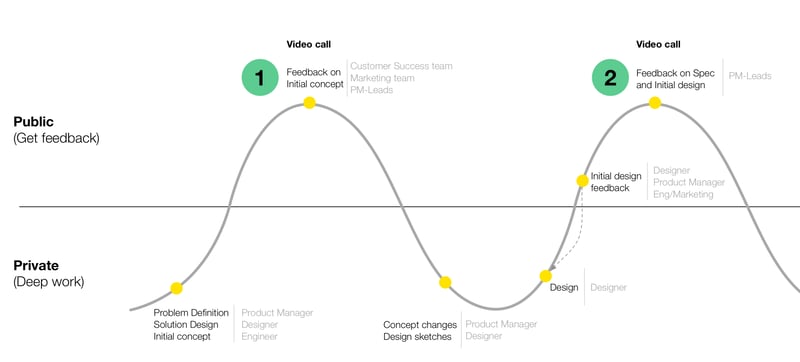
Wave

Because it’s easier to shut down distractions as a remote worker, the deep work part of that cycle can be immensely efficient and dramatically increase both the speed and quality of work that gets done.

But of course, we can’t ignore the parts of remote work that are challenging and need to be figured out. So in this post I want to share a few lessons I’ve learned over the past 2 years that have helped me to overcome some of the more severe challenges to being an effective remote product manager.

In-person time is still important (but maybe not for the reason we think)

I joined Wildbit at the right time: one week before our yearly in-person company retreat. That gave me an opportunity to meet everyone in person, work together, and most importantly, have meals together. Once you’ve eaten a meal with someone, they’re not an anonymous “colleague” any more. Which means that when conflict arises (and of course it will), you’re way more likely to work through it kindly and respectfully. It’s very difficult to be mad at someone you’ve broken bread with.

The point is that in-person time is extremely important for remote teams. But you don’t need it every day, and the reason you need it is not to get more work done. The reason you need it is to sustain the human relationships that will enable you to get more work done.

When I spend time with our team in person, yes we spend quite a bit of time working together in meetings. But the biggest value for me is the lunches, the coffee chats, and the after-work catch-ups. That’s where we begin to see each other as whole people, and it’s at the core of our ability to work together and grow together.

This is certainly true for the whole team, but it’s especially true as a product manager, where your ability to do your job lives and dies with your ability to have good relationships with the team.

Love your tools (and be prepared to do a bit more of the heavy lifting)

One of our principles at Wildbit is that we optimize for asynchronous communication. We don’t hate meetings. We just value focused work extremely highly, so whenever we can we try to protect that work by giving each person the opportunity to work on something when it’s best for their schedule.

To make this work, you need tools. And those tools have to be light-weight and not a pain to use. Sure, we use Slack (although we’re trying to wean ourselves off it), but most of our collaboration work happens in Dropbox Paper and Basecamp. Those tools are designed for the type of collaboration and asynchronous communication that feels good. It can’t be overstated how important it is for remote teams to love their collaboration tools. If everyone hates the tools, the work will find a way to not get done. You’ll end up blaming “remote culture” and hire an onsite product manager, when the problem lies with crappy tools instead.

The catch is that these tools are just like comments on the internet: if you want them to be useful, you need to be prepared to spend quite a bit of time managing the process and the flow of information. As product manager a big part of my role has become making sure the right people know about things, and the wrong people don’t get distracted by things they don’t need to be involved in. This needs time and care, and doesn’t just happen automatically. The good news is this will still take way less time than “back-to-back meetings” every day…

Make prioritization and planning a team effort (and embrace the benefits of that)

Prioritization and planning of work is difficult under the most ideal circumstances. When you’re working on a remote team, the challenges are even bigger. This is where a combination of the right tools and some deliberate time management can make all the difference. The thing is, we know we do better work when all of our team’s perspectives are taken into consideration — not just in terms of the details of a project, but also what we should work on.

As product manager my role in the prioritization and project planning process is way more traffic controller than it is decider. We use our asynchronous tools to discuss ideas, post and gather feedback on initial drafts of plans, and occasionally even make radical changes to a plan as we learn more from customers and everyone on the team. My one goal is to keep the conversation going. It can be a little chaotic at the start, but I always feel like we end up in a better place than if we used a more traditional prioritization process.


Being a remote product manager is not without its challenges. It can be difficult to get the whole team aligned around a common vision, and you’re not always going to be able to get your questions answered right at the moment you want it. But if you can find a way to focus on and nurture the benefits that are unique to remote work, the challenges tend do get pushed to the background.

To put it another way, I understand why people think that product management isn’t a role that can be done remotely. There’s a lot of team communication involved, and of course that can be challenging over electronic channels. But with a slight shift in the lens you view product management through, those challenges fade away as the benefits of deliberate focused work and carefully considered collaboration come to fruition. I’ll say this: it’s totally worth it.

A pragmatic approach to digital ethics

Cal Newport has some thoughts on the “digital ethics” movement. In his post Beyond Digital Ethics he argues that large companies will never turn their backs on revenue just because it’s “the right thing to do”:

Instead of quixotically convincing some of the most valuable business enterprises in the history of the world to behave against their interests, we should convince individuals to adopt a much more skeptical and minimalist approach to the digital junk these companies peddle.

We don’t need to convince YouTube to artificially constrain the effectiveness of its AutoPlay algorithm, we should instead convince users of the life-draining inanity of idly browsing YouTube.

This approach will be challenging too, because we are up against some really strong brain psychology. As Don Norman notes in Why bad technology dominates our lives:

Curiosity is, on the whole, a virtue. We have evolved to be curious. Our nervous system is especially sensitive to change, and changes in the environment attract attention. But the technology-centered view labels this natural, creative trait as a liability: Curiosity is renamed as distraction. A human virtue is now turned into a liability.

Worse, many businesses have learned to exploit our curiosity. The continual bombardment of tantalizing tidbits of information deliberately designed to grab our attention away from other, potentially more valuable activities are distractions that can lead to accidents, injury, and interpersonal problems.

We are in uncharted territory and there are no easy solutions.

What is Twitter even for

Two lofty but surprisingly insightful Twitter think-pieces caught my attention this week. The first is Jennifer Senior’s description of it as The High School We Can’t Log Off From:

A few years back, the sociologist Robert Faris described high school to me as “a large box of strangers.” The kids don’t necessarily share much in common, after all; they just happen to be the same age and live in the same place. So what do they do in this giant box to give it order, structure? They divide into tribes and resort to aggression to determine status.

The same can be said of Twitter. It’s the ultimate large box of strangers. As in high school, Twitter denizens divide into tribes and bully to gain status; as in high school, too-confessional musings and dumb mistakes turn up in the wrong hands and end in humiliation.

The second is Ezra Klein’s pretty profound Twitter is not your friend. Here’s the crux of it:

We write for an audience we think we know, in a vernacular they’ll understand, using reference points they’re familiar with. Six years later, our tweets are weaponized to an audience we don’t know, thick with terms they understand differently, with the reference points completely absent. […]

Twitter is not your friend. It is built to reward us for snarky in-group communication and designed to encourage unintended out-group readership. It fosters both tribalism and tribal collision. It seduces you into thinking you’re writing for one community but it gives everyone the ability to search your words and project them forward in time and space and outward into another community at the point when it’ll do you maximum damage. It leaves you explaining jokes that can’t be explained to employers that don’t like jokes anyway.

And it’s not just what we write. It’s what we see. Our feeds are filled with reasonable, funny, thoughtful comments from our groups and the most unreasonable, offensive tweets sent by our out-groups.


My own experience has been similar recently. For years I used Twitter as a way to share things about product management and design, and in return, learn and get feedback from that community. Also the occasional joke. It was fun, and it played a really big role in my career development.

It’s not fun any more. Don’t get me wrong, I’m not mad about it. There are more important problems to solve right now than how I should approach a specific feature I’m struggling with. I’m not mad about how political Twitter has become. It kind of needs to be that, because that’s what’s important right now.

But I do feel like I’m not sure where to go to share ideas with my product tribe any more. And I’m also too scared to tweet anything personal, for all the reasons Jennifer and Era point out in the essays above.

2018 is so weird.

How businesses have learned to exploit our curiosity

Don Norman attempts to explain Why bad technology dominates our lives:

Curiosity is, on the whole, a virtue. We have evolved to be curious. Our nervous system is especially sensitive to change, and changes in the environment attract attention. But the technology-centered view labels this natural, creative trait as a liability: Curiosity is renamed as distraction. A human virtue is now turned into a liability.

Worse, many businesses have learned to exploit our curiosity. The continual bombardment of tantalizing tidbits of information deliberately designed to grab our attention away from other, potentially more valuable activities are distractions that can lead to accidents, injury, and interpersonal problems. What kind of business exploits curiosity for its own ends? Almost any business that discovers there are profits to be made by continually engaging people’s curiosity, hopes, and interests. For example gambling, computer games, social networks, and even television series that can go on and on, week after week, year after year, trapping their viewers into addiction.

We talk a lot about “personal responsibility” and how it’s up to each person to make good choices about how they spend their time. That is true as far as it goes, but it brushes over the incredibly strong forces of persuasion theory and how easily humans are manipulated. “Personal responsibility” doesn’t give us a hall pass to exploit the human brain’s weaknesses.

Facebook’s biggest problem is its obliviousness to real humans

Nikhil Sonnad writes that Everything bad about Facebook is bad for the same reason:

Underlying all of Facebook’s screw-ups is a bumbling obliviousness to real humans. The company’s singular focus on “connecting people” has allowed it to conquer the world, making possible the creation of a vast network of human relationships, a source of insights and eyeballs that makes advertisers and investors drool.

But the imperative to “connect people” lacks the one ingredient essential for being a good citizen: Treating individual human beings as sacrosanct. To Facebook, the world is not made up of individuals, but of connections between them. The billions of Facebook accounts belong not to “people” but to “users,” collections of data points connected to other collections of data points on a vast Social Network, to be targeted and monetized by computer programs.

Here’s the crux of it:

There are certain things you do not in good conscience do to humans. To data, you can do whatever you like.

Platforms and serendipity on the internet

In Filter Failures Ethan Chiel asks if platforms are sucking the joy out of the internet, and he makes a pretty compelling argument:

The internet as we use it now is, for the most part, what the large platforms want it to be: an engine for serving us what their various systems think we want, or what we wanted before, or what our demographics want en masse.

Here’s the problem:

What’s lost in the process is whatever you might have found that neither you nor an algorithm might guess is interesting. Some song in a forum thread you idly clicked on, a news item about something you’ve never expressed interest in or heard of that you read because you had 5 minutes to kill and it caught your eye.

This reminds me of how we used to browse music stores. We idly flipped through CDs, and picked a few to try out in the listening booth based on the cover, the song titles, and some undefined ¯_(ツ)_/¯ factor. Now we just see and hear what we’ve seen and heard before, and the cycle continues…

Echo chambers and epistemic bubbles, and how to break through

Thi Nguyen’s essay Why it’s as hard to escape an echo chamber as it is to flee a cult is one of the most insightful things I’ve read in a long time. Nguyen argues that echo chambers are very different from what he calls “epistemic bubbles”, and that conflating the two concepts places our focus on the wrong solutions to the problem. In short, the difference is this:

In epistemic bubbles, other voices are not heard; in echo chambers, other voices are actively undermined.
>

Epistemic bubbles are easy to pop, because all it takes is to introduce previously unheard voices into it. Echo chambers, however, are extremely difficult to penetrate, because at its core lies the belief that everyone not in it is untrustworthy:

An ‘echo chamber’ is a social structure from which other relevant voices have been actively discredited. Where an epistemic bubble merely omits contrary views, an echo chamber brings its members to actively distrust outsiders. In their book Echo Chamber: Rush Limbaugh and the Conservative Media Establishment (2010), Kathleen Hall Jamieson and Frank Cappella offer a groundbreaking analysis of the phenomenon. For them, an echo chamber is something like a cult. A cult isolates its members by actively alienating them from any outside sources. Those outside are actively labelled as malignant and untrustworthy. A cult member’s trust is narrowed, aimed with laser-like focus on certain insider voices.

Or to put it even more succinctly:

An epistemic bubble is when you don’t hear people from the other side. An echo chamber is what happens when you don’t trust people from the other side.

This is a long essay, but I highly recommend reading the whole thing. It was a real eye-opener for me.

Social internet, social media, and the move to smaller networks

I should stop reading (and writing) about Facebook at some point, but there’s been some really interesting thinking around the social internet in general recently. I especially enjoyed Benedict Evans’s The death of the newsfeed, because it puts into words a lot of things I’ve been thinking about. On the social implications of algorithmic feeds:

One basic problem here is that if the feed is focused on ‘what do I want to see?’, then it cannot be focused on ‘what do my friends want (or need) me to see?’ Sometimes this is the same thing - my friend and I both want me to see that they’re throwing a party tonight. But if every feed is a sample, then a user has no way to know who will see their post. Indeed, conceptually one might suggest that they have no way to know if anyone will see this post.

This is one of the major flaws of algorithmic feeds. People share things so that those things can be seen. But if you can’t tell who will see the things you share, that’s frustrating, and more than a little nerve-wracking. Hence the move back to smaller networks:

I think one could suggest that this is some of what’s behind the suggestions of systemically lower engagement on Facebook newsfeeds, and behind the obvious growth of person-to person chat (most obviously WhatsApp, iMessage, FB Messenger and Instagram - three of which Facebook of course owns). The social dynamics of a 1:1 chat work much more strongly against overload, and even if one person does overshare they’re in a separate box, that you can mute if you like. […]

Messaging can be more private, have less social pressure, and be more fun. A Snapchat story isn’t a permanent record and has less pressure to show off your perfection. Stickers and filters are more fun and spontaneous than Facebook’s rigid blue boxes (and the days of throwing sheep at people are gone alone with Facebooks’ platform). And some of these offer light-weight ways to interact without obligation, which was also a feature of Facebook’s model, but deliver that piece of Maslow in different ways.


On that note, I think the distinction Cal Newport draws in On Social Media and Its Discontents is really important:

There’s a distinction between the social internet and social media.

The social internet describes the general ways in which the global communication network and open protocols known as “the internet” enable good things like connecting people, spreading information, and supporting expression and activism.

Social media, by contrast, describes the attempt to privatize these capabilities by large companies within the newly emerged algorithmic attention economy, a particularly virulent strain of the attention sector that leverages personal data and sophisticated algorithms to ruthlessly siphon users’ cognitive capital.
>

In the final analysis, I agree with Cal:

I support the social internet. I’m incredibly wary of social media.