Menu

Posts tagged “creativity”

Dreaming about great things

Kyle Baxter wrote a moving tribute to Neil Armstrong. From One Giant Leap:

Let’s lay awake at night, dreaming up great things, things that could only be dreams now, and let’s build them. It need not be related to space; it could be related to an important advancement with renewable energy, or even with something as comparably small as re-creating education for this new century. But it must be something truly new, groundbreaking and meaningful, something that leaves you with the sheer joy of childhood excitement. Something that will make us better as a people. Let’s dream it, and let’s build it.

We’re going to see a lot of tribute pieces over the next few days. Don’t skip this one.

The morning email is my enemy

Letters of Note continues to be a source of endless delight. Monday’s letter is another great example. In The morning mail is my enemy, E.B. White describes with painstaking clarity how distractions ruin our ability to be creative. It was written in 1961, but replacing “mail” with “email” makes it feel like it was written yesterday:

So in the long run, although I’m not immune to praise and to friendliness, I get impatient with the morning mail, because it is, in a sense, my enemy—the thing that stands between me and a final burst of creative effort. (I’m sixty-one and working against time.)

To those who love the web

There are many kinds of people trying to make a living online. There are those who love retail and want to use the Internet to find efficiencies in merchandising and supply chain management. There are those who love the preciseness of search algorithms and want to do everything they can to figure out how to level up in that game. There are those who see the potential of selling “eyeballs” to advertisers and are desperately trying to grab enough of our attention to make that work.

Those are all perfectly fine ways to spend your days. But it’s not what drives me.

Then there are those who love the web. They understand that it’s people all the way down. That the real value of the things we make is in the shared experiences we get to have. They are passionate, critical, creative, opinionated, and cynical. Sometimes arrogant and not nice — but never apathetic. Never lazy enough to let something they care about get away with being less than great.

Those are the people I stand with.

We believe that the quality of what we put out there reflects on all of us. Flipboard and Clear make us all look good. Color makes us look like idiots, and we can’t stand it. When our own work doesn’t live up to our standards of quality for whatever reason, we lose sleep over it. We can’t shut up when we see the Internet being used as a game to be won, an endless well of content to “repurpose” for a quick ad buck, a way to trick people into clicking a link they don’t want to click on. It makes us obnoxious, yes, but we can’t just stand there and do nothing. For we will not have that sh*t. We will not have it.

To those who make a living online because they love the web: I stand with you.

Small and boring ideas

If you secretly enjoy snarky writing as much as I do, you should read Paul Constant’s post called Yesterday, I Went to the American Idol for Startups. It Made Me Want to Die. It’s a scathing and funny rant about lazy, unimaginative use of language in business, and yet he ends with quite a poignant remark:

You can do anything you want with an idea. It can be as big as you want. It doesn’t have to solve a minor problem that nobody ever really realized was a problem. It doesn’t have to fit into something the size of a button crammed into a “folder” the size of a button on a screen the size of a playing card. But everywhere I look, I see tiny little ideas, ideas that are almost petty in their inconsequentiality. And I come back to those cliches, and I think the real problem is in how little thought goes into the language these people use. When the language you employ to communicate your ideas is small and boring, your ideas are going to be small and boring. And when all your ideas are small and boring, your future gets dimmer and dimmer and more claustrophobic until it’s finally just a pinpoint of light on a dark screen, in danger of going out at any time.

Intuition vs. Science in design

Aaron Swartz discusses the possible problems of relying too much on scientific decision-making in Do I have too much faith in science?:

If you’re struggling with a decision, we’re taught to approach it more “scientifically”, by systematically enumerating pros and cons and trying to weight and balance them. That’s what Richard Feynman would do, right? Well, studies have shown that this sort of explicit approach repeatable leads to worse decisions than just going with your gut. Why? Presumably for the same reason: your gut is full of tacit knowledge that it’s tough to articulate and write down. Just focusing on the stuff you can make explicit means throwing away everything else you know—destroying your tacit knowledge.

My initial reaction was probably similar to yours. Something like this:
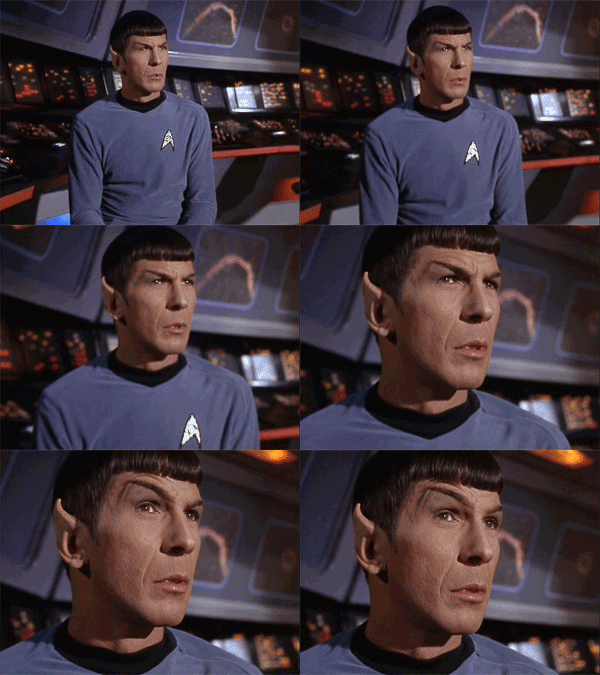
Hmmmmmm

As expected, many commenters on Aaron’s post vehemently disagrees with him. Joe Blaylock asks:

You seem to take a narrow view of what science is and how it’s done. Is this rhetorical? Are you representing an extreme reductivist worldview to try to make a point?

gwern tells an interesting story to make his/her point:

‘One day when I was a junior medical student, a very important Boston surgeon visited the school and delivered a great treatise on a large number of patients who had undergone successful operations for vascular reconstruction. At the end of the lecture, a young student at the back of the room timidly asked, “Do you have any controls?” Well, the great surgeon drew himself up to his full height, hit the desk, and said, “Do you mean did I not operate on half the patients?” The hall grew very quiet then. The voice at the back of the room very hesitantly replied, “Yes, that’s what I had in mind.” Then the visitor’s fist really came down as he thundered, “Of course not. That would have doomed half of them to their death.” God, it was quiet then, and one could scarcely hear the small voice ask, “Which half?”’

To bring this debate over into the world of design, I like Dmitry Fadeyev’s description of the different approaches as Primal (intuitive) vs. Cerebral (scientific). He concludes:

The best work is probably a combination of the two forces: restraining the primal force enough to yield a useful product that performs, but not ignoring it altogether so that the more basic human element is satisfied too, both in the creator and in the user.

Dmitri explores this theme more in his essay The Cerebral Designer:

Likewise, primal and cerebral design instincts are complements, not opposing forces. They are concerned with disparate goals which is why neither is better at achieving what the other sets out to do. If the design is driven only by the cerebral creative instinct, it will be too plain. If it is fully primal, it will not be very good at fulfilling its function for it would be more of an illustration or an ornamental piece than a design. Instead, if the primal is restrained by the cerebral but not yet fully killed, we arrive at a design that is functional, structured, pleasing to the eye and a joy for the designer to create.

I guess as designers we’re lucky. Instead of having to pick extreme points of view in an argument, in many cases the easy way out (calling for a middle ground) is also what’s best for our work. That is certainly the case here. We can combine things like A/B testing (within limits) with an intuitive humanity to design memorable, usable experiences.

Meaningful writing

Dmitry Fadeyev reflects on the purpose of writing in Give Sight:

Meaningful writing has a purpose beyond that of simple entertainment or of generating conversation. Its purpose is to improve society, to improve our life, by teaching us certain truths that the author has learned. John Ruskin puts it well in his essay on books, Of Kings’ Treasuries, by saying that good books give us sight. By teaching us what to look for, and the value of those things, we learn to tell apart the good from the bad, to pass better judgements using our sharpened vision. We grow and become wiser. And that is the only sort of writing that ever improves us as people because all the rest, information and entertainment, it just passes by and leaves us in the same state that we are when we first come into contact with it.

I completely agree with this viewpoint, and that results in a constant struggle as I try to weigh the demands of long-form writing with the demands of, you know, having a day job. The compromise that many of us in this situation goes for, to keep the much-needed momentum of writing going (what Alex Charchar calls “act the pro”), is to share links and quick thoughts, interspersed with some long-form writing when inspiration and a brief excess of time collide.

I’m particularly self-conscious about the dangers of this approach after reading Marcelo Somers’s piece The Linkblog Cancer:

Our job as independent writers isn’t to be first or even to get the most pageviews. It’s to answer the question of “so what?”. Taken as a whole, our sites should tell a unique story that no one else can, with storylines that develop over time that help bring order to the chaos of what we cover.

That’s what I want to happen here, but I know I often fall short. I’ll keep doing it though, because I have hope that, taken as a whole, there is a thread running through the links I post and the essays I write, and that when I look back at it in a few years, that thread will spark some new and interesting ideas. We’ll see.

We can learn a great deal from children's books

I usually avoid articles called “What [X] can teach us about [Y]”, but despite myself I really enjoyed Maria Konnikova’s What Grown-Ups Can Learn From Kids’ Books. It’s a thoughtful essay that gets to the core of The Little Prince, Alice in Wonderland, and Winnie-the-Pooh:

“When you wake up in the morning, Pooh,” Piglet asks him as their adventures near an end, “what’s the first thing you say to yourself?”

“What’s for breakfast?” Pooh answers. “What do you say, Piglet?”

“I say, I wonder what’s going to happen exciting today?” responds Piglet.

Pooh thinks it over. “It’s the same thing,” he says. And as adults, we can at last appreciate just how right he is.

If I were to write an article like this, I would add two books to the list. First, I would mention how Where The Wild Things Are taught me that being king of whatever you’re doing isn’t what life is about:

And Max the king of all the wild things was lonely and wanted to be where someone loved him best of all. Then all around from far away across the world he smelled good things to eat so he gave up being king of where the wild things are.

And then I’d talk about Oh, The Places You’ll Go!, and how it probably contains some of the best advice on life and business that you’ll ever read:

And when things start to happen, don’t worry. Don’t stew. Just go right along. You’ll start happening too.

Except when they don’t. Because, sometimes they won’t.

I’m afraid that some times you’ll play lonely games too. Games you can’t win ‘cause you’ll play against you.

But since I didn’t write such an article, you should definitely read Maria’s. It’s really great.

Limiting our own potential (and another essay project to follow)

Just as Alex Charchar’s excellent 31-day Exercise in Short & Quick Essays came to an end, one of my other favorite writers, Dmitry Fadeyev, started his own An Essay a Day project. I love these projects, and I wish I had the guts to do something similar. Here’s an excerpt from one of Dmitri’s first posts in the series, called The Road to Hyperborea:

And even when people do break away and achieve what we thought ourselves impossible, we label them “geniuses” and thus once again create an artificial wall between us and them, drawing ever more constraints over our potential. Nietzsche warned us against this by saying that our impulse to label the most productive of us as “geniuses” — and that is what they are, productive individuals who have built up enough experience and have created enough material from which they can select the very best — relieves us of the pressure to compete with them. The label lifts them above our playing field, separates them from us, so that the benchmarks they’ve created no longer apply to us. It’s a declaration of surrender.

That’s a solid kick in the pants to stop limiting our own potential just because there are so many others out there who are better than us. Dmitri is a fantastic writer, so I highly recommend following his month-long essay journey.

Iteration, variation, and not giving up on your bad ideas

I’ve written before about the importance of using both iteration (progressively solidifying the details of a product) and variation (coming up with ideas that are very different from the current iteration). We now know that Apple does that all the time; but it also recently became clear that they don’t view their unused variations as failures. Kyle Baxter makes a good point about this in Apple’s iPhone Prototypes:

But what’s fascinating to me is that designs rejected during the development process for an earlier version of the product may come back in future versions. That initial first step, where many unique designs are created, becomes the grist for the future of the product, a conceptual mine to return to for ideas. A particular design may have failed during an earlier product development process but could become the basis for development of a new design. Earlier rejected designs became the iPhone 3G and iPhone 3GS, and others became the iPhone 4 and iPhone 4S, perhaps Apple’s most iconic iPhone version yet.

It’s worth remembering: never underestimate the future value of what might seem like a bad idea at the time.

Don't let negative voices drown out the Will O’ the Wisps

This week’s episode of the Back to Work podcast with Dan Benjamin and Merlin Mann really struck a chord with me. In Scream, Poop, and Run they have a long discussion about an article by Jad Abumrad called The Terrors & Occasional Virtues of Not Knowing What You’re Doing. There is one part in particular, where Merlin talks about not listening to people who tell you what you can’t do, that I keep replaying in my head:

There are so many voices that you are going to hear — some of them actually outside your head — so many voices that you are going to hear about what you should be doing differently, what you’re doing wrong, what you’ll never be capable of, what you’ll always suck at, and you’ve got to not listen to those voices.

The people who constantly tell you what you shouldn’t do are typically really good at not doing things. And that is a virus they are very happy to spread. They are people who just don’t make stuff, they are people who don’t do stuff, and they are more than happy to try to pull the entire world down to their level of not making and not doing. And that’s something to watch out for. Because if you listen too much to all those other voices, they’ll eventually become your voice. And that’s the voice that’s going to be with you all the time.

That’s the voice you’ll go to sleep with, and it’s the voice you’ll wake up with, and if you listen to it too much, it’s going to drown out the tiny voices. And the tiny voices are like the little Will O’ the Wisps in Brave, these little blue lights, saying, “Try this way. Come this way. Come this way.” And those little blue lights — or the tiny voices — you’re only going to hear that if you’re not being drowned out by all the things that say that you’re not even worthy of having your own Wisps.

Those are very loud voices — especially if you make stuff for the Internet. It’s just always there — it’s a constant din of people telling you what you should be beside yourself. And that’s the worst advice in the world.

The whole episode is great. Have a listen.