Over the past few years, Spotify has been ramping up its data analytic capabilities in a bid to help marketers target consumers with adverts tailored to the mood they’re in. They deduce this from the sort of music you’re listening to, coupled with where and when you’re listening to it, along with third-party data that might be available.
And they’re not alone:
Spotify is far from the only platform helping brands target people according to their emotions; real-time mood-based marketing is a growing trend and one we all ought to be cognizant of. In 2016, eBay launched a mood marketing tool, for example. And last year, Facebook told advertisers that it could identify when teenagers felt “insecure” and “worthless” or needed “a confidence boost”.
Nicholas Carr discusses the importance of using the right terminology when we talk about how companies use our data in his essay I am a data factory (and so are you). On the problems with the “data mining” metaphor:
Data does not lie passively within me, like a seam of ore, waiting to be extracted. Rather, I actively produce data through the actions I take over the course of a day. When I drive or walk from one place to another, I produce locational data. When I buy something, I produce purchase data. When I text with someone, I produce affiliation data. When I read or watch something online, I produce preference data. When I upload a photo, I produce not only behavioral data but data that is itself a product. I am, in other words, much more like a data factory than a data mine. I produce data through my labor — the labor of my mind, the labor of my body.
On extending the “data factory” metaphor to the platform companies:
The platform companies, in turn, act more like factory owners and managers than like the owners of oil wells or copper mines. Beyond control of my data, the companies seek control of my actions, which to them are production processes, in order to optimize the efficiency, quality, and value of my data output (and, on the demand side of the platform, my data consumption). They want to script and regulate the work of my factory — i.e., my life — as Frederick Winslow Taylor sought to script and regulate the labor of factory workers at the turn of the last century. The control wielded by these companies, in other words, is not just that of ownership but also that of command. And they exercise this command through the design of their software, which increasingly forms the medium of everything we all do during our waking hours.
The factory metaphor makes clear what the mining metaphor obscures: We work for the Facebooks and Googles of the world, and the work we do is increasingly indistinguishable from the lives we lead. The questions we need to grapple with are political and economic, to be sure. But they are also personal, ethical, and philosophical.
This brings up a point I haven’t given much thought to. It’s not just that platforms use the data we create to further their business interests. It’s that they are also invested in having us create a very specific kind of data. Data that can be as useful as possible to advertisers. That changes our behavior and gives rise to the prevailing wisdom that people are not being authentic on social media.
Many participants started speaking before formulating the query completely (as you would normally do with a human), and occasionally paused searching for the best word. Such pauses are natural in conversation, but assistants did not interpret them correctly and often rushed to respond. Of course, answers to such incomplete queries were incorrect most of the time, and the overall effect was unpleasant: participants complained that they were interrupted, that the assistant “talked over them”, or that the assistant was “rude.” Some even went as far as to explicitly scold the assistant for it (“Alexa, that’s rude!”).
Yep. When I interact with voice UIs I spend way more time and energy planning the exact sentence construction and pronunciation than when I simply type and swipe and figure it out as I go. And then, if one word is out of place, the whole thing falls apart. It’s just too stressful. I can’t.
Don’t even think about jaywalking in Jinan, the capital of Shandong province. Last year, traffic-management authorities there started using facial recognition to crack down. When a camera mounted above one of 50 of the city’s busiest intersections detects a jaywalker, it snaps several photos and records a video of the violation. The photos appear on an overhead screen so the offender can see that he or she has been busted, then are cross-checked with the images in a regional police database. Within 20 minutes, snippets of the perp’s ID number and home address are displayed on the crosswalk screen. The offender can choose among three options: a 20-yuan fine (about $3), a half-hour course in traffic rules, or 20 minutes spent assisting police in controlling traffic. Police have also been known to post names and photos of jaywalkers on social media.
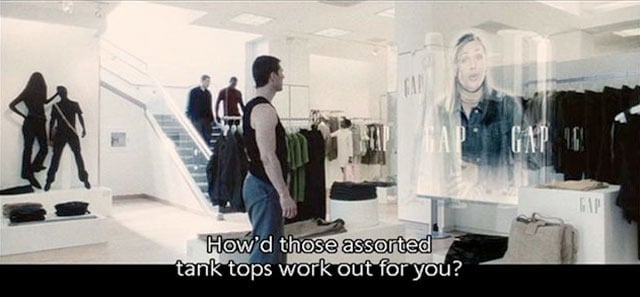
I can’t help but be reminded of that “biometric advertising” scene in Minority Report:
Two related articles about YouTube caught my eye over the past few days. The first, Zeynep Tufekci’s YouTube, the Great Radicalizer explains how YouTube’s algorithms almost always lead people to conspiracy theory videos:
It seems as if you are never “hard core” enough for YouTube’s recommendation algorithm. It promotes, recommends and disseminates videos in a manner that appears to constantly up the stakes. Given its billion or so users, YouTube may be one of the most powerful radicalizing instruments of the 21st century. […]
What we are witnessing is the computational exploitation of a natural human desire: to look “behind the curtain,” to dig deeper into something that engages us. As we click and click, we are carried along by the exciting sensation of uncovering more secrets and deeper truths. YouTube leads viewers down a rabbit hole of extremism, while Google racks up the ad sales.
YouTube’s app specifically for children is meant to filter out adult content and provide a “world of learning and fun,” but Business Insider found that YouTube Kids featured many conspiracy theory videos which make claims that the world is flat, that the moon landing was faked, and that the planet is ruled by reptile-human hybrids.
I try not to be too quick to call technology evil, but this is definitely not a “all technology is neutral” situation. Product managers and developers have the power to stop this kind of escalation from happening.
I accidentally went to a Best Buy the other day. To make a long story short, after an unplanned but long and pleasant chat with an Amazon rep I walked out with an Amazon Echo. Much has been written about Alexa and how good it is, and everything you’ve read about it is accurate. But I want to focus on a different aspect of Alexa: how it’s making my kids more self-sufficient.
See, the thing about kids is, they need you all the time. And that’s cool, because we’re their parents and we love them and we want to be there for them. But some tasks are incredibly boring and menial. I’ve outsourced some of those to Alexa to the great delight of our kids, who continue to find new things she never gets tired of doing.
Alexa, turn on some music that Mom and Dad are totally sick of
The biggest win for my kids so far has been the realization that they can listen to any music they want to. Right now it’s the Moana and Trolls soundtracks. Over and over and over and over and over and… But that’s ok, because my wife and I can be in another room, and they can listen to Get your hair up as much as they want without driving us insane.
Alexa, help us not fight over the iPad
We let our kids do iPad. Let’s just get that out of the way first. Anyway, it’s usually a choice between TV or iPad, and when they choose iPad it tends to result in a constant fight over whose turn it is. Not any more. Now they each get two turns of 10 minutes, and Alexa keeps score. They use Alexa to set the timer, and there hasn’t been any fighting (well, about this…) since.
Alexa, make us laugh
My daughters aren’t big fans of my jokes. It’s fine, I’m not bitter about it. Anyway, they discovered Alexa tells jokes too. I personally think my jokes are way better than hers, and here’s my proof:
Like I said, I’m not bitter about it.
Alexa, are we bad parents?
This is, of course, the big question when it comes to technology. Should we immerse our kids in it or should we shield them from it? We all find our own way when it comes to parenting, and even though we’re still working on what this technology balance looks like, my current feeling is that voice-activated UI doesn’t have many of the issues that are traditionally brought up as negatives about kids and technology.
First of all, Alexa is inherently social. It’s conversational, friendly, and it never gets tired. We laugh at her together. The Echo is not an “alone” device, and I think there’s something really powerful about that. But second, it’s also really useful. Our kids love asking it questions, and coming up with new ways to trick it into a misunderstanding.
Conversational UI certainly has a long way to go. But I will say that I am so far pleasantly surprised with the natural way in which it integrates with our family life. It’s not a substitute for human interaction and connection, and our kids get that. But as a useful playmate of an entirely “other” type of technology, it’s a winner.
“Most people have what we would call a telephone voice, so they actually change away from their local family accent when they’re speaking on the telephone to somebody they don’t know,” said Alan Black, a Scottish computer scientist who is a professor at the Language Technologies Institute at Carnegie Mellon University in Pittsburgh.
They also have a “machine voice”, he said. “People speak to machines differently than how they speak to people. They move into a different register. If you’re standing next to somebody in an airport or at a bus stop or something, you can typically tell when they’re talking to a machine rather than talking to a person.”
This part on the design of Siri is really interesting:
Black speculated that “one of the reasons they designed Siri to be fundamentally a polite, helpful agent who isn’t your friend but works for you, is to encourage people to be somewhat polite and explicit to her, rather than being very colloquial. Because speech recognition is always hard when you drop into colloquialisms.”
Recall that first principle that [Brian Lathrop at Volkswagen] laid out for designing autonomous cars—that the driver has to know whether the car is driving itself. That harks to probably the oldest dictate in interface design; mode confusion causes 90% of airplane crashes, and that insight helped invent the field of human-computer interaction. Think about all the times you’ve heard news reports about a pilot being confused about whether the flaps of the wings were down, or whether to auto-pilot was properly set. If you’ve ever failed to realize that your car was in park when you hit the accelerator, or you’ve ever tried typing into the wrong window on your computer screen, you’ve been a victim of mode confusion.
So, the scariest thing about self-driving cars is not whether or not the car can drive safely, but whether it can effectively communicate when it is driving and when it is not. It’s the age-old Visibility of system status UI heuristic in action.
Doctors can send daily emails with information timed to milestones in surgery prep and recovery and ask patients or caregivers for feedback on specific issues patients may face during recovery.
The doctors may write their own email scripts, as Newport Orthopedics’ physicians did, or use the company’s suggested content. An online dashboard helps doctors and administrators keep track of which patients are doing well and who might need more follow-up care. Patients can also communicate with office staff about medications and office visits. Their responses to daily emails can trigger a call from the doctor’s office.
A patient might see this message: “How are you? Let me know so I can make sure you’re okay. I have four questions for you today.”
The program has had some promising results, but I’d be interested to know if patients are aware that the messages are automated. To put it another way, is it ethical for doctors to send automated, health-related messages that look like they’re individually crafted?
In An End to Parking? Clive Thompson writes about an aspect of self-driving cars that I haven’t seen before: the impact it will have on urban design. In particular, the amount of space we need for parking should change dramatically:
Robot cars could also drive much more closely to one another, packing far more vehicles onto a street. […]
What’s more, they’d never need to park. At the University of Texas-Austin, Kara Kockelman—a professor of transportation engineering—modeled the impact of autonomous ride-sharing vehicles and found that each one could replace up to a dozen regular cars. The robocars could drive all day long, stopping only to refuel or for maintenance; at night, when there was less demand, they could drive out to a remote parking spot on the outskirts of town. The upshot, Kockelman figures, is that if you shifted the entire city to autonomous cars, it would need a staggering 90 percent less parking than it needs today.