Menu

Posts tagged “ai”

Creating from a deeper place

There’s a lot going on in John Warner’s Speed and Efficiency are not Human Values. It’s primarily a reflection on generative AI tools in the context of being a published author—and well worth reading.

But the reason I am linking to it here is because it gives you an excuse to watch (or re-watch!) what John calls “the greatest guitar solo ever captured on a recording” (he is 100% correct). Here is Prince at the Rock and Roll Hall of Fame induction ceremony in the year both he and George Harrison (posthumously) were enshrined:

Here’s how John describes the solo in his post:

Prince was obviously a highly skilled guitarist capable of blazing speed on the fretboard (like the “Flight of the Bumblebee” guy) and indeed there’s a couple of spots where he just rips through some rapid note runs, but it’s also intensely musical, totally its own thing, while also managing to reference aspects of the solo from the original version (performed by Eric Clapton). […]

A great guitar solo is not about how fast you can play, or your degree of technical skill. It comes from a deeper place.

I know you’re going to roll your eyes, but seriously, the solo and that quote—it comes from a deeper place—inspires me to think a little bit more about the feel of the products we make, and a little bit less about the ”correctness” of fitting a specific mold.

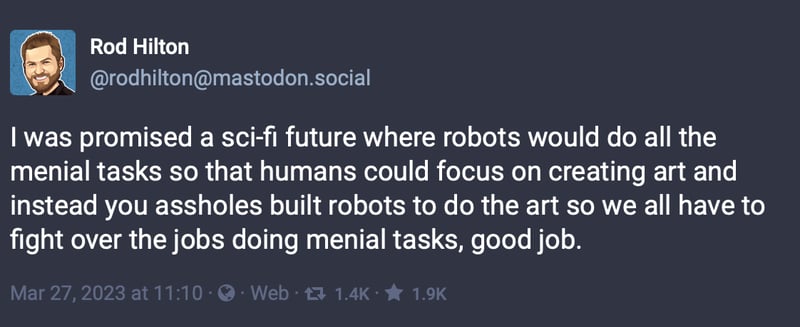
AI won’t free up our time to do more valuable and fun things at work and home

I enjoyed Bill Gates’s post The Age of AI has begun, right until he got to this bit:

When productivity goes up, society benefits because people are freed up to do other things, at work and at home.

The idea that increased productivity gives people more time to do other things that are more useful and fulfilling is a thoroughly-debunked theory. First, there’s the question of what we even mean by “productivity”, especially in the context of the Productivity Paradox:

The productivity paradox (also the Solow computer paradox) is the peculiar observation made in business process analysis that, as more investment is made in information technology, worker productivity may go down instead of up.

But even if we can get to a point where we agree on how to define the word, we have known for a long time that the only thing that increased productivity does is create more work:

The usual first response to encountering the Productivity Paradox is disbelief: “If I have to write a few emails so that I don’t have to use a carrier pigeon, sign me up!”

But in a bureaucracy, the story of those few emails usually doesn’t end there. So, you send your few emails, and then you soon get email replies and comments. Now, you have to write more emails in reply to those emails, which are then sent up the hierarchy and to a chain of full-time reviewers, who each make a comment to show that they are useful.

So when we get more productive the time we “save” on one type of task just gets filled with a different, not necessarily more valuable task. But what about “at home”, you ask? Nope. We have also known for a very long time that instead of giving us more time for hobbies and hanging out, technology is killing leisure time:

The very tools that were supposed to liberate us have bound us to our work (and schools) in ways that were inconceivable just a few years ago. Almost all of us have less leisure time than ever. We work harder, take fewer vacations for shorter periods of time, report more stress than almost any other demographic group and find the boundaries between work and play increasingly blurred. Computing and communications technologies are destroying the idea of privacy and leisure.

So anyway, Bill Gates wrote a pretty insightful take on AI, in my opinion. But the idea that generative AI will free up our time to do more valuable and fun things is not backed up by history at all. Or to put it slightly differently:

Link roundup for March 25, 2023

The Beauty of Earth From Orbit.

Google and Microsoft’s chatbots are already citing one another in a misinformation shitshow. This is fine. “If you ask Microsoft’s Bing chatbot if Google’s Bard chatbot has been shut down, it says yes, citing a news article that discusses a tweet in which a user asked Bard when it would be shut down and Bard said it already had, itself citing a comment from Hacker News in which someone joked about this happening, and someone else used ChatGPT to write fake news coverage about the event.”

One hundred drones now used across IKEA retail for stock inventory. “One hundred busy drones are now at work during non-operational hours to improve stock accuracy and secure availability of products for online or physical retailing. This solution supports a more ergonomic workplace for IKEA co-workers as they no longer need to manually confirm each pallet.”

Is Blockbuster video about to make a comeback? I didn’t realize how many chances Blockbuster had to not die. “In 1997, Warner Bros approached Blockbuster with an exclusive DVD rental deal that would have split revenue 60-40 in favour of the studio. Blockbuster rejected it, and the studio retaliated by dropping its DVD retail prices to undermine the rental industry. And then in 2000, Blockbuster made two even more fatal decisions. First, Blockbuster turned down the opportunity to purchase the then-fledgling Netflix. Second, it chose instead to partner with Enron. Within a year, Enron filed for bankruptcy. Within five years, Netflix was shipping out a million DVDs every day. Suddenly, Blockbuster was yesterday’s news.”

Is there a drop in software engineer job openings, globally? “The US, Canada and UK are currently seeing some of the lowest numbers of developer job listings since Feb 2020.”

Swimming outside the lanes. Tracy Durnell talks about leaving her day job and going out on her own. “People complain that no one wants to work anymore. And it’s true to an extent: no one wants to work in a job where they are underpaid, unfairly treated, unappreciated, and constrained. I like my work, but so far dislike jobs.”

Shiny Happy People, Being Chased By Monsters. Are we in the midst of a vibe shift back to the days of whimsy? “FreakyLinks may have been on my mind lately because I think we’re in another moment of cultural shift from seriousness to whimsy; if you don’t believe me, ask yourself why Everything Everywhere All At Once so thoroughly kicked the ass of that movie about the mean conductor lady at the Oscars. We’re at a similar moment to where we were in the early 2000s — where people are shrieking ‘I want to be happy!’ and ‘I’m tired of thinking! Give me some baggy orange leather pants instead!’”

Songs are what we carry, even when we have nothing else. On the B-Sides I talk about the latest U2 album a little bit. “It’s the sound of a band that has been together for close to 50 years starting to wind things down the only way they know how: they sing the songs they carry, even when they don’t have a whole lot left.”

Link roundup for March 18, 2023

This feed of imagined alternate universe tech products is mind-bendingly wonderful.

Employees Are Feeding Sensitive Business Data to ChatGPT. Feels like this should be a bigger story. “Employees are submitting sensitive business data and privacy-protected information to large language models (LLMs) such as ChatGPT, raising concerns that AI services could be incorporating the data into their models, and that information could be retrieved at a later date if proper data security isn’t in place for the service.”

How companies can better understand neurodivergent employees. Good reminder: “If you use closed captioning, text messaging, or noise-canceling headphones, or have pushed a stroller or ridden a bike over the ramps at the end of sidewalks/curbs (see the curb cut effect), you’ve benefited from design that prioritized users who had these needs but are not the convenient ‘majority’ for whom many products are designed. Designing for difference enables innovation and productivity while setting up an enterprise to be future-fit and successful.”

I needed to hear this, so I’m sharing just in case you might need to hear it too: “When we have a lot on our plate, we tend to neglect the very things that equip us to handle having a lot on our plate. We leave aside exercise, which is important for physical and mental health. […] Leaving out our health to fend for last place in our list of priorities is bad enough. However, doing it when you most need your health to contend with a growing list of priorities is worse still.”

This latest Amazon forced “return to office” news is bleak. “The fact that Amazon’s S-Team did not blink, and refuses to soften the return to work policy signals that they either don’t expect much attrition, or have calculated with additional attrition. […] At the same time, looking at the market, it’s hard not to ask the question: if people want to leave, where will they leave to?”

Chat apps are no substitute for documentation. “Chat apps like Discord [and Slack] end up diluting the available knowledge because the content shared in them isn’t persistent, and the allure of an always-available answer breaks down when the person that could answer is no longer available.”

Modern Font Stacks. System font stack CSS organized by typeface classification for every modern OS. “No downloading, no layout shifts, no flashes — just instant renders.”

In The Name of The Father provides a fatherhood lens on the first season of The Last of Us that really resonated with me.

The new M83 album is out and it is, in my opinion, a return to form. On repeat over here.

Link roundup for March 1, 2023

Open Circuits is “a photographic exploration of the beautiful design inside everyday electronics. Its stunning cross-section photography unlocks a hidden world full of elegance, subtle complexity, and wonder.”

Good conversations have lots of doorknobs. This is a fascinating essay about the elements of good conversation and the difference between “takers” who keep things going, “givers” who tend to ask a lot of questions, and how the wrong match-up can cause a conversation to stall. Includes good advice backed up by tons of academic research. This is one to save and revisit often.

Why do modern pop songs have so many credited writers? Some of the examples are wild. “When these cases are settled in favor of the plaintiff, more songwriting credits are added after a song’s release. This is why the number of songwriters listed on Mark Ronson’s “Uptown Funk” has increased over the years. To avoid a Mark-Ronson-style-courtroom-induced headache, artists will sometimes preemptively credit writers of older songs even if the similarity between the older song and their composition is purely coincidental.”

A “Last of Us” Episode 7 musical mystery (light spoilers). I just want to say don’t worry The Last of Us fans, I’m thinking about the important things over here.

The choice is easy. Robin Sloan with a good reminder: “Anyone who adds one of those email newsletter pop-ups to a website demeans them selves and makes the world worse for everyone else.” Reminder that if you are an author using Substack you can turn off “Subscribe prompts on post pages” in Settings.

Quick Review Summary. Ok this seems like an actually good use of OpenAI. Instead of poring over hundreds of reviews of a hotel, copy the Tripadvisor URL of the hotel into this website and it will generate a summary of the general sentiment of the hotel.

Neurodiversity Design System. Great resource. “The NDS is a coherent set of standards and principles that combine neurodiversity and user experience design for Learning Management Systems. Design accessible learning interfaces supporting success and achievement for everyone.”

SoundPrint is an app to “discover quiet places and share them with others.” This looks really useful, especially if you’re a fellow tinnitus sufferer.

Link roundup for February 15, 2023

AMEN by Jessica Hilltout. “The aim of AMEN was to shine the light on all those in the shadow of the World Cup, far from the big stadiums and the corporate carnival-nature of the event. To embrace Africa and everything that makes it unique. To speak of the authenticity and sheer ingenuousness of a continent that manages to do so much with so little. To capture people with simple needs and huge hearts. To express football in its purest form.” [jessicahilltout.com]

God Did the World a Favor by Destroying Twitter. I love Paul Ford. “Our smarter, richer betters often preach the idea of a town square, a marketplace of ideas, a centralized hub of discourse and entertainment—and we listen. But when I go back and read Genesis, I hear God saying: ‘My children, I designed your brains to scale to 150 stable relationships. Anything beyond that is overclocking. You should all try Mastodon.’” [wired.com]

SolidGoldMagikarp (plus, prompt generation). This is all super weird and shows that we really have no idea what’s going on with these LLMs. Are we really ready for this stuff to become the backbone of internet search? “We’ll demonstrate a previously undocumented failure mode for GPT-2 and GPT-3 language models, which results in bizarre completions (in some cases explicitly contrary to the purpose of the model), and present the results of our investigation into this phenomenon.” [lesswrong.com]

Hey, Ease Up; A Load-Bearing If-Statement. What happens if, for health reasons, you need to use a fitness tracker to move less? “But if you’re trying to conserve energy, you don’t want to reach that goal. You want to stay under it. Sure, you want to maybe get up and about, I guess? Take a very slow short walk outside? But you are supposed to be resting.” [newsletter.danhon.com]

Scientists Develop Compound That Kills So Efficiently They Named It After Keanu Reeves. “The molecules ‘kill so efficiently that we named them after Keanu Reeves,’ German researcher Sebastian Götze said in a press release, ‘because he, too, is extremely deadly in his roles.’” [futurism.com]

Buy Nothing groups and the culture of free stuff. This deep-dive into the things people post in Buy Nothinggroups (and that actually get picked up!) is quite something. “There is something about free stuff that makes us abandon all rational thought.” [washingtonpost.com, soft paywall]

The mystery of the disappearing vacation day. Why have we stopped taking regular vacations? “Many were on a paid-time-off (PTO) plan that lumps sick days, personal days and vacation days in a single bucket. While workers often appreciate the flexibility of PTO and employers find it easier to administer, such plans can deter taking long vacations by making us feel as if we’re cutting into the PTO we might need in case of sudden illness or tragedy.” [washingtonpost.com, gift article link]

Nope, coffee won’t give you extra energy. It’ll just borrow a bit that you’ll pay for later. Ok listen, don’t come at me with your “facts”, please. “While it feels energizing, this little caffeine intervention is more a loan of the awake feeling, rather than a creation of any new energy.” [theconversation.com]

Stray Links for January 22, 2023

Every few days I post some links to things I enjoyed that don’t neatly fit into the topics I usually cover on this blog. Use it to fill your reading queue with interesting stuff.

  • The Most Ridiculous and Weird Tech Gadgets From the Last 25 Years. “The Hushme was a ‘voice mask’ intended to let you make phone calls without bothering anyone.”
  • Between-time by Mandy Brown. “We live in a world full of distractions but short on breaks. The time between activities is consumed by other activities—the scrolling, swiping, tapping of managing a never-ending stream of notifications, of things coming at us that need doing. All that stuff means moments of absolutely nothing—of a gap, of an interval, of a beautiful absence—are themselves absent, missing, abolished.”
  • Movie Trailers Keep Tweaking Well-Known Songs. The Tactic Is Working. (NYT gift article link) “As a composer, Rosen is at the forefront of the trailerization movement: He’s in demand for his ability to rework existing songs to maximize their impact in trailers for films and TV shows.”
  • All Human Systems are Enormous Trash Fires. “Once you recognize that all human systems are enormous trash fires, you stop trying to figure out how to switch to a system that isn’t an enormous trash fire, since they don’t exist. […] Eventually you even start to appreciate the beauty of it. How impressive it is that we manage to get anything done at all, given how completely trash everything is, and how on fire it is all the time.”
  • This is a beautifully-written piece about standup comedy but also about so much more. I don’t want to spoil it, except to say it starts like this: “Perhaps due to lockdown and the interruptions to normal service, but more likely due to autumnal intimations and a long dormant weakness for sentimentality, I now cherish the belief that the only flavour for which a grown-up should cultivate a taste is the bittersweet.”
  • KC Green reflects on creating the “This is Fine” meme. “When a work gets as big as this has, is it still yours?”
  • Eightify: AI Youtube Summary with GPT. A Chrome plugin that promises: “Instant AI summaries for Youtube videos using GPT. Summarize video into 8 key ideas.”
  • Can Doom Run It? An Adding Machine in Doom. “I demonstrate that it is possible to run any bounded computation in Doom, minus constraints on level size.”

Stray Links for January 20, 2023

Every few days I post some links to things I enjoyed that don’t neatly fit into the topics I usually cover on this blog. Use it to fill your reading queue with interesting stuff!

  • The Astronomy Photographer of the Year 2022 Winners are out.
  • Did the Music Business Just Kill the Vinyl Revival? “On an aggregate level, consumers are simply not buying music. They prefer to stream it for pennies rather than purchase it for dollars.”
  • How Do Big Tech Giants Make Their Billions? I know infographics are so 2000s, but this comparison data is super interesting.
  • This week’s useful appReadow provides book recommendations powered by AI.
  • This week’s WTF LinkThe lights have been on at a Massachusetts school for over a year because no one can turn them off. “The lighting system was installed at Minnechaug Regional High School when it was built over a decade ago and was intended to save money and energy. But ever since the software that runs it failed on Aug. 24, 2021, the lights in the Springfield suburbs school have been on continuously, costing taxpayers a small fortune.”
  • This week’s Gen X linkRemembering horse_ebooks in the age of GPT3. “it’s this fear of the uncanny which i think drove the negative response to the discovery that horse_ebooks was actually no longer a bot at all. more than the disgust at feeling like you’d been played in service of a viral marketing campaign, the deeper sense that a future is coming where it won’t be possible to reliably tell the difference between bot activity and human activity lay underneath that negative reaction. and ten years later - that future is here.”

Companies have to get better at explaining the data behind personal recommendations

Ryan Bigge makes some very good points in his post about better personalized recommendations through transparency and content design:

Data-driven companies know something that the user doesn’t. Yet the language used to convince people to act on recommendations lacks variety and explanatory power.

Algorithms aren’t neutral — or as Ryan puts it:

Every facet of machine learning is fueled by human judgement, so it must be multi-disciplinary.

Users are getting more skeptical about where these magical recommendations for what to watch, listen to, and buy come from. To establish and build trust, companies have to get better at explaining exactly why they’re recommending a specific product or action.

The social values of artificial intelligence

A lot of words are being written about AI and machine learning these days, so it’s sometimes hard to know what to pay attention to. M.C. Elish and danah boyd’s Don’t Believe Every AI You See is one of those essays that I would consider essential reading on the topic. On the ethics of artificial intelligence:

When we consider the ethical dimensions of AI deployments, in nearly every instance the imagined capacity of a technology does not match up with current reality. As a result, public conversations about ethics and AI often focus on hypothetical extremes, like whether or not an AI system might kill someone, rather than current ethical dilemmas that need to be faced here and now. The real questions of AI ethics sit in the mundane rather than the spectacular. They emerge at the intersections between a technology and the social context of everyday life, including how small decisions in the design and implementation of AI can create ripple effects with unintended consequences.

And on the supposed “neutrality” of machines:

[There is] a prevailing rhetoric around AI and machine learning, which presents artificial intelligence as the apex of efficiency, insight, and disinterested analysis. And yet, AI is not, and will not be, perfect. To think of it as such obscures the fact that AI technologies are the products of particular decisions made by people within complex organizations. AI technologies are never neutral and always encode specific social values.

As Kevin Kelly also pointed out years ago in his book What Technology Wants, technology is never neutral. It possesses the collective values of its creators. And that’s where things so often go wrong. A great resource on this topic is Sara Wachter-Boettcher’s book Technically Wrong: Sexist Apps, Biased Algorithms, and Other Threats of Toxic Tech.