How mankind will cope with the avalanche of information and entertainment about to descend upon it from the skies, only the future can show. Once again science, with its usual cheerful irresponsibility, has left another squalling infant on civilization’s doorstep.
An avalance of information and entertainment
Should designers learn to code? Who cares, as long as they always remain curious.
Tucked away among the usual arguments for and against designers being able to code, Mandy Brown makes an interesting observation in Specialist or Generalist?, a roundtable discussion on the issue:
You do not need to be proficient in practices other than your own; but you ought to be curious. Curious enough to ask questions, to read about things, to get your hands dirty. It’s lack of curiosity about other disciplines that is deadly, not lack of skill.
This is a statement worth digging into, because curiosity is one of the most important characteristics of a good designer (well, of anyone, really). Sara Wachter-Boettcher explains the reason really well in her piece On Content and Curiosity:
Curiosity keeps us hungry. It leads us to tackle new challenges when the easy questions have all been answered. It makes us wonder how things could be better””even when they are, if w’d just pause to admit it, pretty damn good already.
There is a very legitimate counter-argument to being incurably curious, though. We might gain such shallow knowledge about so many different things that we end up unable to form or articulate opinions on anything because we just don’t know enough about a specific topic.
This is the core of the “specialist” argument, and it’s articulated very well in Stop Trying To Be Diverse, an interesting post about photographers on the Musea blog. The author tells the story of a particular photographer who spent his entire life shooting black-and-white portraits of people against a white or grey background. Boring, right? Well…
We don’t want to restrict ourselves to something like that because we feel that we will get bored. However, boredom is a great thing! What actually occurs is, boredom forces us to be more creative if we can push through it. Our work will improve if we find different ways to solve the same problem over and over, instead of switching between 10 independent problems. Avedon forced himself to come up with something new every time his subject stepped in front of his white seamless background. He had to find something unique about each individual, otherwise he would fail. The difference in his work came from what his subjects brought to the image, not by some new Photoshop filter or fancy off-camera lighting technique he used.
I’ll illustrate this with a story about my own online behavior. The other night I went online to do something (who knows what it was), and an hour later I found myself reading an article about a guy who feels that Louis C.K. was stupid because he made “only” $1 million from his standup comedy experiment. The person claimed that he could have helped Louis C.K. make $5 MILLION!!! I got to end of the article and all I could think was, “Why do I read this crap?” Well, I read it because my curiosity sometimes overcomes my importance filter. And getting that balance right is what we all need to make this curiosity thing work for good, not evil.
So, how do we arrive at (and maintain) this balance? How do we remain curious, and still manage to temper our gluttonous, Internet-fed thirst for All Things, All The Time? The core of the solution lies in learning what to cull from our lives, and what to surrender instead. In The Sad, Beautiful Fact That We’re All Going To Miss Almost Everything, Linda Holmes describes the two concepts as follows:
Culling is the choosing you do for yourself. It’s the sorting of what’s worth your time and what’s not worth your time. It’s saying, “I deem Keeping Up With The Kardashians a poor use of my time, and therefore, I choose not to watch it.” It’s saying, “I read the last Jonathan Franzen book and fell asleep six times, so I’m not going to read this one.”
Surrender, on the other hand, is the realization that you do not have time for everything that would be worth the time you invested in it if you had the time. Surrender is the moment when you say, “I bet every single one of those 1,000 books I’m supposed to read before I die is very, very good, but I cannot read them all, and they will have to go on the list of things I didn’t get to.”
We constantly need to learn how to make better decisions about culling and surrendering. For example, I should have culled that Louis C.K. article. And at some point I need to choose to surrender all the UX articles in my Instapaper queue and just freakin’ fire up Balsamiq.
Should designers learn to code? It depends entirely on each designer’s ability to decide if it’s a skill that should be learned or surrendered in the bigger picture of meeting his or her ultimate life/career goals. Put another way, there is no right answer, as long as the designer is at the very least curious enough to know how development works, and at best has made a conscious decision either to surrender the skill or dive in and learn it.
Think Different (as long as enough people will like it or retweet it)
In Facebook’s Philosophy Kyle Baxter makes a good point about what happens when sharing something becomes part of doing it:
Once the sharing is a part of the doing, you no longer consider whether to do something in the isolation of whether you want to do it. When sharing is a part of the package, you also consider how whatever it is you’re doing will reflect on you. You’ll consider what the general public’s, or your network’s, standards are for it.
Nick Bradbury makes a similar point in The Friction in Frictionless Sharing:
In the past the user only had to decide whether to share something they just read, but now they have to think about every single article before they even read it. If I read this article, then everyone will know I read it, and do I really want people to know I read it?
When you think this all the way through the implications are quite bleak. The theory is that the more we share about our lives, the more we tend to take into consideration what people might think of us before we do something. But it’s not just a passive “I wonder what they’ll think of me”. Figuring out what to do next becomes an obsession, a constant search to answer the same question over and over: what can I do that will get me the most likes or retweets?
It’s a dangerous game - one where we’re not just trying to hang on to our reputations, but actively using our knowledge of what our network “likes” to guide our lives. “Think different” becomes “Think different in a way that will generate the most engagement with my personal brand.” Maybe the value of Allen Salkin’s philosophy that “there is something magical about a life less posted” is that it frees us to live our own lives again.
The value of Very Small Data
Alan Mitchell on the problems with Big Data and the value of what he calls Very Small Data:
So there are two classes of data which help solve different types of problem. Big Data is statistical and deals with general trends and patterns; Very Small Data is specific and deals with getting things done: gathering the information needed to make a decision, to make an arrangement, or to get some administrative chore done. Because it’s Very Small and rather mundane and specific, it doesn’t seem as glamorous and important as Big Data. But it is.
He goes on to discuss four major problems with Big Data, and the enormous opportunities that exist in the area of Very Small Data. It’s an essay well worth your time.
22seven: an observation, a complaint, and a suggestion
Yesterday saw the Beta launch of a new Mint.com-type startup in South Africa called 22seven. They’re essentially aiming to give people better insight into the money they spend, and help them make better decisions about that. Or to put it in their own words:
We use smart information-gathering technology so our users can see all their financial stuff in one place. W’ve applied insights from behavioural economics so our users can better understand the way they think. And by employing principles of play, our users become more engaged, and more willingly engaged, with their money.
It didn’t take long for the banks to start freaking out about the security implications of giving your banking credentials to a third party, but there have also been some defenses of the safety of the service. Instead of rehashing those arguments, I’d like to make three quick comments about the new service.
An observation
I’ve been watching this unfold with fascination over the last 24 hours. Everyone who attended the launch event in Johannesburg seemed really impressed, but it didn’t take long for some (legitimate) concerns to arise as people started trying out the service:
My mom told me never to accept sweets from strangers and to give out my pin number… So… Yeah… Sorry 22seven…
”” Cathryn Reece (@CathrynR) January 26, 2012
That’s a sentiment I agree with, but things started to go downhill a bit from there as the tweets became more and more negative. We’re a finicky bunch of complainers, aren’t we! But as I caught myself just in time before getting sucked into the negativity vortex, a phrase jumped into my head: Schlep Blindess. As in - these guys don’t have it. In Paul Graham’s excellent essay he describes schlep blindness as the inability to identify hard problems to solve:
The most dangerous thing about our dislike of schleps is that much of it is unconscious. Your unconscious won’t even let you see ideas that involve painful schleps. That’s schlep blindness.
He ends his essay by explaining how to avoid schlep blindness:
Some ideas so obviously entail alarming schleps that anyone can see them. How do you see ideas like that? The trick I recommend is to take yourself out of the picture. Instead of asking “what problem should I solve?” ask “what problem do I wish someone else would solve for me?”
And that’s why I admire the creators of 22seven. They’re working on a problem we all want solved, but most of us are too scared to work on. And for doing that, they deserve enormous credit.
A complaint
Speaking of finicky complainers, can I be one of those for a minute? Ok, cool. Obviously my first instinct was to scrutinize the design of the site, and even though there’s a lot to like about it, I have to mention a couple of things that I believe are not implemented correctly from a UX Design perspective.
First, forcing someone to wait for a Flash (!!) animation/introduction to load when they click “Register” is just not a good thing. Users don’t have patience for that stuff. If I ask for a registration form, my expectation is to see a registration form immediately. But my main beef is with the registration form itself:
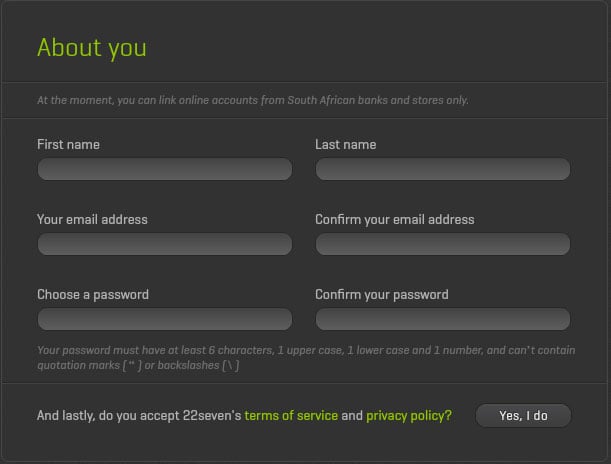
Here are some of the issues:
- The text has very low contrast with the background which makes it difficult to read. Come on, everyone - join the contrast rebellion!
- We know that it’s bad to use multi-column layouts in forms.
- Speaking of contrast, what stands out are the phrases “About you”, “terms of service”, and “privacy policy”, while the primary call to action (“Yes, I do”) is a grey button on a dark grey background.
- While I’m nitpicking, if the button says “Yes, I do”, shouldn’t the title be “About me”?
We just don’t have to re-invent forms any more. The hard work has been done for us - we know how forms should be designed. And I don’t want to get into the Flash debate again, but why build this thing on a waning technology when you can build a responsive HTML web app that works on all devices?
A suggestion
Lastly, I’d like to offer a suggestion. If it is indeed true that 22seven has not met with South African banks yet, that’s a situation that should be rectified soon. In fact, my suggestion is that 22seven meets with one bank and work with them on an API solution that will allow them to access users’ banking information without having to store their credentials at a 3rd party. That’s what OAuth is for. And based on everything we know about Michael Jordaan (the CEO of FNB), wouldn’t FNB be the perfect bank to partner with on this? Once they’re on board, and FNB’s handsome and smart clients start using the service, the other banks are sure to follow.
I’d like to end where I began - on a positive note. I’m truly grateful that 22seven is tackling the banking/money management problem in South Africa in a very real and committed way. I think they vastly underestimated the backlash they would get from users when they’re suddenly asked for their online banking credentials (otherwise the web site would have been littered with trust-building explanations and images). But that’s a fixable problem, and so is my UX nitpicking - they’re not difficult issues to address.
So despite my complaining, I’m extremely excited about 22seven, and I’m rooting for them to succeed. I hope you’ll join me.
Good design practice: agree on the problem before tackling the solution
In 1955 David Ogilvy wrote a fascinating letter about his habits as a copywriter. One of his points jumped out at me:
I write out a definition of the problem and a statement of the purpose which I wish the campaign to achieve. Then I go no further until the statement and its principles have been accepted by the client.
This is applicable to design projects as well. If clients (internal or external) ask us for some quick wireframes, it is our responsibility as user experience designers to push back and make sure everyone agrees on the problem and the goals of the project first - before the design cycle starts. It sounds so obvious, but I see people falling into this trap all the time.
The product discovery process can take months, weeks, or even a few hours if there are tight deadlines. But it cannot take zero hours - that’s a recipe for disaster.
There can be no wisdom without data
Nick Carr on the belief that remembering facts becomes less and less important with the increased accessibility of information online:
But this idea that knowledge can be separated from facts - that we can know without knowing - really needs to be challenged before it gains any further currency. It’s wonderful beyond words that we humans can look things up, whether in books or from the web, but that doesn’t mean that the contents of our memory doesn’t matter. Understanding comes from context, and context comes from knowing stuff. Facts become most meaningful when, thanks to the miracle of memory, we weave them together in our minds into something much greater: personal knowledge and, if we’re lucky, wisdom.
Perhaps this is the kernel of truth in the “Google makes you stupid” argument. The field of Information Science teaches that wisdom comes from knowledge, which comes from information, which comes from data. If we can’t hold enough pieces of data in our heads for at least a little while, the whole house of cards comes tumbling down.
Working at a startup vs. a big company
Interesting perspective from the CEO of Ooga Labs:
In fact, I would argue that you learn the wrong things working for a big company, and that it’s actually not good experience. A good experience is when you really make something happen in the world. Big companies teach you how to work through layers of bureaucracy and how to solve problems in very risk-averse ways ”” in short, how to make something happen in their organization. A big company is not the safe career choice. It’s the risky choice. It risks your mind and your life.
This goes hand in hand with another misconception that big company jobs are more secure than startup jobs. In my experience the chances of a startup running out of money and a big company needing layoffs are roughly the same.
Creepy content
“Content” Creep is an important article by Drew Breunig. I try to shy away from the word “must-read”, but this is probably as close as it gets. Breunig takes a step back to analyze the constant stream of web content we see every day, and he draws some interesting macro conclusions about the current state and future of publishing on the web.
He starts off by explaining the problems with the word “content” itself, and goes on to use the content farm “company” Demand Media as an example of the problem with measuring quality in web publishing:
Unfortunately, even if we assume page views are capable of measuring quality Demand’s business model prevents them from doing so. Because Demand’s “approach is driven by consumers’ desire to search for and discover increasingly specific information across the Internet”, page views are only capable of reflecting how well Demand’s “content” has been optimized for search engines. If a piece appears in search results, is clicked by a user, and closed because the writing is shoddy, Demand is only able to measure everything before the click. At best the page views metric can measure the quality of the headline. At worst they reflect the SEO tricks employed by a site.
Or to put it more succinctly:
Demand has created an environment which incentivizes SEO hacks more than good writing.
This is so true, and results in the type of ad-infested web sites I’ve written about before as well. Breunig goes on to explain what he calls the impending “content crunch”, and the need to adjust business models to account for quality. His conclusion is spot on:
It’s hard to believe a single word could slate an entire industry for failure. On its own, the word “content” is merely awkward. But as a unit of measurement, “content” affects business is real ways. Ignoring the variables audiences care about in order to populate Excel spreadsheets incentivizes weak writing short on substance and attention spans. All this would be tremendously depressing if it wasn’t creating an enormous opportunity for people with the courage to look beyond the numbers, where it’s too messy to measure, and invest in journalism, videos, photography, and art people might actually enjoy.
A site that immediately comes to mind as an example of the kind of courage Breunig speaks of is the brilliant Brainpickings - “a human-powered discovery engine for interestingness, culling and curating cross-disciplinary curiosity-quenchers, and separating the signal from the noise to bring you things you didn’t know you were interested in until you are.”
The article and Breunig’s main conclusions remind me of one of Clay Johnson’s points in his book The Information Diet:
Just as food companies learned that if they want to sell a lot of cheap calories, they should pack them with salt, fat, and sugar””the stuff that people crave””media companies learned that affirmation sells a lot better than information. Who wants to hear the truth when they can hear that they’re right?
The problem lies not just with the content farms, but also with us - the people who click on the links because it gives us more of what we want (even if it’s not good for us). The only solution to this problem is something that sounds like a pipe dream - expecting readers to be more conscious about the information they allow into their lives so that content farming ceases to be effective. In Johnson’s words:
The first step is realizing that there is a choice involved. As much as our televisions, radios, and movie theaters would have us believe otherwise, information consumption is as active an experience as eating, and in order for us to live healthy lives, we must move our information consumption habits from the passive background of channel surfing into the foreground of conscious selection.
For bonus points, read A long sentence is worth the read - it’s also a really good related discussion on the topic:
Enter (I hope) the long sentence: the collection of clauses that is so many-chambered and lavish and abundant in tones and suggestions, that has so much room for near-contradiction and ambiguity and those places in memory or imagination that can’t be simplified, or put into easy words, that it allows the reader to keep many things in her head and heart at the same time, and to descend, as by a spiral staircase, deeper into herself and those things that won’t be squeezed into an either/or.
Beautiful.
Mark Twain's excellent 19th century guidelines for writing on the web
We just don’t rant like we used to. Sure, there have been some good ones recently, but we have lost the art of being angry and highbrow at the same time - a skill that gives the rant a deliciously icy, brutal feel. For example, when you read something like Mark Twain’s 1895 rant about the rules of fiction, the current crop of angry that comes across our Twitter feeds feels a bit Mickey Mouse.
One of Mr. Twain’s specific complaints in the aforementioned rant is about the rules of good dialogue in fiction. As I read through it, I realized it provides a scarily perfect contrast to the language used on many web sites today:
[When] the personages of a tale deal in conversation, the talk shall sound like human talk, and be talk such as human beings would be likely to talk in the given circumstances, and have a discoverable meaning, also a discoverable purpose, and a show of relevancy, and remain in the neighborhood of the subject at hand, and be interesting to the reader, and help out the tale, and stop when the people cannot think of anything more to say. But this requirement has been ignored from the beginning of the “Deerslayer” tale to the end of it.
That’s unfortunately not what most of the web sounds like - but this paragraph from 1895 contains some of the best guidelines we have for effective web writing. Web site and application copy should:
- Not sound robotic.
- Use words that two people would use in everyday conversation.
- Not be gibberish words strung together to sound fancy, but mean something to normal people.
- Not just exist to fill up space, but have an identifiable purpose for being on that page and in that context.
- Be relevant to the flow the user is currently in.
- Be interesting and help tell the story.
It would seem that Mark Twain was one of our first (and best) web Content Strategists.