Menu

Posts tagged “user experience”

The user experience of treadmills

Sheila Marikar wrote a very interesting piece for Bloomberg called The Race to Disrupt Your Tedious Treadmill Workout Is Heating Up. It talks about the mind-numbing boredom of running on a treadmill, with a focus on their design:

Today’s electric machines absorb shock better and look sleeker, but the ones in most gyms retain a certain quaintness, with their last-gen phone-charging cables and omnipresent menu of Calorie, Heart Rate, Manual, Random, Hill.

It then discusses how companies like Peloton are trying to change that:

In a kettlebell-adorned lounge area afterward, Foley talks up the treadmill’s design. “You don’t want to hit a little button 20 times when you’re running full sprint,” he says. “So we asked, ‘Where are your hands, and what would be easy to interact with?’

“Fitness equipment is a very dopey category,” he adds. “It hasn’t evolved. You still sometimes see the dots rotating around the track. It’s a 1979 interface.”

I love reading stories about how user-centered design is used to upend and dramatically improve the user experience of entire industries. We saw it in phones, in the taxi industry, and countless others. I’m looking forward to seeing it in treadmills as well.
Using storytelling to demystify meditation

I enjoyed this interview with Anna Charity, the head of design at Headspace. Here she explains designing the product specifically to make meditation feel more inclusive:

One of the main things that we considered when we created the brand was that meditation should feel like it’s for everybody, and it should feel accessible and inclusive. More importantly, we try to show meditation in a really everyday way — we show it in contexts that people can easily imagine. And one thing that all of us have in common is, is that we have a mind. Ever since Headspace’s inception we have always used characters and storytelling to explain meditation. As we all know, our minds are a complex place. They are full of different thoughts and emotions, and it isn’t always an easy place to inhabit. (That’s the reason meditation is so valuable.) From this, we knew we had to develop a style that communicated these ideas in an approachable and relatable way. And more importantly we found that characters are a great vehicle to represent the weirdness inside your head because they feel playful and memorable.

Why America gave up on mass transit

Jonathan English’s article on mass transit in America starts off sad, and just gets worse from there:

One hundred years ago, the United States had a public transportation system that was the envy of the world. Today, outside a few major urban centers, it is barely on life support. […]

At the turn of the 20th century, when transit companies’ only competition were the legs of a person or a horse, they worked reasonably well, even if they faced challenges. Once cars arrived, nearly every U.S. transit agency slashed service to cut costs, instead of improving service to stay competitive. This drove even more riders away, producing a vicious cycle that led to the point where today, few Americans with a viable alternative ride buses or trains.

It’s important to note that this is not an accident. It is a direct result of urban design:

The story of American transit didn’t have to turn out this way. Look again at Toronto. It’s much like American cities, with sprawling suburbs and a newer postwar subway system. But instead of relying on park-and-ride, Toronto chose to also provide frequent bus service to all of its new suburbs. (It also is nearly alone in North America in maintaining a well-used legacy streetcar network.) Even Toronto’s suburbanites are heavy transit users, thanks to the good service they enjoy.

Likewise, in Europe, even as urban areas expanded dramatically with the construction of suburbs and new towns, planners designed these communities in ways that made transit use still feasible, building many of them around train stations. When cities like Paris, London, and Berlin eliminated their streetcar networks, they replaced them with comparable bus service.

Some further reading that digs into pedestrians and cars a little more:

The benefits of buttons that don’t do anything

CNN has an interesting article about placebo buttons:

In New York City, only about 100 of the 1,000 crosswalk buttons actually function, confirmed a spokesperson from the city’s Department of Transportation in an email.

The article quotes Harvard psychologist Ellen Langer for the reasoning behind this:

According to Langer, placebo buttons have a net positive effect on our lives, because they give us the illusion of control — and something to do in situations where the alternative would be doing nothing (which explains why people press the elevator call button when it’s already lit). […]

In the case of pedestrian crossings, they may even make us safer by forcing us to pay attention to our surroundings. And ultimately, pressing a button doesn’t require much effort.

The BCC had a similar article a couple of years ago. Press me! The buttons that lie to you also quotes Ellen Langer, because there is nothing new under the sun:

But instead of framing this as an irrational delusion, Langer described the effect as a positive thing. “Feeling you have control over your world is a desirable state,” she explains. When it comes to those deceptive traffic light buttons, Langer says there could be a whole host of reasons why the placebo effect might be counted as a good thing. “Doing something is better than doing nothing, so people believe,” she says. “And when you go to press the button your attention is on the activity at hand. If I’m just standing at the corner I may not even see the light change, or I might only catch the last part of the change, in which case I could put myself in danger.”

When friction in software is not a bad thing

Clive Thompson digs into software that aims to add friction to our lives in his Wired essay We Need Software to Help Us Slow Down, Not Speed Up:

It’s certainly possible to slow our software, and thereby ourselves. But it’ll happen only when we become too unsettled by the speed of our journey.

His post reminds me of some other ideas I’ve read about this in the past. Chris Palmieri in A Practice of Ethics:

But some friction is borne of respect, when we present information about the choices available to users and help them make better decisions. An emailed invoice could remind a customer they were paying for a service they no longer use. A checkbox could assure a user of their current content privacy settings before posting a sensitive photo. Recognition of a past purchase can save a customer the hassle of having to return a book they already have, or confirm that they are re-buying exactly the same shampoo.

And here is Andrew Grimes in Meta-Moments: Thoughtfulness by Design:

Meta-moments can provide us with space to interpret, understand, and add meaning to our experiences. A little friction in our flow is all we need. A roadblock must be overcome. A speed bump must be negotiated. A diversion must be navigated. Each of these cases involves our attention in a thoughtful way. Our level of engagement deepens. We have an experience we can remember.

Not all friction is bad…

Vinyl Me, Please and the power of product thinking

I’ve been a Vinyl, Me Please customer since January 2015. Back then things were pretty basic. For roughly $25/month they would send you a “Record of the Month”, along with a custom art print and cocktail recipe. It was cool, and helped to expand my musical palate quite a bit.

But sometime over the over the past year or so they kicked things into high gear. VMP now offers a “Classics” track (my favorite!) and a “Hip Hop” track in addition to their “Essentials” track (the original “Record of the Month”). But what’s even more apparent now is how Vinyl Me, Please has grown into a role model of how to provide value to music lovers in the digital era. The thought and care that went into this month’s “Essentials” release proves it once again.

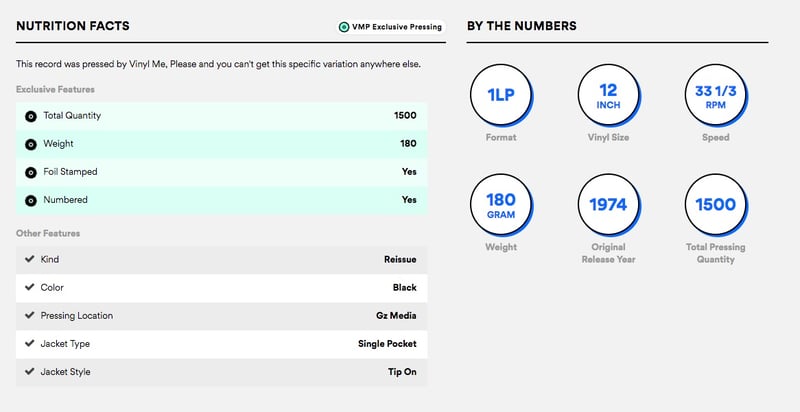
I noticed yet another example yesterday. The Vinyl Me, Please store now shows the “nutrition content” of each record they sell:

Vinyl nutritionn facts

Ask any vinyl collector and they will tell you how much this small detail improves the shopping experience. This is all the information we usually have to hunt for on product pages and do multiple Google searches about — but presented in a consistent, easy-to-read format. It’s such a relief and a breath of fresh air.

I’ve seen quite a few attempts to define “product thinking” lately. This example, to me, sums it up perfectly. “Product thinking” means gaining a deep understanding of what users need and what kind of friction they experience, and then providing a product solution that makes that friction go away in a delightful way.

Facebook’s biggest problem is its obliviousness to real humans

Nikhil Sonnad writes that Everything bad about Facebook is bad for the same reason:

Underlying all of Facebook’s screw-ups is a bumbling obliviousness to real humans. The company’s singular focus on “connecting people” has allowed it to conquer the world, making possible the creation of a vast network of human relationships, a source of insights and eyeballs that makes advertisers and investors drool.

But the imperative to “connect people” lacks the one ingredient essential for being a good citizen: Treating individual human beings as sacrosanct. To Facebook, the world is not made up of individuals, but of connections between them. The billions of Facebook accounts belong not to “people” but to “users,” collections of data points connected to other collections of data points on a vast Social Network, to be targeted and monetized by computer programs.

Here’s the crux of it:

There are certain things you do not in good conscience do to humans. To data, you can do whatever you like.

The stress of interacting with voice UIs

This bit from Raluca Budiu and Page Laubheimer’s user study of digital assistants like Alexa, Google Assistant, and Siri echoes my thoughts exactly on why I don’t like interacting with them:

Many participants started speaking before formulating the query completely (as you would normally do with a human), and occasionally paused searching for the best word. Such pauses are natural in conversation, but assistants did not interpret them correctly and often rushed to respond. Of course, answers to such incomplete queries were incorrect most of the time, and the overall effect was unpleasant: participants complained that they were interrupted, that the assistant “talked over them”, or that the assistant was “rude.” Some even went as far as to explicitly scold the assistant for it (“Alexa, that’s rude!”).

Yep. When I interact with voice UIs I spend way more time and energy planning the exact sentence construction and pronunciation than when I simply type and swipe and figure it out as I go. And then, if one word is out of place, the whole thing falls apart. It’s just too stressful. I can’t.

Personas and Jobs-to-be-Done: a match made in heaven

I’m guessing that not everyone is going to agree with NN Group on this one, but I’m on board with their article about Personas vs. Jobs-to-Be-Done:

With the popularity of the JTBD paradigm, there are calls in some corners to abandon personas, suggesting that JTBD has emerged as a more useful technique. This point of view is based on a fundamental misunderstanding of the purpose of personas as primarily demographic representations of users, missing the key behavioral considerations that are essential to good personas and that provide much needed guidance for interaction design and product strategy.

The thing is that, as I have written in Job stories are great, but personas aren’t dead, we shouldn’t confuse marketing personas with design personas, which are specifically created to guide the development of product features. Design personas are based on needs, goals, and dimensions that have a direct impact on their interaction with the product.

Good design personas are complementary to JTBD, not in conflict with it. As NN Group further explains:

Well-executed personas are based largely on rich behavioral characteristics, attitudinal data, and insights about mental models, and they require qualitative research with real users to uncover the why behind users’ behaviors. These rich personas typically will include information related to specific goals that users must achieve when they use the product; these goals are directly comparable to the information found in the jobs-to-be-done definition.

So instead of choosing between Personas and JTBD, I’d like to have both, please. I’ll use Personas to get a better understanding of the goals and needs of our target market, and I’ll use JTBD to help create the products that will meet those goals and needs.

Effective remote teams over-share

Joe Tullio has some good tips for remote teams in Distributed UX teams: Early lessons learned. This part, in particular, is something I think many teams ignore because it can feel like busywork:

At Google, we have an internal “snippets” tool for posting regular updates on our work, typically at a weekly cadence. Snippets serve to share the latest mock versions, research reports, study plans, hiring updates, and anything else that feels noteworthy.

To be fair, snippets are a diligence task; I’ve been on teams where these updates were neglected for months at a time. However, my far-flung teammates have been instrumental in encouraging the rest of us to share updates, as they benefit greatly from seeing them. We’ve come up with several ways of reminding ourselves to do them, through calendar appointments, shared compilations, and as a last resort, the tried-and-true email nag.

I’ve written about a similar approach we follow in Useful daily standup meetings for remote teams, and I stand by it. The benefits far outweighs the “cost” of spending a few minutes thinking about your day and updating your team about what you’re working on.