Menu

Posts tagged “user experience”

Love your job (a picture is worth a thousand words)

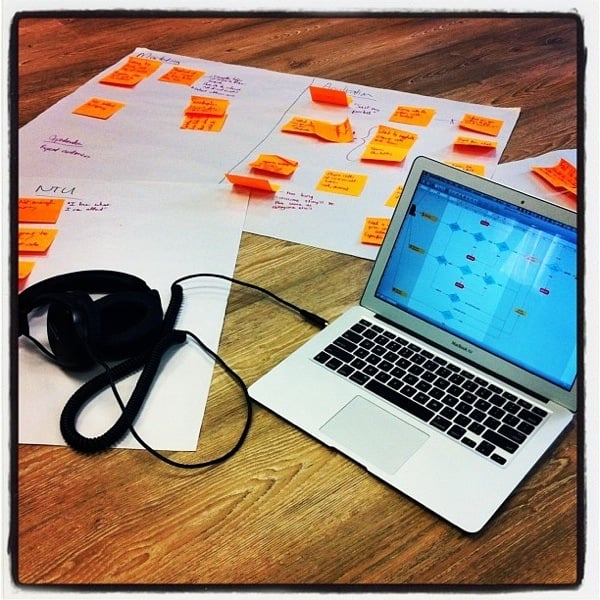
I can’t quite figure out why, but I really like this photo I took in our office earlier this week. I just think it’s such a great summary of everything I love about doing user experience work.

I spent the afternoon sitting on the floor, surrounded by sticky notes, drawing out insights that are based on data we collected from in-person usability testing and customer interviews. And I got to do it while listening to stuff like this.

I guess I’m just really grateful that we get to be in the business of understanding human behavior, and using those insights to make things that people care about. We might not always succeed, but the journey sure is gratifying.

Happy Friday, everyone.

Love

(If you’re wondering, those are Sennheiser HD 380 headphones. Highly recommended.)

Pinterest email notifications and ethical defaults

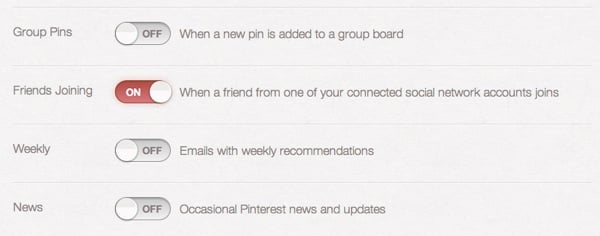
I just received an email from Pinterest to let me know that one of my Facebook friends has joined the service. I found the email odd, because I specifically remember turning off all email notifications (since I don’t use the site any more). I clicked through to “change notification preferences”, and saw this:

Pinterest default notifications

Ah, I see. This is a new “feature” Pinterest added, so they decided to turn the email notification on by default. I immediately thought of Vibhu Norby’s words:

Private is an ethical default. Public is not.

That principle should also go for email notifications from any service. “Off” is an ethical default. “On” is not. I’m picking on Pinterest because it’s the most recent example, but this has become common practice on the web. The irony is that sending me email I didn’t explicitly ask for makes me less likely to engage with a site, not more.

The importance of aesthetics in user experience design

Cole Peters believes the user experience community has relegated aesthetics to a second-class design citizen. From his essay Form Worship:

Despite my challenges with designs that score (theoretically) high on experience and low on beauty, it’s not hard to understand their genesis. UX inherently promises its clients an influx of users, and generally promises increases in conversions (and sales) by inference. The pursuit of aesthetics doesn’t promise to bring more customers through the door or more dollars into the business; in fact, it’s so subjective that it’s tough for it to promise anything at all. What place, then, should it have in today’s business-driven design industry?

Cole goes on to make a case for the importance of aesthetics in design, which I agree with. I do, however, want to add some thoughts about this statement:

We need to stop looking for promises in Design. Design should never be approached as a programmatic practice, like some machine that, given the right ingredients, is guaranteed to spit out a delicious loaf of success.

I love the sentiment, but from a practical perspective we don’t have the luxury not to make promises of success in design. As Brandon Schauer said:

There is no reason for a company to support a great experience unless it makes money. If there is no economic incentive, it either can’t exist (unsustainable) or it’s art.

This leads to my next point, which is that conversion/sales increases aren’t the only design promises we can make. Beautiful design can improve businesses in a variety of ways. Cennydd Bowles has a great piece related to this called Why aren’t we converting?. You should read the whole thing, but here he explains some of the other “promises” of design:

I do suggest seeing user-centred design as something wider than just a means of optimising a conversion rate. While there may not be a noticeable uplift in any specific metric, the raw material of design is frequently intangible: trust, loyalty, engagement, etc. These things are much harder to measure, but they still make themselves felt indirectly in other metrics: support costs, referral rates, customer retention, and so on.

So here’s the thing. UX people who don’t take aesthetics seriously are doing it wrong. As I’ve written before, a focus on good aesthetics helps a design to fit the brand promise and elicit appropriate emotional responses from users1. In fact, there is a strong argument to be made that aesthetics are becoming essential to the survival of any product. Since most products now have a baseline quality that is good enough, users come to expect products to be beautiful, not just functional.

The aesthetics problem in design exists not because UX precludes a focus on beauty. The problem is that not all UX people take the long and difficult road to convince clients and stakeholders of the very real business benefits of good aesthetics.


  1. See also In Defense of Eye Candy, which makes the case that attractive things are perceived to work better. 

More on Intuition vs. Science in design: your assumptions are probably wrong

A couple of articles caught my eye today because they tie in well with my Intuition vs. Science in design post from yesterday. In Design and uncertainty Ellen Beldner writes about an essential characteristic for every designer: acknowledging that your assumptions will be wrong more often than not. She also makes a great case for usability testing:

The problems come when you don’t admit, as a designer or product person, that intuitions based on your mom or yourself may or may not extend to what most other people actually do. So a designer who seems like a hotshot Howard Roark out of college may be great for that one particular project. But when you ask him or her to work on a design for a domain that they don’t “intuitively” understand (since they don’t have years of experience being within that particular community) they’ll flail if they don’t know how to turn to research and data to inform their opinions.

I also love John Lilly’s advice to design like you’re right; listen like you’re wrong:

You should always design the product you think/believe/know is what people want — there’s a genius in that activity that no instrumentation, no data report, no analysis will ever replace. But at the same time you should be relentless in looking at the data on how people actually use what you’ve built, and you should be looking for things that show which assumptions you’ve made are wrong, because those are the clues to what can be made better.

This all comes back to that necessary balance between science (hard data) and intuition. Usability testing and contextual research help us understand unfamiliar domains enough to kick off the design process. Intuition lets us meet those users’ needs in creative ways. And analytics, combined with qualitative user research methods, help us figure out where we got it wrong and how we can do better.

To those who love the web

There are many kinds of people trying to make a living online. There are those who love retail and want to use the Internet to find efficiencies in merchandising and supply chain management. There are those who love the preciseness of search algorithms and want to do everything they can to figure out how to level up in that game. There are those who see the potential of selling “eyeballs” to advertisers and are desperately trying to grab enough of our attention to make that work.

Those are all perfectly fine ways to spend your days. But it’s not what drives me.

Then there are those who love the web. They understand that it’s people all the way down. That the real value of the things we make is in the shared experiences we get to have. They are passionate, critical, creative, opinionated, and cynical. Sometimes arrogant and not nice — but never apathetic. Never lazy enough to let something they care about get away with being less than great.

Those are the people I stand with.

We believe that the quality of what we put out there reflects on all of us. Flipboard and Clear make us all look good. Color makes us look like idiots, and we can’t stand it. When our own work doesn’t live up to our standards of quality for whatever reason, we lose sleep over it. We can’t shut up when we see the Internet being used as a game to be won, an endless well of content to “repurpose” for a quick ad buck, a way to trick people into clicking a link they don’t want to click on. It makes us obnoxious, yes, but we can’t just stand there and do nothing. For we will not have that sh*t. We will not have it.

To those who make a living online because they love the web: I stand with you.

Intuition vs. Science in design

Aaron Swartz discusses the possible problems of relying too much on scientific decision-making in Do I have too much faith in science?:

If you’re struggling with a decision, we’re taught to approach it more “scientifically”, by systematically enumerating pros and cons and trying to weight and balance them. That’s what Richard Feynman would do, right? Well, studies have shown that this sort of explicit approach repeatable leads to worse decisions than just going with your gut. Why? Presumably for the same reason: your gut is full of tacit knowledge that it’s tough to articulate and write down. Just focusing on the stuff you can make explicit means throwing away everything else you know—destroying your tacit knowledge.

My initial reaction was probably similar to yours. Something like this:

Hmmmmmm

As expected, many commenters on Aaron’s post vehemently disagrees with him. Joe Blaylock asks:

You seem to take a narrow view of what science is and how it’s done. Is this rhetorical? Are you representing an extreme reductivist worldview to try to make a point?

gwern tells an interesting story to make his/her point:

‘One day when I was a junior medical student, a very important Boston surgeon visited the school and delivered a great treatise on a large number of patients who had undergone successful operations for vascular reconstruction. At the end of the lecture, a young student at the back of the room timidly asked, “Do you have any controls?” Well, the great surgeon drew himself up to his full height, hit the desk, and said, “Do you mean did I not operate on half the patients?” The hall grew very quiet then. The voice at the back of the room very hesitantly replied, “Yes, that’s what I had in mind.” Then the visitor’s fist really came down as he thundered, “Of course not. That would have doomed half of them to their death.” God, it was quiet then, and one could scarcely hear the small voice ask, “Which half?”’

To bring this debate over into the world of design, I like Dmitry Fadeyev’s description of the different approaches as Primal (intuitive) vs. Cerebral (scientific). He concludes:

The best work is probably a combination of the two forces: restraining the primal force enough to yield a useful product that performs, but not ignoring it altogether so that the more basic human element is satisfied too, both in the creator and in the user.

Dmitri explores this theme more in his essay The Cerebral Designer:

Likewise, primal and cerebral design instincts are complements, not opposing forces. They are concerned with disparate goals which is why neither is better at achieving what the other sets out to do. If the design is driven only by the cerebral creative instinct, it will be too plain. If it is fully primal, it will not be very good at fulfilling its function for it would be more of an illustration or an ornamental piece than a design. Instead, if the primal is restrained by the cerebral but not yet fully killed, we arrive at a design that is functional, structured, pleasing to the eye and a joy for the designer to create.

I guess as designers we’re lucky. Instead of having to pick extreme points of view in an argument, in many cases the easy way out (calling for a middle ground) is also what’s best for our work. That is certainly the case here. We can combine things like A/B testing (within limits) with an intuitive humanity to design memorable, usable experiences.

Stay away from #000000

I agree with Ian Storm Taylor1stay away from #000000:

When you put pure black next to a set of meticulously picked colors, the black overpowers everything else. It stands out because it’s not natural. All of the “black” everyday objects around you have some amount of light bouncing off of them, which means they aren’t black, they’re dark gray. And that light probably has a tint to it, so they’re not even dark gray, they’re colored-dark gray.

Read his post for the very interesting full argument.


  1. What an absolutely ridiculously awesome name. 

When mobile design patterns collide

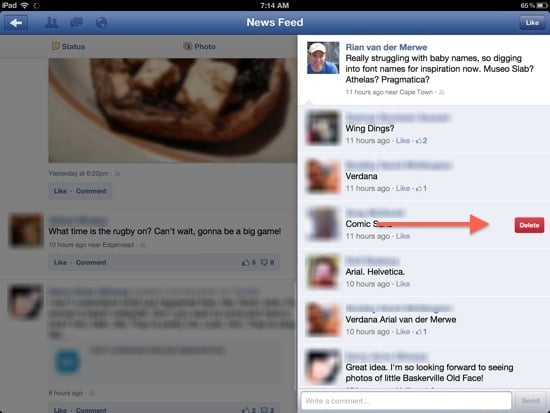
Here is a good example that shows how we still have some work to do before we’ll be able to settle on a standard set of mobile design patterns. In the Facebook iPad app, a drawer slides out if you want to see comments on a status. But once that happens, two existing iOS patterns collide.

I always try to swipe the drawer away to get back to where I was. But, of course, iOS also has a “slide to delete” pattern, so instead of the drawer disappearing, the “Delete” button comes up on swipe. The way to dismiss the drawer is to tap in the greyed-out area.

Facebook swipe

This is certainly a tough problem to solve, so I’m not trying to beat up on Facebook. It’s just an example to show that we’ll have to work through a bunch of these types of colliding patterns before we can comfortably design for mobile using established guidelines.

Nostalgic design and our inability to let go of the past

Angela Riechers wrote a fantastic article for Imprint Magazine about the nostalgic elements that we increasingly see in all types of design — from Industrial Design, to Architecture, to Graphic and Web Design. In this excerpt from Has Nostalgia Become a Toxic Force in Design? she address the skeuomorphism in our digital interfaces:

Nearly every one of the iPhone/iPad’s built-in apps uses an icon that refers to an outdated, much earlier version of itself: the Frank Sinatra stand mike, the vintage tube television, the spiral-bound address book, the envelope. Yet many smartphone users are too young to have used most of these objects in real life (consider the inconvenience of carrying them around); the nostalgic design of the interface feeds upon a set of reconstructed memories divorced from the experiences that generated them, creating a culturally-shared yearning for lost golden moments. The latest iteration of Apple’s iCal looks like a desk blotter—an item that’s been obsolete since we stopped writing with fountain pens. Ask ten people under the age of 30 if they know what a desk blotter is or what it was used for, and see how many have a clue what you’re talking about. Nostalgic design serves as a kind of safekeeping, preserving images of beloved objects so they don’t completely disappear from the collective unconscious.

She goes on to point out the problem of this longing for the past:

Nearly all good design is aspirational, showing us that better possibilities exist, but using lost eras to project images of perfection seems unfair—we can never duplicate the past, no matter how hard we try.

Her conclusion is that we desperately need a renewed faith in the future, and it’s a message we all need to hear. It’s definitely worth reading the whole piece.

So, is good design invisible, or not?

The debate about invisible design is heating up again, thanks to a recent interview with Oliver Reichenstein in which he said this:

Good design is invisible. Good screen design happens in the subatomic level of microtypography (the exact definition of a typeface), the invisible grid of macrotypography (how the typeface is used), and the invisible world of interaction design and information architecture. Minimum input, maximum output, with minimal conscious thought is what screen designers focus on. And just as type designers and engineers we do not try to find the perfect solution but the best compromise.

I’m going to assume that this tweet from Dan Saffer is in response to the interview, and not some amazing coincidence:

Good design isn’t always invisible. In fact, it can be stunningly, beautifully visible.

— Dan Saffer (@odannyboy) July 26, 2012

So, uh, which is it? Well, they’re both right — because I think they mean different things when they say “invisible design”. See, we talk about this stuff, but we rarely define the concepts before we do, and then we get into arguments and don’t even realize that we actually agree. So instead of just talking about invisible design, we have to discuss visible design as well, and how they’re different from each other.

When we talk about invisible design, I like Vitaly Friedman’s description in his excellent talk The Invisible Side of Design (my emphasis added):

Some things are so well designed that we don’t notice them any more. Our experience of them is invisible; almost beyond form and function… unless they break. The same holds true for Web design. Users stop noticing Web design if it works. Users keep noticing design if it’s broken, or when it gets in the way. Good design strikes a balance between elegance and invisibility. Invisible design relates to function and purpose, rather than appearance.

Invisible design is about the decisions we make about what goes into a product, what stays out, and how to get users through the experience as efficiently as possible. If those decisions are made well, and users can just do what they need to do without scratching their heads about where to go next — that’s when you get invisible design that works well.

But there’s also a striking visual layer to design that, in many cases, shouldn’t be invisible because invisible can be boring and soulless. Craig Grannell gives a good example of this in his article Office 2013 shows that user interface extremes aren’t the way to go:

The problem is, not all interface design scales, and when you go very minimal, interfaces can lose any sense of tactility and make it hard to focus. Peter Bright of Ars Technica’s shot of Office 2013 highlights that the opposite of Apple’s current design aesthetic isn’t necessarily any better. Acres of white space lead the eye to flick all over the design, making it hard to focus on the content (which is the smallish box on the right, with “This is an inline reply” in it). It’s unclear which components are buttons and which are content areas. Worse, there’s no sense of warmth at all. This feels like an email client designed to appeal to people bereft of emotion.

Look at sites like Slavery Footprint or MailChimp. There’s a very strong visual aspect to those designs, full of humanity and emotion. There is still an invisible side too — in MailChimp’s case, the functionality to create newsletters needs to be as invisible as possible — but it’s not an either/or situation. Invisible and visible design go hand in hand to create an appropriate product experience. In the case of Outlook 2013, there should be an invisible part of the design (the functionality you use to send email), but also a visible part that makes the software usable and relatable at more than a machine level.

I’m once again reminded of Matthew Butterick’s call to arms in Reversing the Tide of Declining Expectations:

Because what does design want from us, as designers? I think it wants us to take these items that are sort of mundane or boring on their own—like an annual report, or a website shopping cart, or a business card—and it wants us to fill them up. Fill them with ideas, and emotions, and humor, and warmth. Really everything that’s in our hearts and minds. Design wants us to invest these items with our humanity.

What it all comes down to is a term I first heard Karen McGrane use in her essay for The Manual called Ear Trumpets and Bionic Superpowers:

Designs that make technology completely seamless to the user often deserve admiration. But can we balance our desire for intuitiveness with a wider recognition that some tasks are complex, some interactions must be learned, and sometimes the goal isn’t invisible technology but appropriate visibility?

Instead of striving for purely invisible design, or design that is “stunningly, beautiful visible” but unusable, our aim should be to balance the decisions we make and the aesthetic we choose to arrive at a state of appropriate visibility. Now that’s good design.