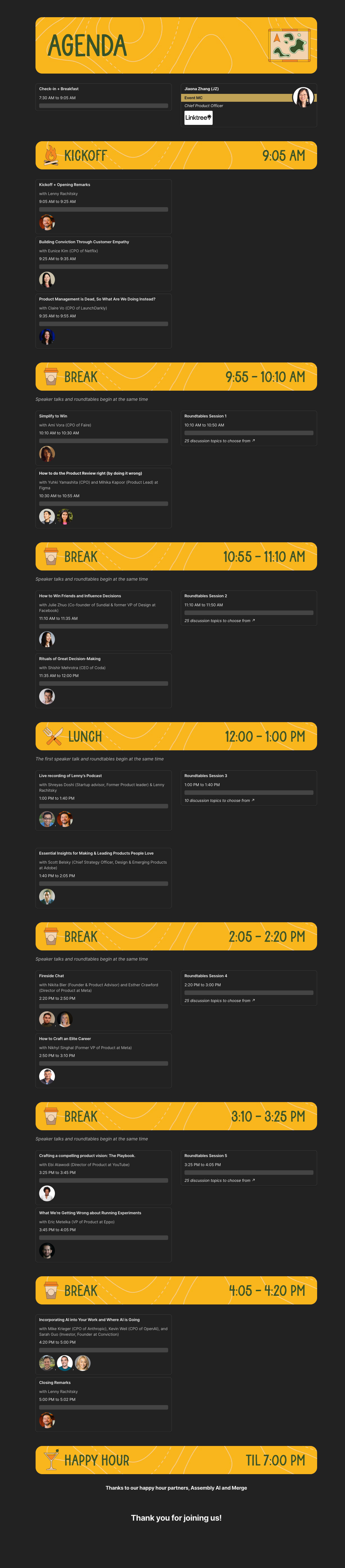
I spent the day at Lenny’s Summit with over 1,000 other product people. The line-up of talks was fantastic, but you never know how it’s really going to go. I am happy to say that the hit rate of good talks was quite a bit higher than some other conferences I’ve been to. I tried to write detailed notes, and below are my summaries and takeaways from 4 of the talks that I enjoyed the most.
There were also a couple of interviews that were really great—Lenny interviewing Shreyas Doshi, and Sarah Guo interviewing Mike Krieger and Kevin Weil (pretty cool to see two major competitors play nice on stage together)—but those were a little harder to summarize so I gave up on note-taking and just listened.
Product Management is Dead (or Will Be Soon) by Claire Vo (LaunchDarkly)
I’ll start with this one since the title is obviously pretty controversial. I expected to disagree with a lot of it, but it was actually really measured and interesting. Claire focused on the rapid transformation of product management due to AI, and outlined the need for product leaders and teams to adapt to these changes. She highlighted the evolving nature of product roles, driven by automation, and offered insights on how to prepare for an AI-powered future.
Key Insights:
- AI Will Transform Product, Design, and Engineering.
- AI is advancing faster than anticipated, reducing the need for traditional product management tasks and roles.
- The key challenge is to not be caught off guard by these changes.
3 Requirements for an AI-Powered Team
- Automate to Speed Up Delivery
- Use AI to accelerate common tasks such as:
- Drafting documents, collecting feedback, writing updates, and creating agendas.
- Monitoring goals (OKRs), tracking competitors, and preparing for interviews.
- Creating customer stories, enhancing presentations, and explaining product functionality.
- Aim to achieve 75% progress quickly with AI assistance, rather than striving for 100% automation.
- Add New Skills and Expand Capabilities
- The future of product management will include people with technical backgrounds (e.g., engineers) who use AI to gain product skills.
- AI will enable individuals to learn and contribute across multiple domains.
- Multiply Your Impact by Teaching AI Skills
- Encourage your team to embrace AI for building products and improving efficiency.
- Normalize the use of AI in everyday tasks to enhance overall team performance.
Impact of AI on Product Teams
- Time & Creativity
- With product work taking less time and requiring less mental effort, product teams can invest more time in creative problem-solving and direct user engagement.
- Fewer PMs Needed
- AI will consolidate previously distinct roles, leading to a new model where one person, with the aid of AI, can manage design, engineering, and product functions—creating an “AI-powered triple threat.”
Evolution of Roles
- From Product Triad to AI-Powered Generalists
- The traditional “product triad” (PM, designer, engineer) is evolving into roles where AI-empowered generalists can handle multiple disciplines.
- Teams will need to adapt to this shift without being intimidated by the collapse of traditional job boundaries.
Takeaways for Product Leaders
- Prepare for the New World of AI-Driven Product Management
- Acquire more commercial and technical skills.
- Learn to budget for AI tools and agents that enhance hiring and team structure.
- Explore new team topologies beyond the traditional triad model.
- Start Adapting Now
- AI-driven changes will happen fast. Begin integrating AI into team processes and management strategies immediately.
Summary
- Product teams must embrace AI now to remain competitive and efficient.
- AI will consolidate roles, but with the right approach, it won’t break your team—rather, it will strengthen and streamline it.
- Product leaders must learn to navigate and manage this new, AI-driven world.
This was, unexpectedly, probably my favorite talk of the day. It was just so well executed: a CPO and IC PM riffing off the experience of doing product reviews. They offered a new perspective on product reviews, emphasizing that their true purpose is not about decision-making but about building trust with stakeholders. They shared key insights on how PMs can run effective reviews by shifting their focus from trying to impress to fostering confidence in their judgment and direction.
Key Insights:
- Product Reviews Are Not for Making Decisions, but for Building Trust
- Traditional advice for product reviews focuses too much on pitching ideas and covering every detail, leading to ineffective presentations.
- The real goal is to gain trust, which allows PMs the time and space to execute on what truly matters—building great products.
What PMs Are Typically Told (but is Ineffective):
- Build up Context First
- Most attendees won’t care about background details.
- Cover All Bases
- Trying to explain everything dilutes your message—“if you say everything, they hear nothing.”
- Circle Back Later if Unsure
- Deferring answers creates uncertainty and erodes confidence.
- Make a Big, Bold Pitch
- Emphasizing a grand vision over clarity and precision can backfire.
What PMs Should Actually Do (for Winning Trust):
- Lead with the Punchline
- Present the most controversial or important point first. This sparks honest reactions early and avoids drawn-out discussions.
- Create an Internal Brand
- Use humor or memorable analogies (“Make a meme”) to spread your idea and make it stick with your team. This can generate internal momentum.
- Share Your Gut Feelings
- Don’t wait for perfect data. Share your instincts and anticipated learnings upfront, demonstrating decisiveness and confidence.
- Be Your Own Biggest Critic
- Show you’ve thoroughly considered all options and potential challenges. Structure your presentation as:
- Pain Point → Solution → Proof Point
- Lay out the solution space and address anticipated concerns to preempt pushback from leadership.
Summary:
- The Product Review Isn’t the Most Important Part
- While product reviews feel critical, what matters more is what happens outside the review. Building trust during the review gives PMs the freedom to focus on what truly counts: creating and delivering valuable products.
By focusing on trust-building rather than decision-making, PMs can create more impactful product reviews and set the stage for successful product development.
How to Win Friends and Influence Decisions by Julie Zhou
Julie outlined a structured approach for moving from having a strong personal opinion to shaping better collective outcomes in decision-making. She provided practical steps to navigate disagreements and arrive at informed, collaborative decisions that benefit the entire team.
Key Steps:
- Step 1: Draw a Circle Around the Team, Not Yourself
- Frame the decision-making process as a collaborative effort, not a personal mission to convince others.
- Encourage open dialogue by focusing on shared goals: “What we really want is X, so let’s explore various ideas.”
- Step 2: Assume Everyone Sees Part of the Truth
- Use the analogy of the “blind men and the elephant” to acknowledge that everyone holds part of the truth.
- Differences in perspective should be seen as valuable pieces of a larger, more cohesive understanding.
- Step 3: Uncover the Truth from Multiple Perspectives
- Facilitate discussions that explore the rationale behind each person’s perspective. Ask questions like:
- “What would have to be true for us to believe this is the right approach?”
- “What data or scenario would convince us that the other option is better?”
- Step 4: Turn the Problem Into a Data-Driven Question
- Shift the debate to evidence-based thinking. Seek out relevant data by asking:
- “How can we know that it’s really true that…?”
- “What evidence do we already have, and what do we need?”
- Step 4b: When Data Isn’t Available, Rely on People
- If data is unavailable, delegate the decision to someone who is deeply invested, knowledgeable, and trusted to make the best call. Trust the judgment of someone with the right context and skills.
- Step 5: Review and Learn from Decisions
- Regularly revisit past decisions to assess their outcomes. This practice helps identify whether decisions led to success or failure.
- Set calendar reminders to review decisions at regular intervals and document areas of disagreement or learning.
- The layers of learning from past decisions:
- What did we learn about our customers and their needs and preferences?
- What did we learn about the levers that drive our product usage?
- What did we learn about the best measurement proxies for our goal?
- What did we learn about making better and more efficient decisions?
- What did we learn about the quality of our individual judgments?
This framework emphasizes collaboration, evidence-based decision-making, and continuous learning to improve both individual and team outcomes.
This talk offered insights on managing a successful career, viewing it as a product to build over time. Nikhyl provided a framework for progressing through different stages of a career while highlighting key pitfalls to avoid and strategies for developing a strong personal brand and maintaining balance.
Key Insights:
- Your Career is Your Most Important Product
- Careers span multiple jobs, typically 2–3 years each, which can result in 20–30 jobs over a lifetime.
- Treat your career like building floors in a structure, with distinct phases to navigate.
- Career Phases:
- Foundational: Gaining experience and stories.
- High Impact: Driving measurable value and influence.
- Joyful Giving: Contributing to others and sharing your knowledge.
- Collect Stories and Build Expertise
- Aim to accumulate stories from diverse experiences (different companies, markets, and cultures).
- The ability to say, “I’ve seen this problem and here’s how I solved it,” is key to advancing.
- Continuously ask yourself: What story will I tell in 12 months? If it’s the same as today, it may signal career stagnation.
- Establish a Strong Reputation
- Develop a reputation of hard work, being a team player, and offering strong opinions that are open to change.
- Your reputation today forms the brand that can open future opportunities.
- Focus on being a builder and a giver—someone who elevates others rather than acting solely for personal gain.
Avoiding Leadership Pitfalls
- Avoid Burnout
- Over-investing in work can lead to resentment when sacrifices (e.g., missed family events) aren’t reciprocated.
- Enforce boundaries early to prevent burnout—success often leads to more responsibilities without additional rewards.
- Beware of Superpower Shadows
- Identify and manage the downsides of your strengths. For example, being great at storytelling might come at the cost of overlooking important details.
- The skills that got you where you are may not be the ones that propel you forward.
- Recognize You Are Not Alone
- Build a network of product leaders for mutual support and collaboration. Helping others is a key part of career longevity and satisfaction.
Summary
- Divide your career into phases: foundational, impactful, and giving.
- Accumulate diverse stories that show your growth and problem-solving abilities.
- Your brand is built on your current reputation—focus on being a builder and contributor.
- Set and enforce boundaries to avoid burnout and resentment.
- Leverage your superpowers, but be mindful of their potential downsides.
- Cultivate a community of peers for long-term support and shared learning.
By focusing on storytelling, reputation-building, and self-awareness, you can craft a career that grows over time, with a strong foundation in both personal and professional fulfillment.