Menu

Posts tagged “engineering”

Learning to code is learning to think

Kyle Baxter in Programming Literacy:

I love the trend toward trying to teach people who aren’t going to necessarily develop software for their occupation how to think like programmers do. The sort of things you learn ”” breaking a larger problem down into smaller problems, thinking very precisely and step-by-step, thinking about things as a system ”” are skills that are widely applicable and useful. It teaches you how to analyze a problem, how to move from “we want this accomplished” to “to accomplish this, we are going to break it down into these pieces,” and it teaches you how to see how systems work. Both are incredibly powerful.

Baxter makes a good point that’s often missed in the “Should Designers learn to code?” debate. In many cases, learning to code is not about being able to build products. It’s about learning how to think better. And that’s a skill that we all need.

Product and design in early-stage startups

Fred Wilson on what’s needed to build product in the early stages of a startup, in The Management Team While Building Product:

Building product is not about having a large team to manage. It is about having a small team with the right people on it. You need product, design, and software engineering skills on the team. And you need to be focused, committed, and driven. Management at this point is all about small team dynamics; everyone on board, working together, and getting stuff done. Strong individual contributors are key in this stage. Management skills are not a requirement. In fact they may even be a hindrance.

Startup teams always have software engineering skills on board from the very beginning - as they should. But too often you see marketing and business development skills being added before you see product/design skills. This leads down a dangerous path that too often ends in a catastrophic lack of product/market fit.

Don't rip into a design too early

How designers and engineers can play nice is a really great post by Jenna Bilotta. I nodded along enthusiastically to this point in particular:

Too often I observe my fellow designers rip into the aesthetics or interaction design of an early engineering prototype. When an engineer is met with critical feedback from a designer about issues they haven’t even begun to think about, it doesn’t encourage that engineer to include the designer in future reviews. This is how designers end up begging for massive changes the week before launch, and how we almost never get them.

One of the most difficult skills for a designer to learn is restraint during the early stages of implementation, when things aren’t perfect yet.

There are some great suggestions in the article - well worth reading.

Celebrating the "Deus Ex Machina" moments in software development

I’ve written about Dhanji R. Prasanna excellent post on Google Wave and working at big companies before, but I wanted to come back to something he said that I just can’t get out of my head. In one section he talks about a topic I care about very much - what motivates people to do great work. I really like his perspective on the importance of incremental progress:

[As] a programmer you must have a series of wins, every single day. It is the Deus Ex Machina of hacker success. It is what makes you eager for the next feature, and the next after that. And a large team is poison to small wins. The nature of large teams is such that even when you do have wins, they come after long, tiresome and disproportionately many hurdles. And this takes all the wind out of them. Often when I shipped a feature it felt more like relief than euphoria.

I like the analogy of these small wins as Deus Ex Machina:

[It means] “God out of the machine”; a seemingly inextricable problem is suddenly and abruptly solved with the contrived and unexpected intervention of some new event, character, ability, or object.

It’s so important for large teams to celebrate those wins with the people they work with every day - and to call out the “characters” responsible for accomplishing Deus Ex Machina. It is hard to get that right in large organizations because the invisibility of individual team members and the pressures to move on to The Next Thing aren’t naturally conducive to this type of behavior. But it’s possible if you work at it.

Whether you keep some champagne in a fridge, send out company-wide emails thanking people personally, or ring a bell every time code gets deployed (ok, that last one is lame, sorry), being in a large organization isn’t an excuse for acting like a faceless corporation.

The fallacy of rewarding activity more than accomplishment

John D. Cook writes some scary true words in Productivity and negative space:

People who fracture their time putting out fires seem more productive, or at least more responsive, than the people who block out time to think. It’s harder to notice someone not being frantic. Thinkers don’t fare well in environments that reward activity more than accomplishment.

This is such a huge problem in big corporations today. People who are running from meeting to meeting are perceived to be more productive than those who sit at their desks working all day[1]. And the problem is worse for programmers - very few managers understand what they do, so it’s hard for them to stomach days and days of solid coding without seeing something “tangible” (in their view).

It all comes back the difference between Makers and Managers, and how the Makers should be evaluated on completely different criteria than the Managers. Criteria that reward the quality of what they make, not the number of status updates they give.

(link via Graham Poulter)


  1. I’m not saying that people who have a lot of meetings are necessarily less productive, just that those who are not in meetings are “out of sight, out of mind”, and therefore not seen as particularly productive.  â†©

Tech4Africa slides: Breaking down silos

I was privileged to speak at Tech4Africa 2011 about a topic that I care about a great deal: how our environments and the way we work impact the quality of the software we produce. The talk came out of a question I keep asking myself over and over: why, despite our best efforts, do we still too often produce low quality software? Here’s the talk summary:

Why do we see so many web applications with inferior user experiences? Why do UX designers often get stuck being asked to “make the design pop a little more,” with no room or incentive to innovate? Why do some web developers feel demotivated and unable to break out of doing things the way they’ve always been done?

In this talk I explore some of the main causes of ineffective software development, and discuss practical recommendations on how to improve team structures and development processes to build high quality software that users care about, want to use, and that therefore makes more money for the business.

I discuss how designers and developers can work better together, how to ensure everyone gets input into the roadmap without it becoming chaos, and how to make sure that the business benefits are clearly articulated and communicated.

So here are the slides from my talk - I hope you find it useful. If you’d like to read more about this topic, you can check out a two-part series of articles that I wrote for Smashing Magazine.

Want to build great software? Get your culture right first.

I love the Automattic Creed that all their employees have to sign before they join the company:

I will never stop learning. I won’t just work on things that are assigned to me. I know ther’s no such thing as a status quo. I will build our business sustainably through passionate and loyal customers. I will never pass up an opportunity to help out a colleague, and I’ll remember the days before I knew everything.

I am more motivated by impact than money, and I know that Open Source is one of the most powerful ideas of our generation. I will communicate as much as possible, because it’s the oxygen of a distributed company.

I am in a marathon, not a sprint, and no matter how far away the goal is, the only way to get there is by putting one foot in front of another every day. Given time, there is no problem that’s insurmountable.

(h/t to @SwimGeek for the link)

This is going to sound like such a lame “management guru” thing to say, but it’s true: the cultural fit of the people you hire is more important than their past experience or absolute skill level. I’ve seen this time and time again. If I have a choice between hiring someone who is highly skilled in their work but doesn’t display humility and a genuine drive to learn more, and someone who knows enough to know that there is much to learn and they’re hungry to get there, I’ll choose the latter every time.

We recently went through an exercise to define our team values, and in many ways it’s similar to Automattic’s creed. I won’t bore you with the whole thing, but here are the main points. This is how we want other people to describe our team:

  • We are zealots about quality
  • We have autonomy to do what’s best for the product, its users, and our business
  • We have a high fix:complain ratio
  • We have a healthy work/life perspective
  • We are empathetic to the core

The relationship between a healthy culture and doing great work is causal, not simply correlation. Good culture is the prerequisite for great work to happen, and actually causes it. Alan Cooper recently address this issue in a great article called The pipeline to your corporate soul:

If you want to improve the quality of your website, app, or software, you need to also improve the quality of your organization. You need to ferret out the people who play politics but don’t get things done. You need to squash bureaucracy that stops innovation with doubt and red tape. You need to eliminate the energy drains, systemic distortions, and toxic people that force others to act like corporate drones instead of like entrepreneurs with a vested interest in success.

If you put a bunch of talented, energetic, ambitious people together and make it easy for them to collaborate and do great things, they will. I haven’t seen a single example of great work preceding a clearly defined and healthy culture - even if it’s just an unspoken understanding between two startup founders. Spending time on getting your culture right is worth the effort.

UI engineering is hard

Dhanji Prasanna wrote a great article about his experiences on the Google Wave team, and the difficulties of working in large development teams. He brings a particularly interesting perspective to UI engineering:

To say we should have been better prepared or organized is to miss the point - large teams starting on a new project are inherently dysfunctional. One common consequence of all this chaos is that experienced engineers seclude themselves to their area of expertise. At a company like Google, this generally means infrastructure or backend architecture. A major externality of this is that fresh grads, and junior engineers are shunted to the UI layer. I have seen this happen time and again in a number of organizations, and it is a critical, unrecognized problem.

UI is hard.

You need the same mix of experienced talent working in the UI as you do with traditional “serious” stuff. This is where Apple is simply ahead of everyone else - taking design seriously is not about having a dictator fuss over seams and pixels. It’s about giving it the same consideration that you give any other critical part of the system.

I’ve experienced this first-hand, and I’ve also seen what happens when backend developers are forced to do UI work (which can happen for a variety of reasons). I’ve heard developers say that they don’t like to do UI work because “it’s not real programming”. They prefer to focus on the real stuff, not this fluffy CSS/JavaScript thing.

Whether or not their perception is accurate is only one part of the discussion. What I want to point out is this: If you make backend developers do front-end work that they’re not passionate about (or worse, work they find embarrassing to do), they’re not going to be motivated to expand their knowledge and do a good job. That’s unfair to everyone and disastrous for the product.

It’s essential to have dedicated UI engineers in an organization so that everyone can focus on the technologies that they’re obsessed with.

Speaking the web's language

Frank Chimero on why designers should learn to code:

Design decisions are not only affected by the characteristics of the content being designed, but also the qualities of the format. The best way to understand the characteristics of the web is to speak its language.

Good design and good markup provide structure to content. Good markup is a fundamental part of good design: beautiful on the inside, beautiful on the outside. HTML and CSS give another venue to provide structure to content in the native language of the web, and learning these guides decisions by surfacing the affordances of the medium. Design decisions are affected by both the content and the format, like how a sculptor would make different decisions if she were working with clay rather than marble.

Spot on. The whole post is worth a read, and Frank gives some good suggestions for resources to help designers get started on coding.

Software development and product management: Part 1 (Overview)

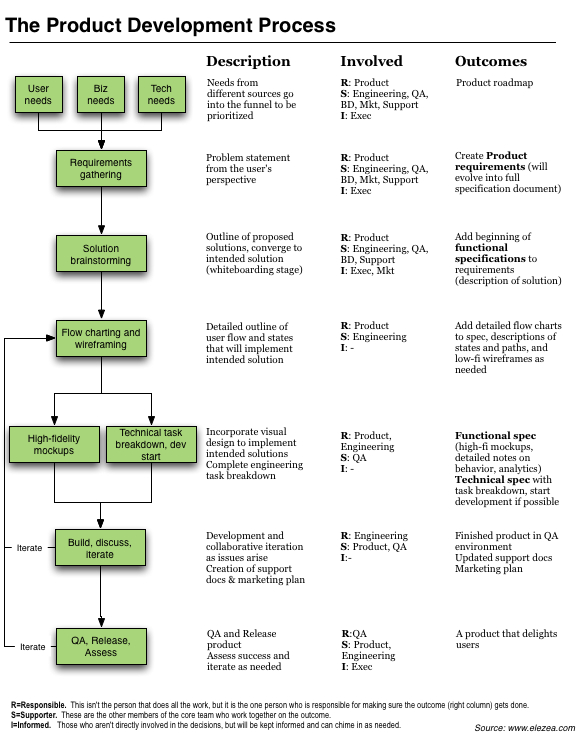
Almost a year ago I wrote a post to propose/summarize a universal model for product development.  I’ve now refined that model into what I believe is much closer to what the original intention was: a product development framework that is detailed enough to be practically usable, but generic enough to fit on top of any development paradigm (Agile, Waterfall, etc.).

I’ve decided to start a series of posts on software development and the Product Manager’s role in that process.  The first, this one, is a very general overview — it’s basic, yes, but necessary to lay the groundwork.  After that, I want to spend time writing down my thoughts on each of these stages in detail.

Why do this? Because I think the Product Management profession is finally starting to come into its own, and I’m hoping that through discussion we can, together, evolve a practical guide to what we do from day to day, something that is both flexible enough and rigid enough to be helpful without being constricting.  And maybe also just to force myself to think through this in detail and become more deliberate and focused on each of these steps.  I hope you’ll join the discussion!

I won’t be talking about scheduling, scrum methodology, or team organization in these posts.  The goal is to focus on the work that needs to be done — whether it’s being done by an individual or a core team is not the focus here, and will be different depending on the company, the philosophy, and the team.

So let’s start here — a diagram of a proposed universal model for software product development:
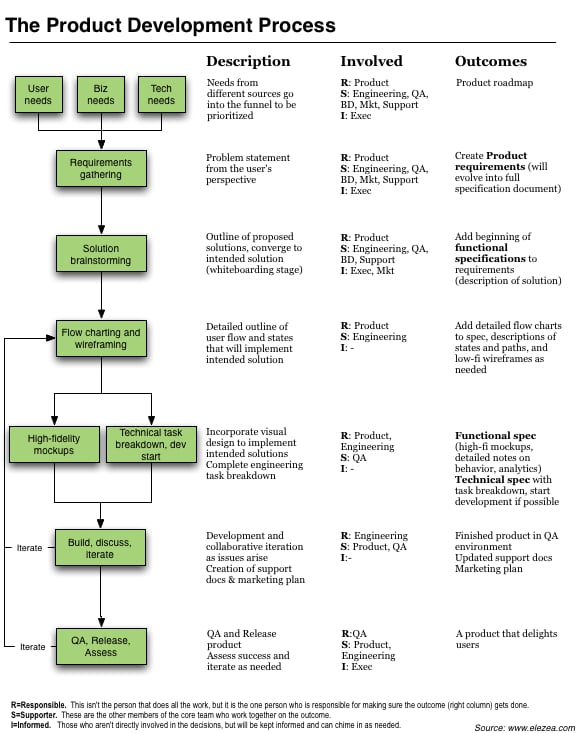
Borrowing from and expanding on my original post, I want to make a few observations. First, there are a few assumptions that are important to note about this model:

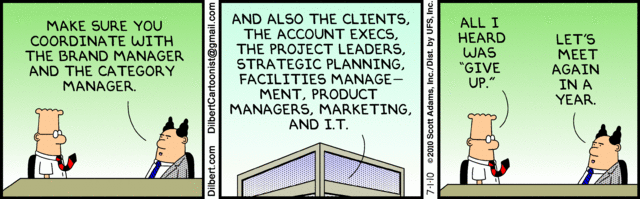
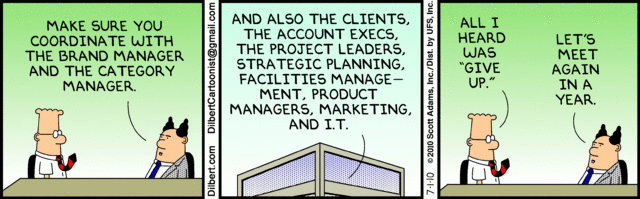
  • Regardless of the development methodology, representatives from Product, Marketing, Business, Design, and Engineering should be involved to some extent from the very beginning of the process. Once detailed requirements are being written, it largely becomes an Engineering and Product effort to ensure momentum and avoid the dangers of design by committee, best summed up by Dilbert:
  • Having said that, it is important for one person to own this process (i.e. be accountable for its success) from start to finish, and that person should be the Product Manager/Product Owner. A good product manager is not a dictator. He/she is a facilitator between all the different stakeholders of a product, and the really good ones are able to get through this model on time and on budget, every time and with as much consensus between groups as possible.
  • The roles of the Responsible (R), Supporter (S), and Informed (I) are important to define for each of these steps.  Most important is that there should be only one “R” for each step.  This doesn’t necessarily mean it’s the person who does all the work, but it’s the person who is ultimately responsible to get the work done (with help from the “S”es).
  • This model is designed to work for any organizational structure, project size, and timeline. If the project is large, more time can be spent on each step. If the project has a tight timeline, it doesn’t mean that you will skip the “Iterate” part of “Design + Iterate.” It just means that you will spend less time on it (more on that later).

Summary of the different aspects of the model

The rest of this series will be devoted to detailed discussions about this model. My goal with this post is to be general and make one or two points about each aspect. So let’s look at some definitions and implications of the model:

  • The starting point - identifying needs. At the beginning of any project (new or iterative), it is important to gather and synthesize input from three different sources:
    • User needs. Everyone needs to have a good understand of the market, the target segments, and their behaviors and attitudes. There’s not enough room to go into detail here, but it is important to look at four sources of user input: market research (segmentation, etc.), user experience research (usability studies, ethnographic explorations), site analytics (behavioral analysis), and customer support (call transcripts, interviews with CS reps, etc.). Having this common understanding allows the organization to build products that matter to users.
    • Business needs. User experience practitioners too often neglect the fact that well, your site has to make money! Revenue goals are not a good excuse for bad design, and that attainable revenue goals are essential to push the organization to design good product.
    • Technology needs. Engineering needs to be at the table from the start. They know the limitations of the product, they know what needs to be fixed, they know what technical debt needs to be paid down. Having engineering and product working together is essential in good product development.
  • Requirements gathering. Pragmatic Marketing, in a post entitled “On Reqs and Specs: The Roles and Behaviors for Effective Product Definition,” proposes some solid definitions for the three different documentation outcomes in this model: Requirements, Functional specifications, and Technical specifications. The first outcome from the discussion and synthesis of needs is a common understanding of the problem statement you are trying to address, which takes the form of Requirements. A requirement is simply a short statement of the problem, and Pragmatic Marketing recommends the following format: “Our preference is the Requirements That Work format: [Persona] has [problem] with [frequency]. It forces product managers to explore the problem, not the solution, and helps the design team understand the context of the problem.”
  • Solution brainstorming. Once the problem has been defined and agreed upon, the team starts thinking about solutions, usually through some form of design thinking or abductive reasoning. There are three important aspects of this phase, which is often called Product Discovery:
    • Start with blue sky ideation (divergent thinking). At this point, don’t limit solutions by what is technically or otherwise feasible. Spend time dreaming about the product - this is where innovation happens!
    • Relentlessly prioritize (convergent thinking). This is the part of the process where nonsensical ideas are thrown out, and the team consolidates around a few possible solutions to the problem that can be further explored. Remember: there is no commitment to implementation or specific designs yet at this phase.
    • Apply the technology filter only after the ideation phase. There is a very important technology filter that needs to be applied during prioritization. What is technically feasible? If something is currently not feasible, what would it cost to build the right architecture? Those early inputs can save a lot of headache down the road.
  • Flow charting and wireframing. This phase starts to put some flesh around the second output document, Functional specifications, which Joel Spolsky defines as follows: “A functional specification describes how a product will work entirely from the user’s perspective. It doesn’t care how the thing is implemented. It talks about features. It specifies screens, menus, dialogs, and so on.” At this point visual design is still left out of the picture, all you are doing is defining flows and interactions.
  • High-fidelity mockups. In this phase, visual design gets involved to design the experience as it will look on the screen.  If there are pre-defined patterns and standards (as is hopefully this case), this could be a pretty light step, but I do believe it is important, even in an agile environment, not to leave this part up to chance.
  • Technical specifications. Development can start before the full designs have been completed.  Once the flow and interaction are sorted out, you do in most cases have enough information to start task breakdown and implementation.  Quoting Joel Spolsky again, “A technical specification describes the internal implementation of the program. It talks about data structures, relational database models, choice of programming languages and tools, algorithms, etc.”
  • Build, discuss, iterate. Everyone designs a product, but it is sad to see that when time/budget gets tight, iterating on it before it goes live is often the first part of the process to fly out the window. It cannot be overstated how important it is to prototype and test your designs before they go live. And not having time is really no excuse. If you have no time, make a paper prototype and test it with three of your friends over coffee in the evening. You’d be surprised how much value this can add. Boxes and Arrows has a great article on prototyping and how to integrate it with your design process that’s well worth the read.
  • QA, release, assess. After the thrill of releasing, the assessment phase is extremely important and often overlooked. It is important to define your measures of success upfront, and then follow up to see if you’ve met those goals. How do users respond to the product? Are we meeting revenue/engagement goals? What can we learn from how users interact with the product to give us ideas for new products? I’m also an advocate for using the same four sources of input we discussed earlier (market research, user experience research, site analytics, and customer support), as opposed to relying on only one methodology, like a 3-week A/B test. More on the dangers of that in one of my earlier posts.

Where we go from here

So now that the stage is set, what happens next?  Over the next weeks and months, I’d like to write a detailed post on each of these phases, particularly from a Product Management perspective, and what the role of the PM/PO is during each of the phases.

There are, of course, lots of resources out there for Product Managers, but I’m hoping to talk more practice than theory here, and hopefully generate some discussion (and disagreements!) to help us reflect on our chosen profession.

PS Big hat tip to @justinspratt who gave me the nudge I needed to start this series.  He is the real deal, despite being Australian.